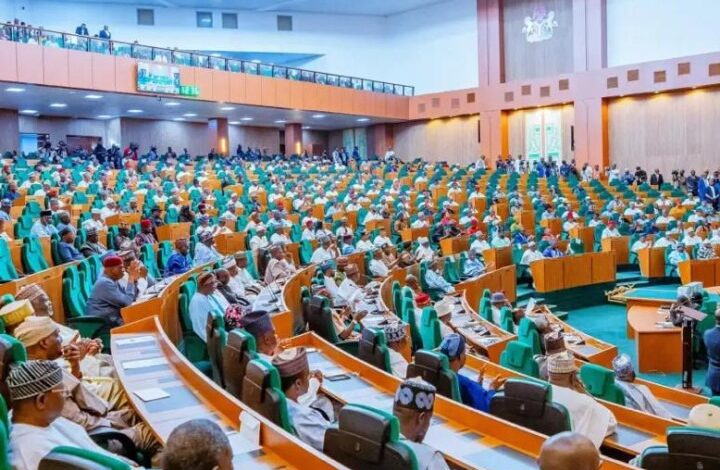
(House of Representatives. Photo by Tribune Online)
The minority caucus of the House of Representatives on Wednesday delivered a harsh assessment of the state of the nation, accusing President Bola Tinubu’s administration of failing to confront worsening insecurity, deepening economic hardship, and growing threats to the country’s democratic institutions.
The opposition lawmakers also alleged that the government was more focused on political positioning ahead of the 2027 general elections than on tackling the pressing issues affecting Nigerians.
Speaking to journalists at the National Assembly Complex in Abuja, Minority Leader of the House, Fred Agbedi, said the country was going through one of its most difficult periods since the return to democratic governance in 1999, pointing to persistent insecurity, rising poverty, and growing public frustration.


He described Nigeria as bleeding and confused, accusing the government of deliberately pushing the country toward the brink by prioritising 2027 electioneering above the welfare and lives of citizens.
He explained that the caucus convened the briefing with heavy hearts but firm resolve to speak truth to power, stressing that staying silent amid the nation’s challenges would amount to complicity.
The lawmakers argued that three years into the Tinubu administration, Nigerians had yet to witness meaningful improvement in security or economic conditions despite repeated government assurances.
A major focus of the briefing centred on the recent d£ath of retired Major General Rabe Abubakar, who was reportedly abducted alongside his wife in Katsina State before d!ying in captivity.
The lawmakers described the incident as a painful reflection of the country’s worsening security situation and called for a transparent investigation into the circumstances surrounding his d£ath.
Agbedi argued that the kidn@pping of a General who once commanded troops and defended the nation, followed by his d£ath under unclear circumstances, was a grave indictment of a failing state and a national embarrassment.
The caucus noted that the incident occurred amid a wave of att@cks by b@ndits, terr0rists, and criminal gangs across several regions, including the North-West, North-Central, and parts of the South-East.
The lawmakers recalled that security personnel, traditional rulers, and ordinary citizens had increasingly become targets of kidn@ppers and armed groups despite continued military operations, with Agbedi questioning how anyone could feel safe if even a General was not.
He lamented the vulnerability of community leaders and traditional rulers who have become frequent targets of criminal elements, arguing that the nation’s security situation was in disarray while the political class appeared preoccupied with electoral manoeuvring.
The caucus called on Tinubu, in his capacity as Commander-in-Chief, to urgently present a comprehensive security strategy capable of addressing the country’s multifaceted threats.
Agbedi noted that at a point when victory against insurgents seemed within reach, particularly with mercenaries active on the frontlines, there now appeared to be no clear strategy in place.
The lawmakers further demanded improved welfare for security personnel, stronger intelligence gathering, and a complete overhaul of the country’s security architecture.
They also expressed deep concern over the continued captivity of schoolchildren and teachers abducted in Oyo State, describing it as yet another example of the state’s failure to guarantee citizens’ safety.
Agbedi noted that the children and teachers remained in captivity simply for attending school in Nigeria, and the caucus called for an immediate, coordinated rescue operation, warning that prolonged captivity could expose the victims to serious danger.
They noted that the incident revived painful memories of earlier mass abductions of students nationwide, which have continued to raise concerns about school safety despite government efforts under existing safety initiatives.
The minority caucus also raised alarm over developments within the judiciary, particularly a Federal High Court ruling directing the Independent National Electoral Commission to deregister five opposition political parties.
According to Agbedi, the ruling raised serious questions about the health of Nigeria’s democracy and could threaten political pluralism ahead of future elections.
He argued that the judgment, coming just months before the general elections and following a standing Court of Appeal decision on the same matter, appeared less about justice and more like a deliberate attempt to create judicial confusion aimed at destabilising the polity.
The Bayelsa lawmaker described the ruling as recklessness taken too far, warning that it set a dangerous precedent capable of weakening democratic participation and shrinking political space.
He questioned why submissions reportedly made by INEC, indicating that the affected parties had met legal requirements through previous electoral victories, appeared to have been disregarded.
The caucus further alleged that opposition parties had faced mounting institutional obstacles, including delays in registering new political parties and efforts to obstruct emerging political alliances, arguing that such moves were geared toward pushing credible opposition out of the 2027 contest.
While welcoming the Court of Appeal’s intervention in halting the implementation of the Federal High Court judgment, the lawmakers urged democratic stakeholders to remain watchful.
Turning to the economy, the caucus painted a grim picture of conditions facing Nigerians, citing inflation, high food prices, weakening purchasing power, and widespread hardship.
They argued that the removal of fuel subsidy and the floating of the naira, both key reforms under the Tinubu administration, had placed heavy burdens on citizens without adequate social protection.
Agbedi noted that across the country, from Sokoto to Enugu and from Borno to Lagos, the story remained the same: hunger, kill!ngs, kidn@ppings, a collapsing currency, and dwindling hope.
The opposition lawmakers accused the ruling APC and the presidency of prioritising political activities over governance, noting that while the nation grappled with crisis, the ruling party and presidency appeared consumed by 2027 endorsement rallies, defections, re-election strategies, and town hall meetings centred on tenure security.
They challenged President Tinubu to temporarily pause election-related political activities and focus fully on addressing the country’s pressing challenges, calling on him to suspend all 2027 political activities and declare a six-month National Security and Economic Recovery Plan, urging him to either lead decisively or step aside.
Among its recommendations, the caucus called for an independent and transparent investigation into the abduction and d£ath of Major General Abubakar, immediate efforts to secure the release of the abducted Oyo schoolchildren, and urgent reforms within the security sector.
The lawmakers also urged the Chief Justice of Nigeria to intervene in the controversy surrounding conflicting court judgments on political parties, while calling on INEC to safeguard democratic competition ahead of the 2027 elections.
Agbedi further cautioned against what he described as efforts to weaken opposition voices through judicial and institutional means, describing attempts to dismantle opposition parties through judicial manoeuvring, the disregard for mass kill!ngs amid pursuit of a second term, and the normalisation of child abductions as a declaration of war against Nigerians.
He vowed that opposition lawmakers would continue holding the government accountable through legitimate constitutional and legislative means, insisting that they would not be silenced or intimidated.
Addressing Nigerians directly, Agbedi urged citizens not to lose faith in democracy despite the nation’s current challenges, assuring them that the outcome of 2027 would ultimately be determined by the people rather than by Aso Rock or compromised courts, and that the opposition would stand with them and resist being pushed out of the political process.
The briefing was attended by the House Minority Whip, Mansur Soro; Deputy Minority Leader, Abdussamad Dasuki; and the leader of the Nigeria Democratic Congress caucus in the House, Afam Ogene.