Scientists found a hidden signal beneath the Sun and it may change what we know about solar cycles

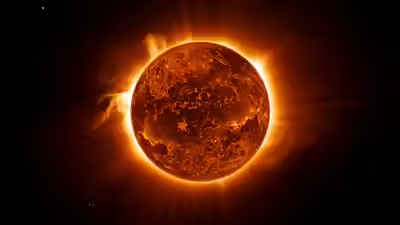
For many years now, the activity of the Sun’s 11-year solar cycle has been gauged through visible indications like sunspots, solar activity, magnetic fields, and radio waves. Yet according to recent findings by the Birmingham Solar-Oscillations Network (BiSON), there could actually be an underlying solar signal forming in the depths of the Sun. According to scientists, structural changes occurring in relation to Solar Cycles 22, 23, 24, and 25 seem to be moving deeper and deeper down towards the outer layers of the solar core. Such information poses interesting implications when it comes to how solar activity has traditionally been gauged and what other areas of science can learn from this phenomenon.
Solar cycle study uncovers a hidden signal beneath the Sun
A team led by Professor William J. Chaplin of the University of Birmingham analysed nearly four decades of helioseismic observations gathered by Birmingham Solar-Oscillations Network (BiSON), a global network that measures oscillations inside the Sun.Unlike traditional methods that monitor surface activity through sunspots and radio flux, helioseismology studies acoustic. In their report, Professor William J. Chaplin conducted an analysis of almost four decades of data collected by BiSON, an international network for observing oscillations occurring inside the Sun.While conventional methods of tracking solar activity involve tracking changes in sunspot numbers and radio flux, helioseismology observes p-mode acoustic waves, which are sound waves passing through the Sun’s interior. They help scientists study structures below the Sun’s surface.Based on findings in the paper, the link between surface and seismic solar activity has undergone significant changes during Solar Cycle 25.The authors stated, “Cycle 25 is as strong as Cycles 22 and 23 when studied in this high-frequency seismic band, unlike the relative sizes of the cycles in the activity proxies.”Overall, it can be concluded that the solar activity inside the Sun is much higher than what is observed at the Sun’s surface.Waves, known as p-modes, travel through the Sun’s interior. These vibrations allow researchers to investigate structures hidden beneath the visible surface.According to the study, the relationship between solar activity at the surface and seismic activity beneath it has changed significantly during Solar Cycle 25.The researchers wrote: “Cycle 25 is as strong as Cycles 22 and 23 when observed in this higher-frequency seismic band, in marked contrast to the relative sizes of the cycles seen in the global activity proxies.”In simple terms, the Sun’s interior appears far more active than surface measurements suggest.
Study reveals changes closer to the solar surface


It was revealed that structural processes within the Sun have been getting nearer to the surface with each solar cycle.Structural processes were much deeper in older solar cycles. In contrast, recent research has shown that the structural changes within the Sun are limited to a narrow layer close to the surface of the star.Higher-frequency modes are more responsive to structural processes occurring within a distance of around 1,000 kilometres from the surface. Research has discovered an unusually high number of these processes occurring within the upper layers of the Sun in Solar Cycle 25.Thus, the researchers concluded that “subsurface structural changes occurring in successive 11-year cycles are increasingly progressively confined near the surface.”This phenomenon is believed to start in the declining part of Solar Cycle 23 and persist in Cycles 24 and 25. Moreover, these results confirm the findings of BiSON research in 2017 that the Sun may undergo significant changes concerning its dynamo.In particular, that study mentioned that “a fundamental change in the nature of the solar dynamo may be in progress.”
What the hidden solar signal could mean for future solar activity
What causes this change still eludes scientists at this time. As the study shows, changing magnetic field strength alone is inadequate to explain the observed phenomenon. It seems, however, that magnetic structures are getting increasingly compacted within shallower depths under the solar surface.This is significant for the reason that the solar dynamo creates solar flares, coronal mass ejections and other space weather phenomena, which may influence satellites and even terrestrial communications and energy networks.Moreover, the latest results coincide with the outcome of other recent research about long-term changes in the behaviour of sunspots and subsurface layers of the Sun. Scientific studies of recent years have established the change of strength of sunspots, oscillations of the solar seismic radius and other strange changes in the magnetic environment, indicating that a different phase of the Sun’s life cycle is starting.As the researchers emphasise that further investigation is required, their conclusions are still intriguing – maybe some of the major processes taking place in the Sun cannot be understood simply based on what we see from its surface anymore.For now, the hidden signal detected through helioseismology offers a rare glimpse beneath the Sun’s outer layers and suggests there is still much to learn about the star that sustains life on Earth.