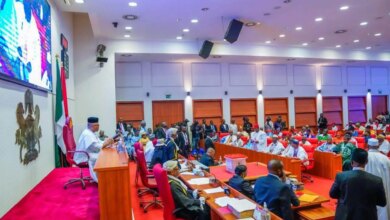
The move sets the stage for Nigeria’s first comprehensive legal framework for the regulation of cryptocurrency, digital assets and virtual asset service providers.
The senators argued during plenary, that the absence of a clear regulatory regime has allowed billions of naira in investments, jobs and government revenue to remain outside official oversight, while exposing citizens to fraud and other financial crimes.
Senate Whip, Senator Tahir Monguno, led the debate on the bill, sponsored by the Deputy President of the Senate, Jibrin Barau.
Monguno said Nigeria has fallen behind several African countries in providing a robust legal framework for the rapidly expanding digital assets ecosystem.


The proposed legislation seeks to establish a legal, regulatory and supervisory framework for virtual assets, digital assets and virtual asset service providers (VASPs), while mandating licensing, transparency and compliance requirements for cryptocurrency exchanges and other operators in the sector.
Senators who spoke in support of the bill described virtual assets as an inevitable feature of the global digital economy and warned that Nigeria risks losing investment opportunities if it fails to act.
According to the sponsor, Nigeria currently leads Africa in virtual asset adoption, but the lack of regulation poses significant risks to the economy.
“There are three challenges if we don’t regulate. One, it goes under the table into a black market. Two, it is opaque and allows for all kinds of criminal activities. Three, it undermines the digital economy’s contribution to the $1 trillion target of President Tinubu’s administration,” a senator said during the debate.
Barau maintained that the bill was designed to provide certainty and protection for investors without stifling innovation.
“This bill does not seek to stifle innovation. It seeks to create clear rules that bring order, confidence, accountability and consumer protection,” he said.
The legislation is also intended to align Nigeria’s digital asset regulations with international standards established by the Financial Action Task Force (FATF) and the International Monetary Fund (IMF).
In a passionate intervention, Senator Natasha Akpoti-Uduaghan lamented that regulatory gaps were driving Nigerian technology entrepreneurs and investments to other countries.
“My 20-year-old son has a gaming platform with about 100,000 real-time players globally. He lets me know time after time that he can’t do that in Nigeria because the gaming servers that offer backend support are not hosting in Nigeria.
“Recently, they opened up for South Africa, but they are yet to do so in Nigeria. The reason? We do not have the regulations in place,” she said.
The Kogi central lawmaker warned that Nigeria was losing billions of dollars in investments tied to the virtual economy.
“There is a lot of investment in the virtual space now that runs into almost billions of dollars. Young people are creating jobs and earning a living from gaming and other virtual services. It will be out of place if we don’t put regulations in place,” she added.
Senator Adams Oshiomhole also threw his weight behind the bill, arguing that the need for regulation was self-evident.
“Whatever needs to be said has been said. Everything suggests that this is self-evident. We don’t need to overdo it. There is always something beautiful – we don’t do too much makeup. I suggest that we proceed to support this bill to go through,” he said.
Also contributing, Senator Adetokunbo Abiru urged lawmakers to ensure that the proposed legislation is harmonised with existing financial sector laws, including the Investments and Securities Act and the Bank and Other Financial Institutions Act (BOFIA).
“If we regulate crypto in isolation, we will create confusion. We need one clear, joined-up view of how the entire digital finance industry should be regulated,” he said.
Summing up the debate, Senator Barau said the proposed legislation would provide legal protection for investors and other participants in the digital assets ecosystem.
“You have spoken eloquently about the need to create a legal framework to regulate or to protect investors in the virtual assets ecosystem. This is good in order to make sure that this new innovation in our economy brings attributes that will promote the nation.
“Players within the ecosystem should be protected by law so that nobody will be cheated and nobody will cheat anybody,” he said.
The Senate subsequently referred the bill to the Committee on Capital Market for further legislative scrutiny, directing the panel to report back within four weeks.
If eventually passed into law, the legislation will empower regulators to license virtual asset operators and strengthen measures against fraud, money laundering and terrorism financing.
It would also position Nigeria alongside other African countries that have established clear regulatory frameworks for digital assets.
What do you think about this?
Drop your opinion in the comment section.
FOLLOW US & Share this with someone who needs to see this.