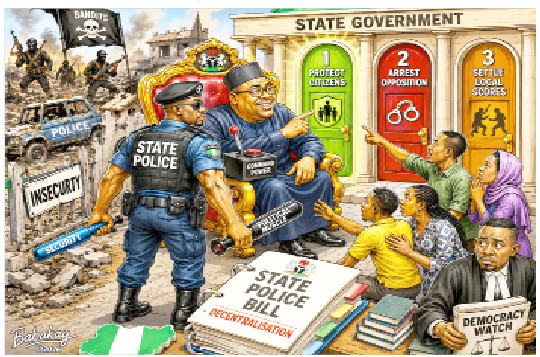
We need state police. Over-centralised policing has failed to adequately protect lives and property,” said Dr Monday Ubani, a Senior Advocate of Nigeria (SAN) and public affairs analyst, in reaction to the passing of the state police bill by the National Assembly.
But some other people are sulking. The debate over the introduction of state police in Nigeria has long been a contrived, polarising issue. While the recent escalating security crises have pushed many northern governors and legislators toward an uneasy consensus in favour of decentralisation, several prominent individuals, socio-political groups, and factions within Northern Nigeria remain firmly opposed to the move.


Opposing Forces
During the 8th and 9th National Assemblies, attempts to pass the State Police Bill were repeatedly blocked or stalled primarily by a powerful coalition of Northern lawmakers. Northern legislators consistently argued that Nigeria was not mature enough for decentralised policing. They claimed that the State Independent Electoral Commissions (SIECs)—which are routinely manipulated by sitting governors to ensure 100% victories for their own political parties—served as a dangerous blueprint for how governors would manipulate state policing when introduced.
One of the most vocal contemporary political groups in the North opposing the initiative is the North-Central All Progressives Congress (APC) Forum, led by its chairman, Saleh Zazzaga, which argues that the introduction of state police will inevitably lead to tyranny, anarchy, and increased impunity. Considering the fact that the North-Central (Middle Belt) region is highly diverse with a complex mix of ethnic and religious minorities, the forum fears that governors will use state-controlled police to systematically oppress minority groups, criminalise political dissent, and even impose subtle versions of “state religion” by suppressing minority traditional and religious practices.
Similarly, the Northern Elders Forum (NEF) has always historically pushed back against the state police model. NEF voices argued that a local government structure (similar to the Native Authority Police of the First Republic) keeps law enforcement closer to the grassroots, whereas a statewide police force simply hands an unrestricted coercive weapon to state governors, who are prone to abusing it.
Commentators like Mamman Bashar (Kebbi) and Ben Adaji (Taraba) have argued that the security crises in the North have long surpassed what state-level political structures can handle. They argue that introducing state police serves as a political distraction, preferring, instead, the introduction of temporary federal military administrators with full executive powers in worst-hit zones.
Weaponised
There are concerns regarding how newly formed state police forces will merge with or conflict with existing sharia-based or localised vigilante entities already operating in the North, such as Kano’s Hisbah or various state community watch and vigilante corps. These concerns are vociferously expressed in spite of Nigeria’s claim to being a secular country unaffiliated to any particular religion.
As with everything in Nigeria, the state police issue has been so politically weaponised that, at the height of the debate, some self-appointed gatekeepers of the destiny of northern Nigeria openly threatened to mobilise their people against President Tinubu in the 2027 elections if he allowed state policing to be introduced.
The State Police Bill is currently at the state level for consideration. It requires the approval of at least 24 out of the 36 State Houses of Assembly before it can be passed into law. There is every indication that that threshold will be surpassed. State policing, here we come!
One of the prices we have to pay for democracy is that national issues that are so apparent and urgent are consigned to the back burner or delayed unnecessarily in order to carry everybody along. Those who argued against state policing choose to forget that we had different levels of policing in the first republic, which served us well. The federal police was different from the regional and local government (native authority) police services. One of the so-called ‘crimes’ of General Ironsi was the introduction of a unitary federal government and the abrogation of the regions. How can one explain the fascination of those regionalists of yore with unitary policing today?
I have no apologies for my advocacy for state police over the years. Policing is about familiarity with the environment you want to protect. Personnel recruited from within a specific state naturally understand local languages, cultural subtexts, internal societal friction points, and the unique geographical terrain.
Advantages
Under the current centralised command, localised security emergencies often require orders to flow upward through a federal hierarchy before tactical deployment can occur. State-level command centres empower localised forces to respond immediately to rapid-onset challenges like banditry, kidnapping, or communal clashes without waiting for a directive from Abuja.
Nigeria claims to operate a federal constitution, yet its security architecture remains starkly centralised. Granting states the constitutional authority to establish, fund, and manage their own law enforcement provides state governors the actual executive tools required to carry out their constitutional mandate as chief security officers of their states
The current federal police architecture is drastically understaffed and overextended relative to Nigeria’s population and complex internal conflicts. Generally, a target of one policeman to 400 people is considered a desirable minimum. For an estimated population of 250 million people, Nigeria requires at least 625,000 officers in addition to several other security agencies responsible for specific areas of speciality.