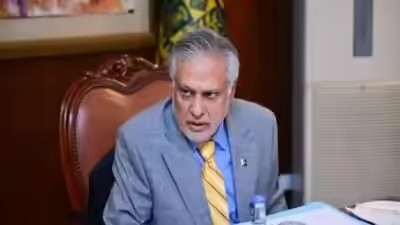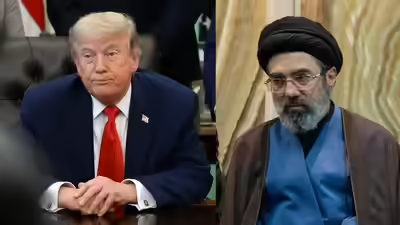
The United States and Iran appeared to be moving closer to an agreement to end their war, with both US President Donald Trump and Pakistan Prime Minister Shehbaz Sharif—whose government has been actively facilitating talks between Washington and Tehran—indicating that a peace deal is nearly finalised and could be signed soon.Also Read | Deal or no deal? Conflicting US-Iran accounts of peace terms keep world on edgeHowever, while Iranian foreign minister Abbas Araghchi has said that an understanding has “never been closer,” officials in Tehran remained cautious, maintaing that several key issues remain unresolved and have dismissed reports suggesting that a formal signing ceremony has already been scheduled.Here’s what we know about a ‘peace deal’ between the United States and IranDeal to be signed on Sunday: Donald TrumpTrump said on Saturday that a deal to end the conflict with Iran would be signed on Sunday and that the strategically vital Strait of Hormuz would be reopened to international shipping immediately afterward.“The Deal is scheduled to get signed tomorrow, and immediately after it is signed, the Hormuz Strait is OPEN TO ALL,” he wrote on Truth Social, describing what would amount to a major diplomatic breakthrough following months of tensions and negotiations.The US president also contrasted the proposed agreement with the 2015 Joint Comprehensive Plan of Action (JCPOA), negotiated under former President Barack Obama.“Barack Hussein Obama’s Deal with Iran, the JCPOA, was an easy, beautiful, smooth road to a Nuclear Weapon, which Iran would have had six years ago, and would have used long before now. My Agreement with Iran is the exact opposite, A WALL TO NO NUCLEAR WEAPON! In fact, they no longer want a Nuclear Weapon, nor will they have one, either through purchase, development, or any other form of procurement,” Trump posted.However, Trump has repeatedly predicted that a deal was imminent. Including his latest remarks, he has now claimed on 39 separate occasions that an agreement was close to being signed.US-Iran deal within 24 hours: Shehbaz SharifTrump’s remarks came shortly after Pakistan Prime Minister Shehbaz Sharif announced that a peace agreement was “likely” to be finalised within the next 24 hours.“We are closer to a peace deal than ever before. With finalisation likely expected in the next 24 hours, Pakistan is preparing for the electronic signing of the peace deal immediately after, followed by technical-level talks next week. We are confident that this historic peace deal will form a strong foundation for lasting peace,” Sharif wrote on X.Pakistan’s Foreign Office also released details of a conversation between Deputy Prime Minister and Foreign Minister Ishaq Dar and Saudi Foreign Minister Prince Faisal bin Farhan.According to the statement, Prince Faisal commended Islamabad’s “consistent and sustained efforts” to promote mediation and dialogue throughout the negotiations.The latest optimism contrasts with the outcome of an initial round of talks held in Islamabad on April 12–13, which ended without a breakthrough.Iran remains cautiousMeanwhile, Iranian foreign ministry spokesperson Esmaeil Baghaei pushed back against reports that an agreement would be signed on Sunday.“We have to wait and see about the exact time of signing; although it will not be tomorrow,” the IRNA news agency quoted Baghaei as saying.He added that while a signing was not expected on Sunday, “the possibility of this happening in the coming days cannot be ruled out.”Baghaei also dismissed reports that Iranian negotiators were preparing to travel to Geneva or Islamabad for a signing ceremony, denying claims that Tehran’s negotiating team planned to visit either city in the “next day or two” despite earlier Pakistani statements suggesting a deal could be finalized within 24 hours.Iran agrees not to develop nuclear weapons?According to a senior Trump administration official, the proposed agreement would require Iran to permanently forgo the development or acquisition of nuclear weapons, eliminate its stockpile of enriched nuclear material, and dismantle infrastructure that could enable weapons production.Any sanctions relief would be phased in only after strict verification and inspections confirmed Iranian compliance, with a 60-day technical negotiation period envisioned to finalise implementation details.The official further stated that the deal would still allow Tehran to maintain a civilian nuclear energy programme, provided it could not be used as a pathway to developing nuclear weapons.(With ANI inputs)