US Congress welcomes Taiwan's parliamentary leader to Washington, affirms support for the island

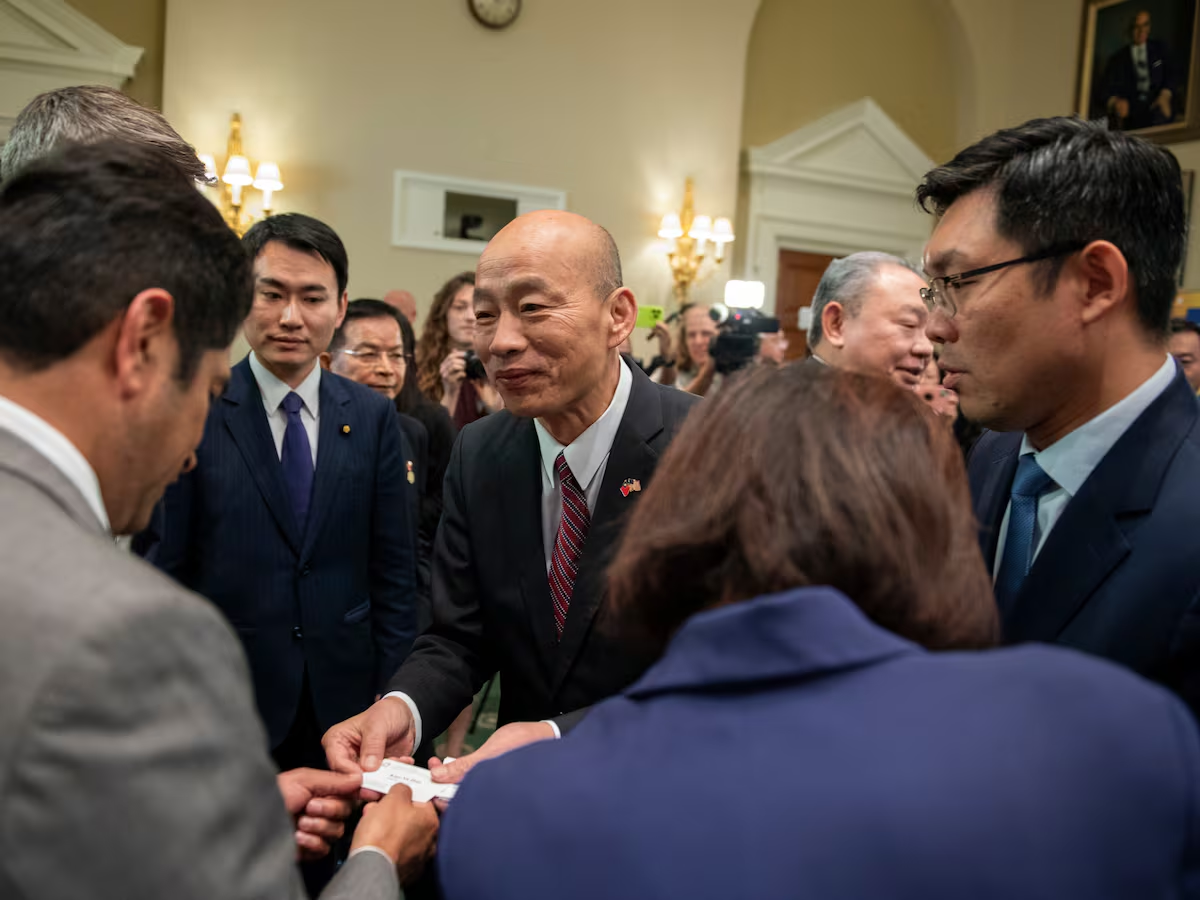
WASHINGTON (AP) — Members of the U.S. House of Representatives on Wednesday pledged firm support for the self-governed island of Taiwan as they welcomed Han Kuo-yu, president of Taiwan’s Legislative Yuan, to Washington, at a time the Trump administration is reviewing a $14 billion arms sales package to Taiwan, months after it got preliminary congressional approval.
More than 30 House representatives, both Democratic and Republican, streamed into the reception at the Longworth House Office Building to show their support, including Speaker Emerita Nancy Pelosi, D.-California; Rep. Michael McCaul, a Texas Republican and former chair of the House Foreign Affairs Committee; and Ted Lieu, a California Democrat who serves as the vice chair of the House Democratic Caucus.
“I love Taiwan,” declared McCaul, as he welcomed Han. “It’s very important to me to say that the United States supports you, Mr. Speaker.”

“The support for Taiwan is bipartisan and bicameral — both houses, both parties,” Pelosi said. “It’s about peace. It’s also about commerce in terms of keeping the ships able to travel here.”
Han, who is leading an eight-person parliamentary delegation, arrived in the nation’s capital on Tuesday night after a stop in Phoenix, Arizona, where the chipmaker Taiwan Semiconductor Manufacturing Co. is building new fabs and producing advanced chips crucial to powering the A.I. boom. TSMC is the poster child of Taiwan’s importance to the U.S. economy.
The delegation met seven Democratic senators earlier Wednesday, including New Hampshire Sen. Jeanne Shaheen, the top Democrat on the Senate Foreign Relations Committee. It wasn’t clear if Republicans senators also met the visiting lawmakers.
The Democrats called on the Trump administration to move ahead with the $14 billion in arms sales to Taiwan without further delay. “We remain committed to maintaining close and friendly relations with Taiwan, providing Taiwan with arms for self-defense and supporting deterrence against growing coercion from the People’s Republic of China,” they said in a statement.
Taiwan, which Beijing claims to be part of the Chinese territory and vows to seize by force if necessary, is a highly thorny issue in U.S.-China relations. Washington is obligated by a domestic law to provide the island with sufficient hardware to fend off any invasion from the mainland. President Donald Trump, after his May trip to Beijing, has said he would be reviewing the $14 billion arms sales package, which Beijing strongly opposes. Trump also has suggested that the arms sales package could be a bargaining chip. Secretary of State Marco Rubio has said the U.S. policy on Taiwan remains unchanged.
On Wednesday, several U.S. lawmakers showed their support for the arms sales package.
“I’m here today … to affirm in the strongest terms that Taiwan is not a bargaining chip. It is an island of freedom. And we need to do all we can to preserve it,” said Rep. Lloyd Doggett, D.-Texas. “ I believe we need to make available every weapon that Taiwan needs in its defense as quickly as it becomes possible.”
Lieu criticized the Trump administration for holding up the $14 billion package. “I urge the administration to reverse that and to allow their arms sale to proceed,” he said.
Han, who is a member of Taiwan’s opposition KMT party, in his speech complimented the U.S. for its achievements in the past 250 years and said the island, like the U.S., cherishes the value of freedom and democracy and that both sides shoulder the responsibilities of safeguarding the democratic system and of maintaining regional stability and peace.
Han touted the robust trade between Taiwan and the U.S. The island of 23 million people has surpassed Germany as the fourth-largest trading partner of the U.S., largely driven by the demand for Taiwan’s advanced chips and other tech hardware.
Han also urged the U.S. to help Taiwan gain more international space. No country can have diplomatic ties with both Beijing and Taipei because of China’s territorial claim over the island. Only 12 governments, including the Holy See, still recognize Taiwan’s statehood. Beijing also has kept Taiwan out of many international organizations, including the World Health Organization.
“On the international stage, Taiwan feels very lonely in its heart,” Han said. “I am here asking Taiwan’s good friends in Congress … to help us participate in global activities.”
Han is scheduled to leave on Friday for the inaugural nonstop flight by the Taiwanese carrier EVA Air between Washington Dulles International Airport and Taiwan Taoyuan International Airport, which has also been touted as proof of deepening U.S.-Taiwan ties.
Copyright 2026 The Associated Press. All rights reserved. This material may not be published, broadcast, rewritten or redistributed without permission.