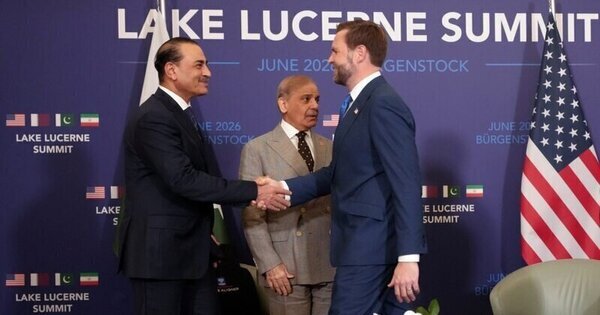
LUCERNE, Switzerland — High-level talks are now under way between US Vice President JD Vance and Iranian representatives at the Burgenstock resort in Switzerland, launching what could become the most consequential diplomatic effort yet to stabilize the Middle East after nearly four months of war.
Iranian state media as well as the Foreign Ministry of Qatar, which is acting as mediator, announced the start of negotiations on June 21.
The formal talks are centered on implementing the US-Iran memorandum of understanding (MOU) that established a 60-day cease-fire.
SEE ALSO:
Analysis: Could A Fragile Wartime Memorandum Turn Into A Broader Political Settlement?
The summit’s setup reflects the unusual coalition behind the deal: The flags of Washington and Tehran flanked by Qatar and Pakistan, the two states that played critical mediation roles in brokering the agreement.
While the core focus remains Iran’s nuclear program and mechanisms for deescalation, the talks are expected to unfold across multiple tracks, with side sessions addressing regional flashpoints including Lebanon and maritime security in the Strait of Hormuz. Neither Israel nor Lebanon is directly represented, but both conflicts loom heavily over the discussions.
The timing is critical. The Israel-Lebanon cease-fire, only two days old, is already under visible pressure. Lebanese authorities say Israeli strikes killed 67 people over the past 48 hours, while Hezbollah attacks left five Israeli soldiers dead. Israel has since paused operations, but Prime Minister Benjamin Netanyahu has vowed retaliation for any future threats.
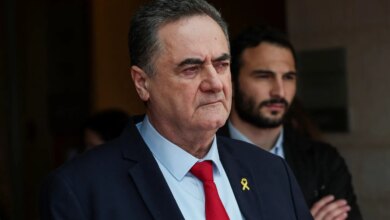
Israeli Minister Israel Katz said on June 21 that Israeli soldiers are free to act without restriction to eliminate threats in Lebanon, adding that troops remained in position in what Israel refers to as a security zone.
Hezbollah is both a militant group and political party that controls much of southern Lebanon. It is considered a terrorist organization by the United States, although the European Union has only blacklisted its armed wing.
SEE ALSO:
Iran Under Pressure To Act As Fighting In Lebanon Continues
That raises the possibility that even as Washington and Tehran negotiate, regional escalation could undermine the diplomatic track.
The Strait of Hormuz remains another major fault line. US and Iranian officials continue to dispute whether the waterway — vital for global energy markets — is fully open, a disagreement analysts say Tehran may use as leverage throughout the talks.
On the eve of the talks in Switzerland, Irans military announced that it was again closing the Strait of Hormuz to all shipping in response to the ceasefire violations in Lebanon.
Citing a source close to the Iranian negotiating team, Tasnim News reported on June 21 that Tehran would not allow the Strait of Hormuz to be fully reopened until Israeli military actions in southern Lebanon are halted and the agreed cease-fire commitments are upheld.
The Strait of Hormuz will not be opened without restraining Israel in Lebanon, and lifting the naval blockade is not enough to reopen this waterway, the agency quoted the source as saying.
“It’s a card the Iranians are likely to keep playing,” said one regional analyst close to the negotiations.
SEE ALSO:
Regional Escalation Could Undermine Diplomatic Track
Still, officials arriving in Lucerne signaled cautious optimism. Both Washington and Tehran have accused each other of violating elements of the cease-fire, but diplomats say both sides retain a strong interest in preventing a return to full-scale war.
“This is just the beginning,” one senior US official told RFE/RL. “Remember, we still have 58 days to go.”
That window — the remainder of the 60-day implementation period — may determine whether the Lucerne talks evolve into a broader regional reset or collapse under the weight of unresolved battlefield realities.
US-Iran Talks Under Way At Swiss Resort Amid Fragile Regional Truce
Share
Copy link
Facebook
X (Twitter)
LinkedIn
Email
Share
Share
Copy link
Facebook
X (Twitter)
LinkedIn
Email
Share
Follow us
Facebook
X (Twitter)
Youtube
Instagram
Follow us