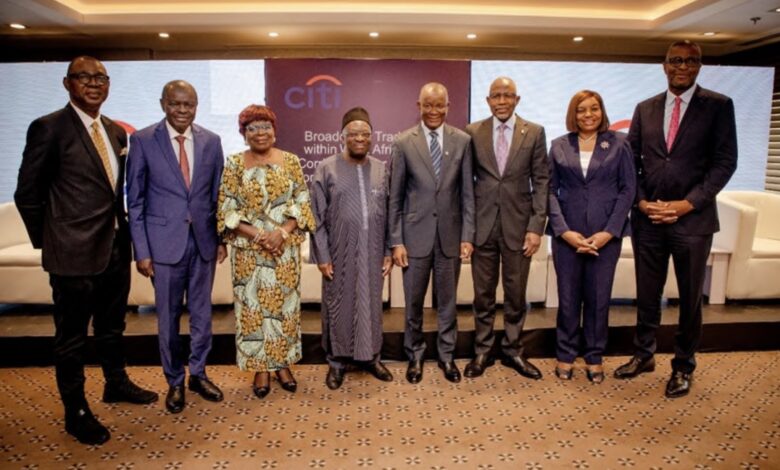
Senior government officials, diplomats, financial regulators and business leaders from Nigeria, Ghana and Côte d’Ivoire have called for urgent reforms to strengthen West Africa’s trade corridors and accelerate the implementation of the African Continental Free Trade Area (AfCFTA).
The call was made at a high-level Business Symposium organised by Citi in Abuja on Thursday, where stakeholders examined practical measures to boost intra-African trade, address longstanding bottlenecks, and unlock new opportunities for regional commerce.

The symposium, titled:“Broadening Trade Flows within West Africa’s Main Corridors under the African Continental Free Trade Area (AfCFTA),” brought together representatives from the public and private sectors to discuss strategies to enhance trade flows across the region.
Participants acknowledged the vast economic opportunities presented by AfCFTA but noted that significant challenges remain, including regulatory fragmentation, inadequate trade finance, poor infrastructure and logistical inefficiencies.
Speaking at the event, Côte d’Ivoire’s Ambassador to Nigeria, Kalilou Traoré, described AfCFTA as a transformative initiative aimed at creating a single market of more than 1.3 billion consumers across Africa.
He noted that despite progress made so far, non-tariff barriers, unharmonised standards and infrastructure deficits continue to hinder trade across the continent.
According to him, the success of AfCFTA will depend largely on stronger collaboration among African countries in financing trade, promoting industrialisation and developing economic zones.
Similarly, Ghana’s Deputy High Commissioner to Nigeria, Dr Gladys Mansa Yawa Feddy Akyea, said the true measure of AfCFTA’s success would be its ability to facilitate trade, improve connectivity, mobilise finance and remove practical obstacles confronting businesses.
She stressed the need for deeper regional collaboration to build value chains capable of transforming Africa into a globally competitive integrated market.
The Deputy Governor of the Central Bank of Nigeria (CBN) in charge of Financial System Stability, Lamido Yuguda, underscored the critical role of financial systems in supporting regional trade.
“As intra-African trade scales under AfCFTA, the efficiency of financial intermediation will play a pivotal role,” Yuguda said.
“Strengthening cross-border payment systems, improving FX market functionality and deepening access to trade finance are essential to reducing transaction costs and enabling smoother trade flows.”
He added that the apex bank would continue supporting initiatives aimed at enhancing financial stability while promoting greater regional integration.
Yuguda further argued that central banks should be viewed as enablers rather than passive observers, emphasising their responsibility to build efficient payment and trade systems while improving access to finance for businesses operating across borders.
On his part, the Minister of State for Industry, Senator John Owan Enoh, said AfCFTA offers Nigeria a major opportunity to accelerate industrial growth and expand market access for local businesses.
“AfCFTA presents a significant opportunity to accelerate Nigeria’s industrial growth and expand market access for our businesses,” Enoh said.
“Our focus is on strengthening the competitiveness of Nigerian industries, improving the ease of doing business and implementing policies that support export growth and regional value chains.”
He stated that the Federal Government is positioning Nigeria to become a leading exporter of manufactured goods and a key driver of intra-African trade and economic integration.
The minister urged African countries to move beyond exporting raw materials and focus on value-added products.
“Industrial policy is the missing link,” he said, stressing that greater value can be derived when African countries process and brand their products rather than exporting raw commodities.