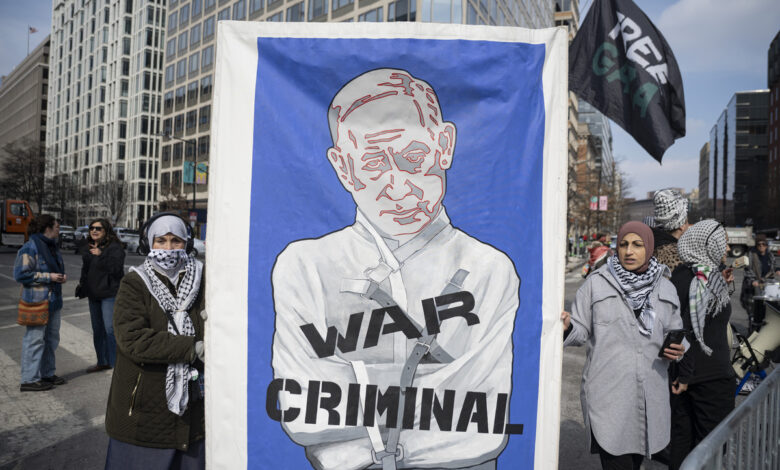
Israeli Prime Minister Benjamin Netanyahu is facing perhaps the most precarious moment of his political career. He knows it. His allies know it. And his rivals—both within his coalition and across Israel’s political spectrum—are preparing to capitalize on his growing weakness.
Former Israeli Justice Minister Haim Ramon, who also served as deputy prime minister between 2007 and 2009, is among the latest Israeli political figures to join a growing chorus of criticism directed at Netanyahu.
“In the final result,” Ramon said in an interview with Radio Galey, cited by the Israeli outlet Srugim, “we did not win.” He then broke down that failure in blunt terms: “We did not win in Lebanon, we did not win in Iran, and we did not win against Hamas.”

Another prominent critic is former Israeli army chief Gadi Eisenkot, who joined Netanyahu’s emergency war government following the events of October 7, 2023, before resigning with Benny Gantz in June 2024.
Beyond accusing Netanyahu of failing to protect Israel on October 7, Eisenkot argues that the prime minister has effectively surrendered Israel’s political decision-making to US President Donald Trump, thereby strategically weakening Israel.
Ironically, Netanyahu’s coalition partners have often been even more opportunistic than the opposition.
READ: US: Clinton says Netanyahu is ‘obsessed’ with Iran, Saudi normalisation
Since the formation of the current coalition government on December 29, 2022—widely regarded as the most right-wing government in Israel’s history—figures such as National Security Minister Itamar Ben-Gvir and Finance Minister Bezalel Smotrich have repeatedly used Netanyahu’s political vulnerability to expand their own influence. Whenever Netanyahu needed political support to remain in power, they demanded concessions in return.
For Israel’s far-right extremists, Netanyahu’s inability to secure decisive strategic victories has often translated into opportunities to advance their own agendas. Every setback on the battlefield became an opening for greater settlement expansion, harsher measures against Palestinians, and deeper entrenchment of extremist policies.
Unable to deliver ‘victory’, Netanyahu turned perpetual war into a political strategy in its own right. The result has been a genocidal war in Gaza, widespread devastation in Lebanon, and a dangerous confrontation with Iran that has repeatedly brought the region to the brink of a wider catastrophe.
For a time, this formula proved politically sustainable. Netanyahu successfully enlisted unwavering US support to keep the fires of war burning.
At the same time, the failure of Europe and much of the international community to hold a wanted war criminal accountable provided him with the political space necessary to continue his bloody calculations.
Yet that formula may be nearing its limits. While this possibility may appear encouraging, it comes with a serious warning. If Netanyahu can no longer sustain the wars that have prolonged his political life for nearly three years, he may escalate where resistance is weakest: the occupied West Bank.
Regarding Iran, there is growing recognition that the current confrontation is unsustainable indefinitely and that some form of arrangement will eventually emerge. Likewise, regardless of whether Lebanon is formally included in any future agreement, Israel’s ambition of permanently occupying parts of Lebanese territory remains untenable.
Historically, when Israel fails to secure a strategic breakthrough on one front, it seeks compensation on another—typically where Palestinians are most vulnerable and where international scrutiny is weakest.
As Israeli elections approach, it is therefore reasonable to fear a further escalation of the genocide in Gaza, pushing both the death toll and the level of destruction to new heights. According to Gaza health authorities, nearly 1,000 Palestinians have been killed since the ceasefire agreement was announced in October, bringing the overall death toll of Israel’s genocide in Gaza to 73,000 Palestinians.
Though Israel’s war has already failed to break Palestinian steadfastness, the broader objective remains unchanged: the ethnic cleansing of Palestinians from Gaza and the transformation of the Strip into a space that can no longer sustain Palestinian life.
The West Bank, however, presents a different challenge.
There, Israel faces a fragmented political landscape and a Palestinian Authority that refuses to develop an effective strategy for confronting accelerating Israeli violence, ethnic cleansing, home demolitions, land confiscation, and the relentless expansion of illegal settlements.
READ: Israeli analysts call Netanyahu ‘liar,’ ‘humiliated’ by Trump after US-Iran deal
This vulnerability has enabled Israel to move from discussing annexation to implementing it in practice. The strategy rests on two interconnected pillars: extreme violence and displacement on the one hand, and rapid settlement expansion on the other.
According to an Oxfam International study published on June 12, Israel has killed 1,244 Palestinians, including 268 children, in the occupied West Bank since 2023—more than the total number killed during the previous seventeen years combined.
This bloodshed has been accompanied by large-scale displacement that has already uprooted nearly 46,000 Palestinians, many of them from refugee camps and vulnerable communities across the northern West Bank.
An Amnesty International report published on June 10 documented the full or partial displacement of at least 117 Palestinian Bedouin and herding communities between January 2023 and April 2026.
Expectedly, the violence, displacement, settlement expansion, and land seizures are not isolated developments but components of a coherent political project. In September 2025, Smotrich openly proposed the annexation of 82 percent of the occupied West Bank. What was once presented as a political vision is now steadily being translated into facts on the ground.
The era of Netanyahu may be nearing its end, but before this bloody political chapter closes, countless more Palestinians may be forced to bear the cost.
Arab and Muslim countries, along with their allies in the international community, must not wait for Israel to launch a much larger assault on the West Bank before responding.
The matter demands urgent attention and immediate action.
OPINION: The Mladenov distraction: Behind the screen, Netanyahu is annexing Gaza ‘step-by-step’
The views expressed in this article belong to the author and do not necessarily reflect the editorial policy of Middle East Monitor.