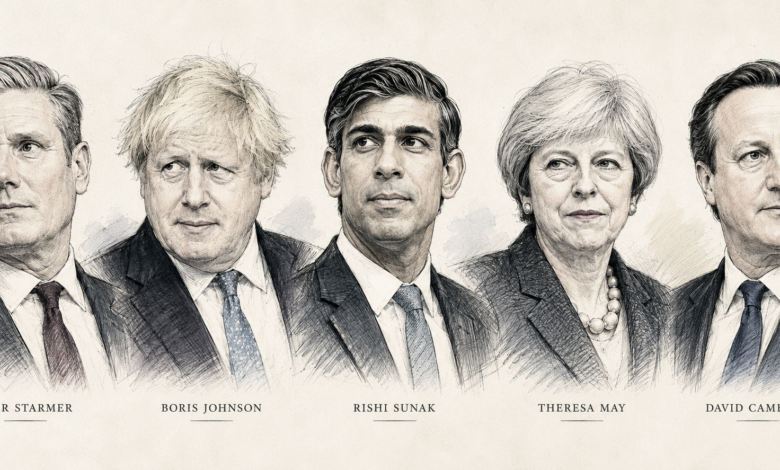
UK prime ministers are falling faster than many voters can understand, and the pattern now tells a bigger story about Britain itself. Since the Brexit referendum in 2016, the country has moved from one leadership crisis to another, with each prime minister promising stability before being weakened by party pressure, public anger or economic reality.
David Cameron fell after Brexit. Theresa May fell because she could not pass her Brexit deal. Boris Johnson fell after scandal and mass resignations. Liz Truss fell after the markets rejected her economic plan. Rishi Sunak fell after voters rejected the Conservatives. Keir Starmer has now announced he will stand down after pressure inside Labour and poor results raised doubts over his ability to lead the party into the next election.
The names are different, but the lesson is the same: in British politics, ideology shapes the debate, but confidence decides who survives.
In the UK, voters do not directly elect the prime minister. They elect MPs. The prime minister is normally the person who can command support in the House of Commons. That means a leader can only stay in power if their party believes they can govern, win elections and hold the country together.


Once MPs believe a leader has become a risk to the party’s future, loyalty can disappear quickly.
Read related news:
Starmer: Six UK Prime Ministers who have resigned in 10 years
Keir Starmer resigns as UK prime minister after losing party support
Resignation gamble backfires as Tinubu’s ex-ministers lose APC tickets
Scottish Labour leader Sarwar demands ex-ministers probeover Glasgow hospital scandal
Why UK Prime Ministers need more than ideology
Ideology plays a major role in UK politics. Immigration, the economy, tax, welfare, defence, energy and public services all shape how leaders are judged.
Left-wing politics usually supports stronger public services, more government involvement, workers’ rights, welfare support and policies to reduce inequality. The Labour Party is usually described as the main centre-left party.
Right-wing politics usually supports lower taxes, smaller government, business growth, stricter immigration control and more individual responsibility. The Conservative Party is usually described as the main centre-right party.
But Britain is no longer shaped only by Labour and the Conservatives. Smaller parties have become more influential because many voters believe the two main parties have failed to give clear answers on immigration, living costs, national identity and public services.
Reform UK is often described as a right-wing populist party. It has built support by focusing on immigration, sovereignty, Brexit, tax, energy and anger with the political establishment. For a neutral report, it is better to call Reform UK “right-wing populist” unless quoting a source that describes it differently.
Far-right politics goes further than normal right-wing politics. It often focuses on extreme nationalism, very strict anti-immigration views, opposition to multiculturalism and hostility to asylum seekers or global institutions.
The difference is simple. Right-wing politics may say immigration should be controlled. Far-right politics may say immigration is destroying the country and should be stopped almost completely.
There is also a difference between left-wing and far-left politics. Labour supports public services and workers’ rights, but still works within the capitalist economy. Far-left politics usually wants much bigger economic change, such as state ownership of major industries or worker control of production.
This matters because Britain’s leadership crisis is also an identity crisis. Voters are not only asking who should govern. They are asking what kind of country Britain should become.
Brexit opened the door to chaos
David Cameron promised a referendum on Britain’s membership of the European Union because the Conservative Party was divided over Europe and pressure was growing from voters who wanted more control over borders, laws and immigration.
The European Union’s single market is based on the free movement of people, goods, services and capital. In economic terms, this connects with the factors of production. Labour can move, capital can be invested, goods can be traded and businesses can operate across borders.
Supporters of Brexit said Britain needed to take back control. Opponents warned that leaving the EU would create uncertainty for trade, investment, jobs and growth.
Cameron campaigned for Remain, but the country voted Leave on 23 June 2016. He announced his resignation the next day and left office in July.
His political gamble did not only end his premiership. It changed the direction of British politics.
Theresa May and the Brexit Deadlock
Theresa May replaced Cameron with one mission: deliver Brexit.
But Brexit meant different things to different people. Some wanted a clean break from the EU. Others wanted to protect trade and avoid economic damage. Parliament was divided. The Conservative Party was divided. The country was divided.
May negotiated a deal with the EU, but MPs rejected it three times. Each defeat weakened her authority and made it harder for her to claim she could deliver the referendum result.
She spent just over three years as prime minister before announcing her resignation in May 2019. She officially left office in July that year.
Her fall showed that a prime minister may hold the title, but without the support of MPs, power becomes fragile.
Boris Johnson won Brexit, then lost trust
Boris Johnson became prime minister in July 2019 after winning the Conservative leadership contest. He was one of the most prominent campaigners for Leave and promised to “get Brexit done”.
That message worked. He called a general election in 2019, won a large majority and passed his Brexit deal. For a short time, Johnson looked politically strong.
Then Covid changed the country’s priorities. The government had to spend heavily to protect jobs, businesses and public services. The NHS came under pressure. The economy suffered. Immigration did not disappear. Britain still needed workers, growth and stability.
Johnson’s leadership was later damaged by scandal. Partygate hurt him because many people believed Downing Street had broken the same Covid rules the public had been told to obey. The Chris Pincher scandal added more pressure, after questions were raised about what Johnson knew before appointing him to a senior role.
Ministers resigned. Conservative MPs turned against him. Johnson did not fall because of one mistake. He fell because trust collapsed.
Liz Truss and the Market Rebellion
Liz Truss entered Downing Street in September 2022 with a strong low-tax economic plan. She wanted to cut taxes and push growth.
But her mini-budget caused panic in the financial markets. Investors were worried because the tax cuts were not backed by a clear plan for public finances. The pound fell, government borrowing costs rose and mortgage fears grew. The Bank of England had to step in to calm the markets.
Truss reversed many parts of the plan and sacked her chancellor, Kwasi Kwarteng. But the damage had already been done.
She resigned after only 49 days, becoming the shortest-serving prime minister in British history.
Her downfall proved that ideology is not enough. A leader also needs credibility.
Rishi Sunak Could Not Save the Conservatives
Rishi Sunak replaced Truss as a safer and calmer figure. He was brought in to restore order after the market crisis.
But the Conservative Party was already badly damaged. Years of Brexit battles, Covid pressure, scandal, inflation and leadership changes had exhausted the party and the public.
At the 2024 general election, voters rejected the Conservatives. Labour won power, and Keir Starmer became prime minister.
Sunak did not fall because of one dramatic scandal. He fell because voters decided the Conservatives had run out of road.
Starmer and Labour’s Problem of Direction
Keir Starmer entered Downing Street promising stability after years of Conservative chaos. Labour moved closer to the centre under his leadership, especially on spending, immigration and economic policy. That helped the party win power.
But in government, stability was not enough.
Starmer faced pressure over the economy, public services, immigration, tax and defence spending. Some traditional Labour supporters felt the party had moved too far from its left-wing roots. Some voters on the right still did not trust Labour. At the same time, right-wing populist politics grew stronger by focusing on immigration, identity and frustration with the old parties.
Poor election results increased pressure inside Labour. MPs began asking the question that often decides a leader’s future: can this person win the next election?
Once MPs believe the answer is no, the leader is in danger.
The Real Lesson for Britain
Britain’s recent prime ministers did not all fall for the same reason, but they all lost confidence.
Cameron lost after the Brexit vote. May lost after Parliament rejected her deal. Johnson lost after scandal and mass resignations. Truss lost after the markets rejected her economic plan. Sunak lost after voters rejected the Conservatives. Starmer lost support after Labour MPs feared the party was losing public confidence and direction.
The bigger lesson is clear.
In British politics, ideology shapes the argument. But confidence decides who survives.
A prime minister needs three things: public trust, party support and a clear story for the country.
Once those three things disappear, Downing Street becomes a waiting room.
Britain’s crisis is not just about left or right. It is about leadership, identity, borders, money, public services and the future direction of the country.
Until a leader can give voters a clear answer to those questions, Britain may continue changing prime ministers faster than it can solve the problems that remove them.