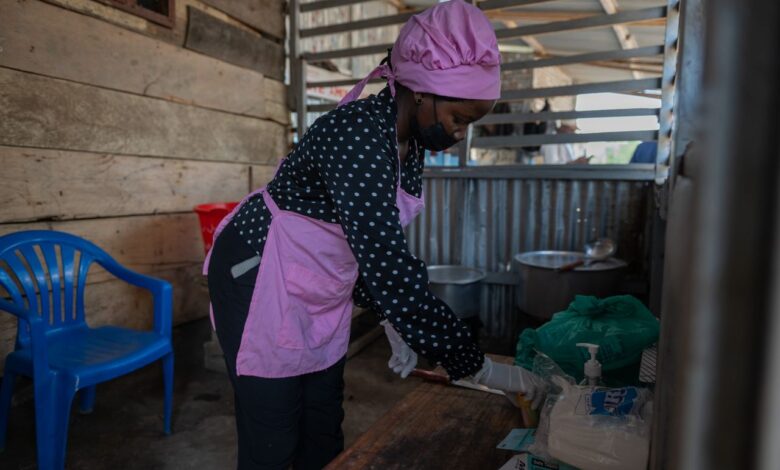
Every day for the past week, Aline Kasiwa has fed her sick mother, helped her drink and washed her clothes, all while fearing she could catch the virus as eastern parts of the Democratic Republic of Congo are plagued by one of the fastest-spreading outbreaks of the disease on record.
“She is the only family I have left. I cannot abandon her,” Kasiwa said, adding that she is too afraid to take her mother to the hospital where an infection could be confirmed. “These days we hear that many people are dying there, even nurses,” she said.
With no protective equipment beyond a cheap face mask, the 28-year-old in Bunia, a city at the heart of the outbreak, symbolises the women in eastern Congo who are almost always the first caregiver, a role that health workers say is putting them at higher risk of contracting Ebola.
“It’s the woman who gives them a bath, it’s the woman who feeds them, and it’s the woman who’s there to wash the dirty clothes and everything else,” said Dr. Furaha Elisabeth, director of the Karibuni Wa Maman gynecology and obstetrics clinic in Bunia.

Bundibugyo, the type of Ebola in this outbreak, has no approved treatment or vaccine. Even health workers have said they don’t have the masks, gloves and other gear to protect themselves.
That leaves some women with impossible choices, especially pregnant ones.
“When you see the way people die — even the nurses who treat us are dying — how can you not be afraid?” said Anny Ekyambo, a 32-year-old in Bunia who said she is too afraid to go to a clinic for checkups, even though she is five months pregnant.
Related
Ebola outbreaks have affected women more
The outbreak was identified weeks late because the rare Bundibugyo type was not tested for at first. Congolese authorities said on Wednesday they have confirmed 344 cases, including 60 deaths, and more are suspected. Neighbouring Uganda has reported 15 confirmed cases, including one death.
It is not clear how many women have been infected. But history shows that previous Ebola outbreaks have affected women more.
In the first recorded outbreak in the 1970s, women accounted for 56 percent of deaths, UN Women said. During the 2018-2020 outbreak in Congo, the deadliest in the country’s history, women and girls made up about two-thirds of reported cases.
“We will certainly see the same pattern emerge in the current outbreak,” Sofia Calltorp, UN Women’s chief of humanitarian action, said in a statement. “Ebola transmission follows social realities. The virus spreads along the lines of care-giving, domestic labor, front-line health work and burial practices.”
Women in many eastern Congo communities are the ones preparing bodies for burial.
Related
‘They had no protection and no equipment’
At the Karibuni wa Maman clinic, staff said they had received no personal protective equipment since the outbreak began, despite appeals to health authorities.