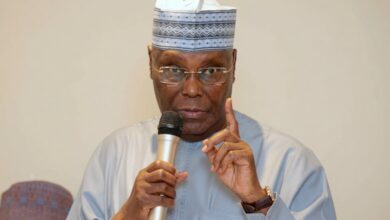
Former Vice President and African Democratic Congress (ADC) presidential candidate, Atiku Abubakar, has dismissed the latest allegations by former Secretary to the Government of the Federation (SGF), Engr. Babachir Lawal, saying the latter came forward with claims but failed to provide any evidence to support them.
The position was contained in a statement issued on Tuesday and signed by Atiku’s Senior Special Assistant on Public Communication, Phrank Shaibu, who described Babachir’s recent television interview as “an unfortunate cocktail of bitterness, conjecture, and political revisionism masquerading as public interest.”

According to the statement, Nigerians who watched the former SGF’s recent television interview “were confronted with a curious spectacle: a man armed with outrage but bereft of evidence; rich in allegations but poor in facts.”
Shaibu argued that what was presented as a serious political intervention “ultimately collapsed into an extended exercise in speculation and unsubstantiated claims.”
“Mr. Lawal spent nearly an hour making grave accusations about the conduct of the ADC presidential primary. Yet he failed to produce a single piece of verifiable evidence. No document. No petition. No result sheet. No witness statement. No recording. Nothing,” the statement said.
“For a man who repeatedly insisted that proof was ‘everywhere,’ his performance was a masterclass in making extraordinary allegations without meeting the elementary obligation of substantiating them.
“He arrived with accusations. He left with accusations. In between, the evidence never arrived.”
The former vice president’s media aide further faulted Babachir for relying on unnamed sources and unverifiable claims, insisting that a politician of his standing should understand the difference between suspicion and evidence.
“Ordinarily, one would expect a former Secretary to the Government of the Federation and former National Vice Chairman of a political party to understand the elementary distinction between evidence and suspicion,” Shaibu stated.
“Instead, Nigerians were treated to stories about unnamed callers, unnamed officials, unnamed witnesses, and unnamed conspirators. By the time the interview ended, the only thing in abundance was speculation.”
The statement also suggested that Babachir’s criticisms stemmed from disappointment over the outcome of the ADC presidential primaries, alleging that he had openly supported another aspirant before the contest was concluded.
“What the interview ultimately revealed was not a whistleblower exposing wrongdoing but a disappointed political actor struggling to come to terms with the failure of his preferred candidate,” the statement read.
“By his own admission, Mr. Lawal openly aligned himself with another aspirant long before the conclusion of the process. He campaigned for that candidate, promoted that candidate, and publicly believed that candidate should emerge victorious. Having failed in that objective, he now seeks to dress personal disappointment in the borrowed robes of moral outrage.”
Shaibu also described as contradictory Babachir’s portrayal of Atiku as both politically irrelevant and powerful enough to manipulate a nationwide political process.
“Perhaps the most laughable contradiction in Mr. Lawal’s performance was his attempt to portray Atiku Abubakar as both politically irrelevant and politically omnipotent at the same time,” he said.
“According to his own account, Atiku was inactive, unpopular, and absent from the field. Yet Nigerians are simultaneously expected to believe that this same supposedly dormant politician somehow orchestrated a nationwide conspiracy across 8,809 wards.”
He argued that such a theory would require party members across the country to have abandoned their independent judgment in favour of an alleged invisible conspiracy.
“What makes this theory particularly absurd is that it requires Nigerians to believe that thousands of ADC members across the federation abandoned their own judgment and surrendered their votes to an invisible conspiracy directed by a man whom Mr. Lawal simultaneously describes as politically inactive,” the statement added.
The statement further drew attention to comments made by Engr. Babachir during the interview concerning President Bola Tinubu.
“More revealing, however, was Mr. Lawal’s astonishing confession on national television that if he ever needed money, all he had to do was call President Tinubu and the money would reach him before he got home,” Shaibu claimed.