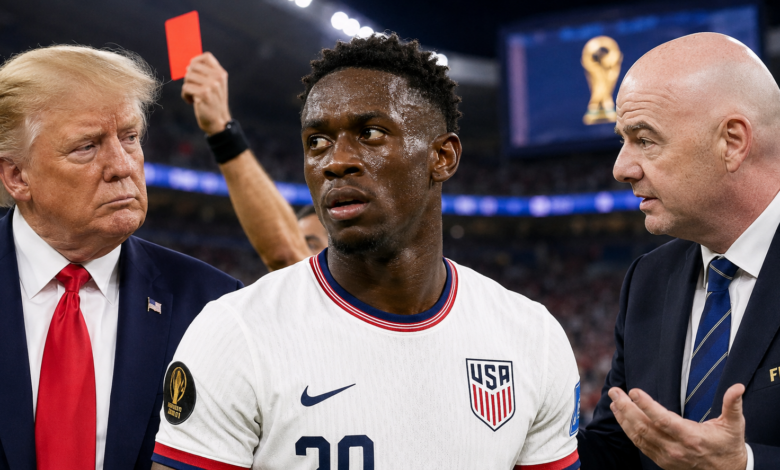
Folarin Balogun’s red card review has become more than a World Cup disciplinary row. It has placed the United States striker at the centre of a wider debate about Donald Trump, Fifa’s independence and the meaning of US birthright citizenship.
Balogun was expected to miss the United States’ last-16 match against Belgium after being sent off in the win over Bosnia and Herzegovina. But Fifa later suspended his automatic World Cup ban, allowing him to remain available, even though the red card itself was not erased.
The decision caused immediate controversy because Trump, the US president, had contacted Fifa president Gianni Infantino to ask for a review of the case. Trump has said he did not pressure Fifa and only asked for the incident to be looked at again.
Read related news:
Infantino defends 2026 World Cup ticket prices amid record demand
‘Good idea’ – FIFA President Infantino on potential Drake World Cup halftime show
FIFA World Cup 2026 Preview: Spain vs. Cape Verde
Why Balogun’s citizenship matters
The political irony is difficult to miss. Balogun is American because he was born in New York to a Nigerian mother who was unable to return home because she was too far advanced in her pregnancy to fly. He was taken to Britain when he was one month old and grew up there before later choosing to play for the United States.
That background has made his World Cup story part of a larger American argument over birthright citizenship. Birthright citizenship means a person can become a citizen by being born in a country. In the US, it is rooted in the 14th Amendment and was affirmed by an 1898 Supreme Court ruling, according to Reuters.
Trump has repeatedly called for ending birthright citizenship. Yet, in this case, he intervened on behalf of a player whose right to represent the United States exists because of that same principle.
For supporters of birthright citizenship, Balogun’s rise has become a powerful example of how immigration and identity can strengthen national life. Reuters reported that immigration advocates have pointed to his case as evidence that citizenship by birth can give people the chance to contribute to the country in meaningful ways.
Balogun’s football journey also adds to the story. He played for England at youth level before switching to the US national team in 2023. At this World Cup, he has emerged as one of the United States’ key players, scoring three goals and helping raise hopes of a deep run.
Fifa faces questions over fairness
The row is not only about Balogun’s identity. It is also about whether Fifa’s disciplinary process is seen as fair.
Uefa criticised Fifa’s decision, describing it as “unprecedented, incomprehensible and unjustifiable”. Belgium, who were due to face the United States, also expressed concern because Balogun’s availability could directly affect their World Cup campaign.
Fifa has said its disciplinary bodies are independent and that the decision was made under its own rules. The governing body relied on Article 27 of its disciplinary code, which allows the implementation of some disciplinary measures to be suspended in certain circumstances.
That explanation has not ended the argument. Critics say the timing of Trump’s call has created the appearance of political influence, even if Fifa insists the process remained independent. A rights group, FairSquare, said the episode raised serious questions about Fifa’s political neutrality under Infantino.
For the United States, Balogun’s availability is a major sporting boost. For Fifa, the episode is a test of trust. The governing body must show that its rules are applied consistently, especially when powerful political figures are involved.
For readers, the key point is this: Balogun is eligible to play because Fifa suspended the implementation of his ban, not because the red card disappeared. But the wider story is now about much more than one tackle. It has exposed how football, politics, immigration and national identity can collide on the world stage.