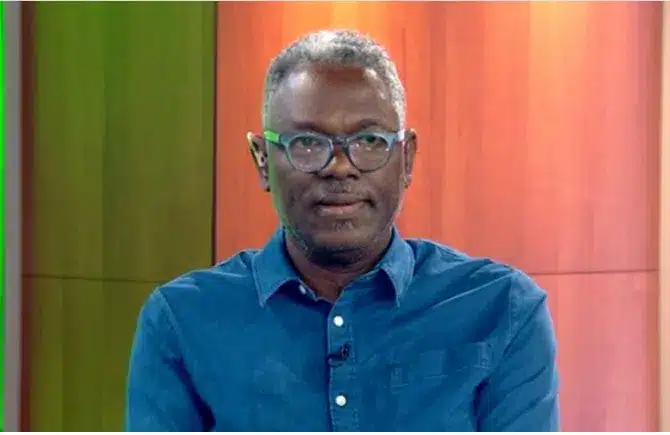
A former Political Adviser to ex-President Olusegun Obasanjo, Akin Osuntokun, has criticised the administration of the late former President Muhammadu Buhari, saying he failed to govern the country effectively despite being regarded as a hero in the North.
Osuntokun said Buhari’s eight-year administration did not significantly improve the living standards of Nigerians, adding that insecurity and ethnic tensions worsened during his tenure.
Naijaonpoint reports that the former presidential aide spoke on Monday during an appearance on Arise Television’s Morning Show, where he assessed Buhari’s legacy one year after the former President’s death.
According to Osuntokun, Buhari enjoyed considerable popularity in the northern part of the country but failed to translate that support into policies that improved the welfare of the general population.
“He was a hero of the North but didn’t govern well in terms of affecting the living standards of the people,” he said.
The former presidential adviser also accused the Buhari administration of failing to adequately address the conflict involving farmers, herders and armed groups in different parts of the country.
Osuntokun argued that the clashes escalated under Buhari, particularly as communities accused the government of not taking decisive action against perpetrators of violence.
“It was under him that the conflict between the Hausa-Fulani militias and farmers and herders escalated beyond proportion, while statements were being made that they were your brothers and you should learn to live with them,” he said.
During Buhari’s presidency, several communities across the North-Central and southern parts of the country experienced repeated clashes between farmers and pastoralists over land, grazing routes and access to water.
The violence resulted in deaths, displacement and destruction of property, while critics accused the administration of failing to respond firmly to the crisis.
Osuntokun further alleged that Buhari’s appointments into key government and security positions were heavily tilted towards the northern part of the country.
According to him, the former President appeared unconcerned about criticisms that his administration did not sufficiently reflect Nigeria’s federal character.
“When you look at his appointments, it was categorically a Northern-dominated government. He himself was unapologetic about being perceived as such,” Osuntokun said.
Buhari faced sustained criticism during his administration over the regional composition of his appointments, particularly in the security sector.
Although his supporters argued that appointments were based on competence and trust, critics maintained that the distribution did not adequately represent the country’s ethnic and regional diversity.
The former presidential adviser also recalled Buhari’s intervention in a dispute between Fulani residents and members of a host Yoruba community in the Oke-Ogun area of Oyo State.
He said Buhari, before becoming President, led a Fulani-Muslim delegation to meet the then governor of Oyo State, Lam Adesina, over the conflict.
“During the period that we are evaluating him as the President of Nigeria, he had earlier led a Fulani-Muslim delegation to Ibadan due to the conflict in the Oke-Ogun area between Fulani people and the host Yoruba community,” he said.
“He went to see Governor Lam Adesina, where he said he was there on behalf of the Fulani people.”
Osuntokun cited the incident as evidence of what he described as Buhari’s strong identification with northern and Fulani interests.
Naijaonpoint reports that Buhari, a former military Head of State, governed Nigeria as an elected President from 2015 to 2023 after defeating incumbent President Goodluck Jonathan in the 2015 general election.
His supporters praised his anti-corruption stance, infrastructure projects and efforts against insurgency, while critics faulted his handling of the economy, insecurity, national unity and appointments.
Recall that the former President died in a London hospital on July 13, 2025, at the age of 82, following a prolonged illness.
He was buried in his hometown of Daura, Katsina State, in accordance with Islamic rites after receiving a state funeral.