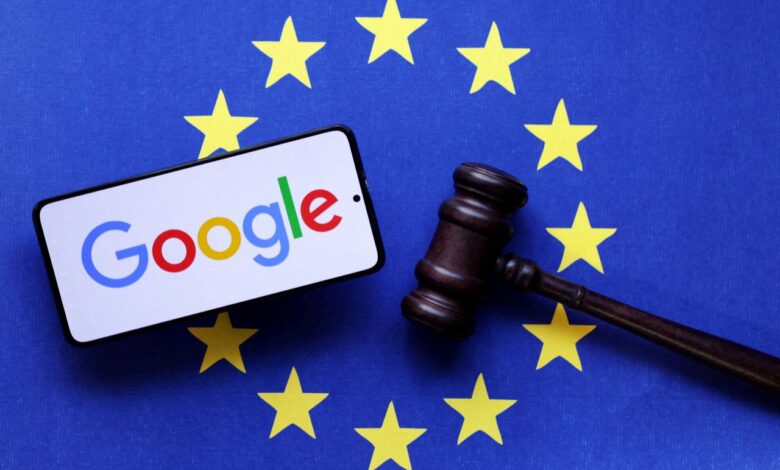
The European Union on Thursday hit Google with fines totalling $1 billion, in a move that risks escalating tensions with the United States.
The EU fined the US tech giant $530 million for illegally favouring its own services, such as Google Flights and Google Hotels, over rivals in search results.
A second fine of $489 million was levied because Google barred app developers from showing consumers offers, free of charge, outside the Google Play store, the European Commission said in a statement.
“After this decision, we want to make sure that there is more competition and also other companies are able to innovate,” EU tech chief Henna Virkkunen said.

A senior EU official said Google still favours its own services, though the second fine covers only the period from March 2024 to December 2025.
The US tech giant accused the EU of dismantling safety protections on Google Play through its enforcement.
“Regulation should improve products, not make them worse,” Google’s Kent Walker said in a statement.
The fines land just days before the first anniversary of a tariff deal between Washington and Brussels that had eased trade tensions.
President Donald Trump’s administration has repeatedly accused Brussels of targeting US tech firms and has threatened retaliatory tariffs.
US Trade Representative Jamieson Greer said the fines undermined hopes for smoother trade ties, warning they “pose a real risk to the continuation of transatlantic stability with respect to trade.”
Related
‘Not fair competition’
The penalties are the largest yet against a single company under the Digital Markets Act (DMA), the EU’s signature tech competition law.
In 2025, the bloc fined Meta $227 million and Apple $568 million under the same rules.
The DMA, which took effect in 2024, aims to curb what Brussels views as Big Tech’s excesses and ensure fair competition in the digital economy. Washington firmly objects to the DMA and other EU tech regulations.
Under the DMA, the EU can fine companies up to 10 percent of their global turnover for violations.