From the Silk Road to the Sahara: Why the Dikwa–Gamboru/Ngala and Bama–Banki Roads Could Transform Africa’s Trade Future

By Mukhtar Imam
When historians recount the world’s greatest trade networks, two ancient corridors stand out. The first is the Old Silk Road, which connected China to Europe through an intricate web of commercial routes stretching from Beijing to the United Kingdom. The second is the Trans-Saharan trade route, the historic artery that connected West Africa with North Africa and the Mediterranean, making it one of the greatest engines of commerce on the African continent.
Today, China is writing a new chapter in economic history through President Xi Jinping’s Belt and Road Initiative (BRI), an ambitious programme that seeks to revive the ancient Silk Road by investing in roads, railways, ports, industrial parks, and logistics hubs across Asia, Europe, and Africa. The initiative is founded on a simple but powerful principle: connectivity drives prosperity. Nations linked by efficient transport infrastructure enjoy increased trade, greater investment, stronger regional integration, and sustained economic growth.
Nigeria now has an opportunity to embrace a similar vision within its own historical and geographical context.
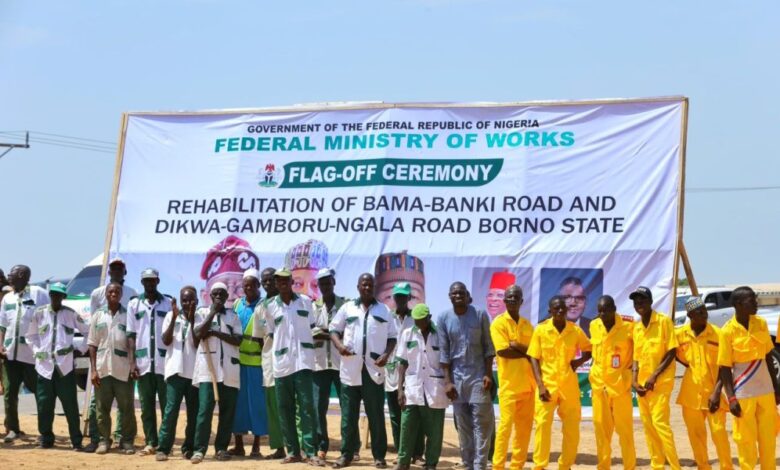
The ongoing construction of the Dikwa–Gamboru/Ngala and Bama–Banki roads in Borno State should not be viewed merely as infrastructure projects designed to improve transportation. Rather, they represent strategic economic corridors capable of reopening one of Africa’s oldest and most important commercial routes—the Trans-Saharan trade network.
For centuries, caravans traversed this route carrying gold, salt, leather, textiles, livestock, grains, and other valuable commodities between the kingdoms of West Africa and the markets of North Africa and beyond. These exchanges not only enriched economies but also facilitated the movement of knowledge, technology, religion, and culture across continents. The Trans-Saharan trade corridor became the second-largest historical trading network in the world, surpassed only by the ancient Silk Road.
Like the Belt and Road Initiative, the reconstruction of the Dikwa–Gamboru/Ngala and Bama–Banki roads is fundamentally about restoring connectivity. These roads reconnect Nigeria with Cameroon and neighbouring markets, creating vital gateways into the Lake Chad Basin and linking commercial activities across West and Central Africa. They also hold the promise of restoring trade flows that have been disrupted by years of conflict and insecurity.
The economic implications are enormous.
Efficient transport corridors reduce the cost of moving goods, improve access to domestic and international markets, attract private investment, encourage industrial development, expand agricultural value chains, and create employment opportunities. Border communities that once thrived as centres of commerce can once again become vibrant hubs of economic activity, while manufacturers, farmers, livestock traders, transporters, and exporters benefit from improved market access.
More importantly, infrastructure of this nature strengthens regional integration under the African Continental Free Trade Area (AfCFTA), positioning northeastern Nigeria as a strategic gateway for commerce between West, Central, and North Africa. As trade expands, so too does the potential for peace, stability, and shared prosperity.
China’s Belt and Road Initiative demonstrates what is possible when infrastructure is aligned with long-term economic strategy. By rejuvenating the Old Silk Road, China has created an extensive network of economic activities that spans continents, connecting Beijing with major commercial centres across Asia and Europe, ultimately reaching the United Kingdom. The objective extends beyond transportation; it is about creating interconnected economies capable of generating sustained growth and development.
The same philosophy can inspire Nigeria’s approach to rebuilding the northeast. The Dikwa–Gamboru/Ngala and Bama–Banki roads can become the backbone of a renewed Trans-Saharan economic corridor—one that restores the region’s historical significance while unlocking new opportunities for commerce, investment, and regional cooperation.
This vision, however, must extend beyond road construction. Modern border infrastructure, efficient customs administration, enhanced security, logistics parks, agro-processing zones, dry ports, and industrial clusters should accompany these transport corridors. Together, these investments would transform roads into engines of development rather than mere passageways.
History teaches that, great civilizations are built around great trade routes. The Silk Road transformed Asia and Europe. The Trans-Saharan trade route shaped the political and economic fortunes of Africa for centuries. Reviving this historic corridor through strategic infrastructure investment offers Nigeria an opportunity not simply to rebuild roads, but to reconnect economies, restore livelihoods, and reposition the country as a central player in continental trade.
The Dikwa–Gamboru/Ngala and Bama–Banki roads therefore represent something far greater than civil engineering projects. They are pathways to economic renewal, symbols of regional integration, and foundations for a more prosperous future. Just as the Belt and Road Initiative is breathing new life into the world’s greatest historical trade corridor, these roads can herald the renaissance of Africa’s second-greatest trading network—the Trans-Saharan route—and, in doing so, contribute meaningfully to the economic transformation of Nigeria and the African continent.