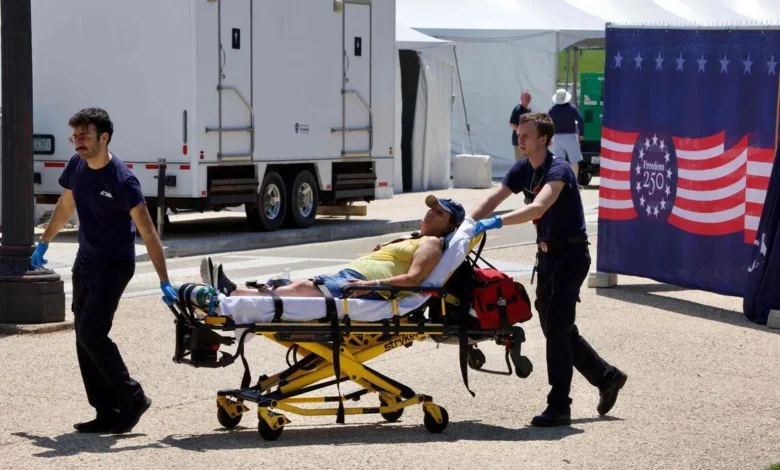
WASHINGTON – A dangerous heat wave upended Fourth of July celebrations across swaths of the central and eastern US on July 3, forcing officials in the nation’s capital and elsewhere to cancel or postpone dozens of parades, concerts and fireworks displays.
Among the events disrupted by the sweltering heat was the Great American State Fair on the National Mall in Washington, a centrepiece of President Donald Trump’s efforts to mark the nation’s 250th birthday.
The fair, designed to showcase all 50 states, was temporarily closed on the afternoon of July 3 as temperatures reached 38 deg C. Local media said the event later reopened.
Record-breaking temperatures spread to the eastern US from the Midwest earlier this week due to the emergence of a high-pressure system known as a “heat dome”, which traps a mass of hot air over a region and can cause humidity to spike.

The scorching conditions also strained power grids. PJM, the largest US power grid operator serving 67 million people in the Mid-Atlantic, South and Washington, DC, areas, ordered customers enroled in emergency conservation programmes to curb usage.
The steps were needed to battle generator outages, overloaded transmission lines and a surge in air-conditioning demand due to the heat.
In New York, Con Edison said roughly 17,000 customers were without power as at late afternoon on July 3. As demand surged, it urged customers in New York City and Westchester County to conserve electricity.
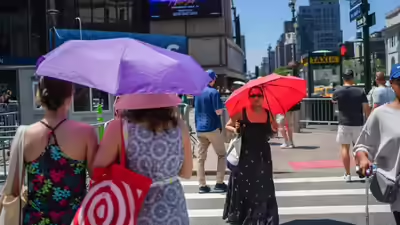
In New York City, shoe soles stuck to Manhattan streets as adhesives softened in the heat.
The city’s extreme heat warning did not stop fans from gathering on sweltering sidewalks to watch celebrity guests arrive at Madison Square Garden for what was widely expected to be the wedding celebration of pop megastar Taylor Swift and football hero Travis Kelce.
A worker waved SUVs carrying guests into the venue while holding a water bottle in one hand and a towel to wipe sweat from his face in the other.
Over 185 million people, more than half the US population, were under heat alerts on July 3, the National Weather Service said. Peak heat indexes could reach 46 deg C in parts of the country, with several cities setting record temperature highs.
Forecasters and government officials have warned that the heat wave could prove deadly. They urged Americans spending the long weekend outdoors to stay hydrated, seek shade and watch for signs of heat illness at gatherings and public events.
Event cancellations were reported across the Eastern Seaboard for the July 4 weekend, when Americans typically gather for barbecues, parades and fireworks displays to celebrate the nation’s 1776 Declaration of Independence from Britain.
In Philadelphia, officials cancelled the Salute to Independence Parade, a marquee event in the city’s semiquincentennial celebrations, citing extreme heat. The decision came after temperatures hit 39 deg C on July 2, tying a record high last seen in 1901.
Elsewhere, heat-related disruptions rippled across the region. Haddon Township, New Jersey, cancelled its annual July 4 parade. Watertown in upstate New York called off its Independence Day concert and fireworks display.
In Boston, officials delayed entry to an annual riverside fireworks celebration by four hours, to 4pm instead of noon. REUTERS