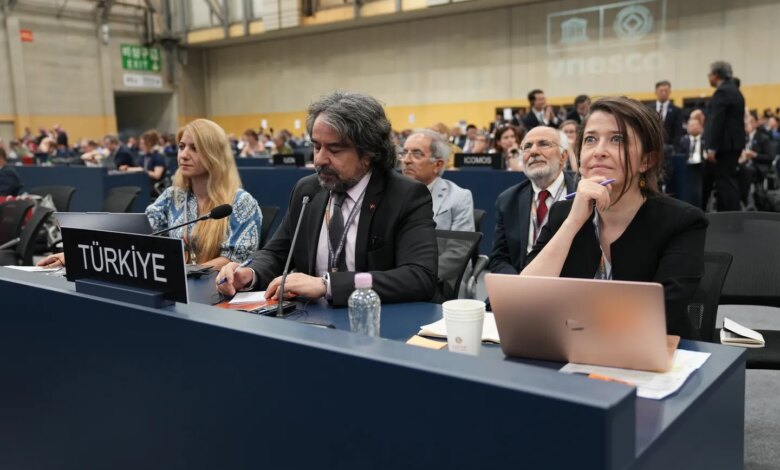
As the 48th session of UNESCO’s World Heritage Committee draws to a close in Busan, South Korea, Türkiye is emerging as one of the organisation’s most active diplomatic players.
From helping broker consensus on some of the session’s most closely watched heritage decisions to preparing to host the Committee’s next meeting in Istanbul, Türkiye has sought to position itself as both a guardian of cultural heritage and a bridge between countries facing complex conservation challenges.
Among the most closely watched discussions were those surrounding Palestine’s Sebastia archaeological site in the occupied West Bank and Lebanon’s Mount Amel Castles, both recognised as heritage sites on July 23 by a panel of international experts. Both under threat from ongoing Israeli attacks.


“We believe that Sebastia’s inscription on the World Heritage List will further strengthen international cooperation and support for safeguarding Palestine’s rich cultural heritage for future generations,” Ambassador Mustafa Yurdakul, Türkiye’s Permanent Delegate to UNESCO, told TRT World.
“We appreciate Palestine’s efforts to preserve its rich cultural heritage, often under extremely difficult circumstances,” Yurdakul added, stressing that Sebastia “bears witness to a succession of civilisations that have shaped the region’s history for more than three thousand years.”
Located near Nablus in the occupied West Bank, Sebastia has been the focus of Palestinian efforts to secure UNESCO recognition for more than a decade, with officials arguing that international protection is essential to safeguard the archaeological site under Israeli occupation.
Commenting on Türkiye’s efforts to build consensus for Sebastia’s emergency inscription, Adel Attieh, Permanent Delegate of the State of Palestine to UNESCO, praised what he described as “the moral power and the political power of the ambassador of Türkiye, who led a strong fight against all attempts to intimidate member states and to hijack this committee into voting against this nomination.”
Despite “the heated debate and the endless attempts of the (Israeli) occupying power to sabotage the voting”, including what he described as intimidation by Tel Aviv, “the international community decided to uphold its responsibilities to recognise the universal values of those sites as Palestinian sites,” Attieh told TRT World.


