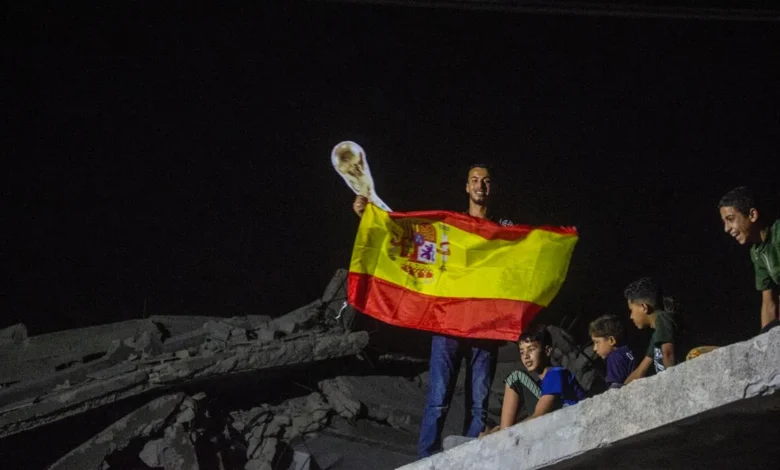
GAZA – On the night of July 19, dozens of people settled into their seats in front of a large screen at a makeshift, open-air venue in the central Gaza Strip. Each person in the crowd of mostly young men had paid a cover charge of 10 shekels (S$4.30), which included something to drink, to watch the men’s World Cup final, joining more than 1 billion people around the world.
The owner and organiser of the makeshift cafe, Haitham Zidan, 31, said he had spent hours setting up the screen and securing electricity that was generated locally. The power cut four times, and each time Zidan asked attendees to unplug their phones so there would be enough electricity to keep the cafe operating.
Two-plus hours later, nearly all of them were celebrating Spain’s 1-0 victory over Argentina in the final.
“I felt I had created something successful,” Zidan said. “After Morocco and Egypt were eliminated, people left disappointed. But tonight I watched young men leave smiling, clapping and waving Spanish flags. For at least two hours, they forgot the war.”


Many Palestinians, both in the Gaza Strip and the West Bank, supported Spain throughout the World Cup for reasons beyond football itself. Spain opposed Israel’s war in Gaza after the Hamas-led attacks on Israel on Oct 7, 2023, and it was an early supporter of Palestinian statehood, officially recognising its independence in March 2024.
Some players on the Spanish team, too, have expressed public support of Palestinians. In May, Lamine Yamal – the 19-year-old Spanish phenom – waved a Palestinian flag during celebrations in Barcelona after his team won the Spanish league title in 2026, and posted a picture of himself with the flag on his Instagram account.
After Spain won, videos on social media showed people in Gaza and the West Bank celebrating – some of them in Spanish jerseys – by lifting chairs and cheering. Husam Zomlot, the Palestinian ambassador to Britain, congratulated Spain on its victory on social media on July 19.
“We supported Spain because we felt some of its players had spoken about what is happening to us,” said Moutaz Rabee, one of the spectators in Gaza on July 19. “When the goal was scored, tears came to my eyes.”
For many Israeli soccer fans, it was a disappointing night. Argentina’s team was popular among Israeli fans throughout the tournament, and especially on July 19.
Before the final, Prime Minister Benjamin Netanyahu of Israel had publicly expressed support for Argentina and met with the country’s ambassador. In a message to Javier Milei, Argentina’s president, Netanyahu wished him luck. “We support you and support Argentina tomorrow,” Netanyahu said.
Neither the Palestinian national soccer team nor the Israeli national soccer team took part in this year’s World Cup. As a result, Uri Levy, an Israeli soccer expert and journalist, said, fans on both sides were looking for “representation on the biggest stage” by supporting other countries.
While many Israelis gravitated toward Argentina, Levy cautioned that comparing the Argentina-Spain final to the conflict in the Middle East would be flattening a complicated narrative of the real world.
“Unfortunately, social media is shaping up the discussion on so many levels nowadays. In the world today you cannot remain in the gray areas – you have to pick a side,” Levy said. But, he acknowledged: “That’s the most football thing to do.”
Argentina is particularly popular in Israel, Levy said, because it is one of the most popular destinations for young Israeli travellers. The team itself, the 2022 men’s World Cup champion, is also part of the draw, Levy said.
“They’re a team of distraction and escapism,” he said, adding that Argentina’s games had been particularly exciting. “Until the final, every game against Argentina was like a movie,” Levy said.
In the Arab world, fans were also already disappointed with the Argentina squad after it eliminated Egypt from the tournament in a dramatic round of 16 match. Egypt had been ahead by 2-0 until Argentina quickly scored three goals, the final one in stoppage time.
For fans in Gaza on July 19, the game was a small reprieve from the reality of war and fighting. At halftime, the dominant conversations in the crowd were not about aid deliveries, displacement or ceasefire negotiations. Instead, they argued about substitutions, lamented missed chances and debated whether Yamal would produce a goal.
Among the rubble, dozens of men shared a brief connection with one another – and the rest of the world.
“For me, it wasn’t only about football,” Zidan said. “When the final whistle blew, it felt like we had shared a rare moment of happiness.” NYTIMES
This article originally appeared in The New York Times.


