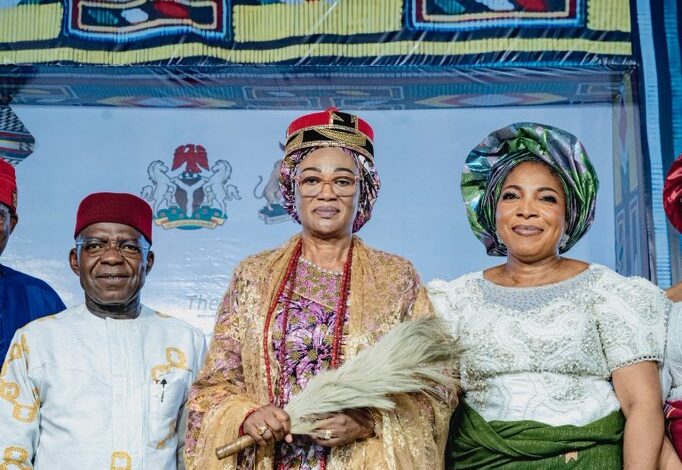
Nigeria’s First Lady, Senator Oluremi Tinubu, has announced a ₦2 billion intervention to revive the historic Akwete weaving industry in Abia State, where she termed the centuries-old craft as both a cultural inheritance and an economic asset that deserves renewed national attention.
The intervention, unveiled during her visit to Akwete in Ukwa East Local Government Area, signals one of the Federal Government’s strongest public endorsements of indigenous textile production at a time when Nigeria continues to rely heavily on imported fabrics despite its rich history of local weaving.
The funding is expected to support the development of the Akwete production site, improve the working environment for local weavers, and preserve a craft widely regarded as one of Nigeria’s oldest surviving hand-woven textile traditions.
READ RELATED NEWS UPDATES
Portable defends Remi Tinubu’s advice on small businesses for unemployed women
FG to replace NYSC Khaki uniform with Adire in push to boost local textile industry
FCCPC seals 5 Kano textile warehouses over consumer exploitation, underweight fabric sales
Addressing traditional rulers, artisans, and community leaders, the First Lady established that protecting indigenous crafts goes beyond preserving history, and that it also creates opportunities for employment, cultural tourism, and economic development.
She urged Nigerians, particularly people of the South-East, to reclaim ownership of the renowned fabric and promote it beyond the country’s borders.


The Firs Lady said, “Our young people need to also be encouraged to get used to our tradition and cultural outfits.”
She continued, “I love traditional outfits because our tradition, our culture tells us who we are. The moment we lose that, we won’t remember where we come from.”
Tinubu observed that the weaving tradition had survived largely because families continued to pass the skills from one generation to another, a practice she described as worthy of preservation.
According to her, the craft represents patience, discipline, and identity rather than mere commercial production.
She further said, “For the women of Akwete, I heard your cry. I am here to announce to all Nigerians, and the Igbo should take Akwete to the nations.”
The announcement comes against the backdrop of years of concern over the decline of Nigeria’s indigenous textile industry. Once among Africa’s largest employers, the sector has suffered decades of factory closures, shrinking local production, cheap imports, and reduced patronage, leaving many traditional weaving communities struggling to sustain their craft.
Unlike industrial textile factories, however, Akwete weaving has survived largely through family-based apprenticeship, with women remaining the custodians of techniques that have existed for generations.
During the visit, Tinubu also indicated support for upgrading facilities within the weaving community. She noted that existing structures should be developed into spaces that properly document and preserve the history of the craft.
The First Lady was earlier conferred with the traditional title of Ugo Nwanyi of Abia before proceeding to the historic weaving settlement.
She was received by Governor Alex Otti and his wife, Priscilla Otti, alongside traditional rulers, political leaders, members of the clergy, and representatives of the weaving community.
Although the ₦2 billion donation is expected to strengthen the Akwete production hub, the broader challenge facing Nigeria’s indigenous textile sector extends beyond infrastructure. It has been noted that sustained government patronage, easier access to markets, modern equipment, financing, and stronger protection against counterfeit imports will ultimately determine whether traditional fabrics such as Akwete regain their place in both local and international fashion markets.
For the women whose livelihoods have depended on the loom for generations, the announcement offers renewed hope that a craft once threatened by neglect may yet find a more secure future.
For More Details Visit New Daily Prime News