Syria maps, Trump and Vance's meeting: What really happened behind Washington's doors – analysis

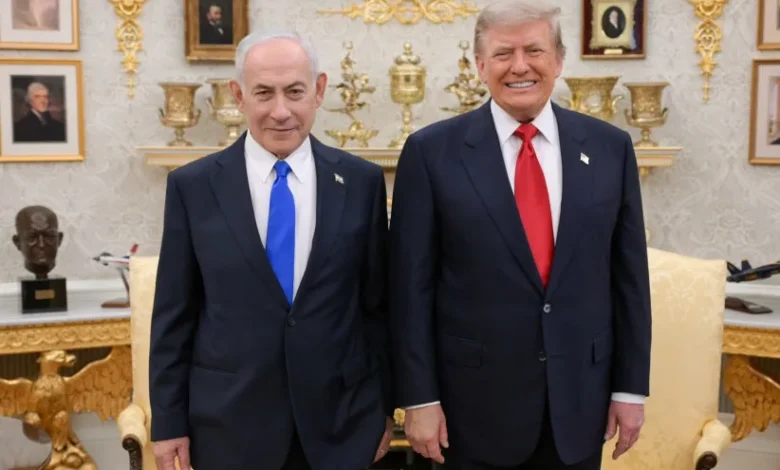
It had been quite some time since a senior Israeli diplomatic official held such a lengthy and detailed background briefing. Nearly every question was answered, often at considerable length, while insisting that Prime Minister Benjamin Netanyahu’s visit to Washington was not another ceremonial meeting but a genuine strategic exchange between two leaders who know each other well.
“It wasn’t about checking a box,” the official said. “It was an exchange of ideas.”
According to the briefing, the discussion with President Donald Trump revolved around three possible paths regarding Iran: reaching a new agreement, maintaining the current economic blockade, or escalating military pressure. Each option, the official stressed, was examined objectively and “honestly.”
Yet beyond the substance of the briefing, there was another impression that was difficult to ignore: A sense of urgency, perhaps even unease.


For months, Trump has publicly stated that he urged Netanyahu not to launch further strikes in Lebanon and that he would like to see Israel withdraw from parts of Syria. On several occasions, he has suggested that Washington and Jerusalem do not necessarily see eye-to-eye on every regional issue.
The senior official, as expected, blamed the media, arguing that journalists are often fed inaccurate, or even fabricated, information. But his own description of what Netanyahu chose to do inside the Oval Office suggested that Trump’s public remarks, and perhaps the assumptions held by those briefing him, were very much on the prime minister’s mind.
Netanyhu wanted to make sure Trump fully understood Israel’s position
The briefing left the clear impression that Netanyahu wanted to make sure Trump fully understood Israel’s position on Syria before those assumptions became entrenched.
According to the official, Netanyahu arrived at the Oval Office carrying maps. He showed Trump that Israel controls roughly 0.1% of Syrian territory, while Turkey controls about 5%, arguing that Israel’s limited presence is intended solely to prevent Iran, Hezbollah, Palestinian Islamic Jihad and other terrorist organizations from establishing themselves along its border.
The official explained that Trump sometimes develops “certain assumptions” which, “if you don’t find a way to change them, become fixed.” That, he said, was precisely why Netanyahu believed it was important to present the facts visually.
Perhaps that was the most revealing moment of the entire briefing.
If Netanyahu devoted valuable meeting time with the US president to explaining Israel’s footprint in Syria, it suggests that the issue extends far beyond media speculation. Syria has become part of a broader strategic conversation between Jerusalem and Washington-one in which Iran remains the central issue-and Netanyahu clearly believed Trump’s understanding of the situation required further clarification.
Netanyahu’s private meeting with JD Vance
Another notable element was Netanyahu’s private meeting with Vice President JD Vance.
During the briefing, I asked the senior official about the relationship between the two, given Vance’s past criticism of Netanyahu and his coalition, as well as his growing stature within the Republican Party.
The answer was brief but revealing.
According to the official, Netanyahu specifically requested the one-on-one meeting. It was described as “good, candid and genuine,” but no further details were offered.
The fact that the initiative came from Netanyahu is significant in itself.
If Trump is the leader of today, Vance could very well become one of the most influential figures of tomorrow. Netanyahu appears to have concluded that this visit was not only about maintaining his relationship with the current administration, but also about investing in a relationship that could prove equally important in the years ahead. As the official himself put it, the prime minister wanted to make the most of every moment during the visit.
Iran, naturally, dominated much of the discussion.
The senior official described a detailed assessment of mounting economic pressure on Tehran, including fuel shortages, diesel shortages, soaring inflation and growing concern within the regime over potential public unrest.
He also highlighted what he described as Israel’s achievements in degrading Iran’s nuclear program by targeting nuclear scientists, production facilities and missile manufacturing capabilities.
Then came Pickaxe Mountain.
According to the official, centrifuges have indeed been transferred to the underground facility. However, he stressed that Israel’s objective remains preventing Iran from rebuilding its nuclear program and that Jerusalem would not hesitate to act again if necessary.
Another recurring theme was Netanyahu’s long-standing vision of redefining Israel’s strategic relationship with the United States.
Rather than relying indefinitely on the traditional Foreign Military Financing program, Netanyahu told Trump that Israel should gradually transition toward a partnership built on joint technological development, defense industries and collaborative strategic projects.
From his perspective, the future relationship should evolve from one based on assistance to one based on partnership.
Turkey also featured prominently in the discussion.
The official said Netanyahu argued that Turkish President Recep Tayyip Erdogan seeks to expand Ankara’s regional influence. With what appeared to be a slightly sarcastic smile, the official added that Netanyahu believes he succeeded in convincing Trump that Israel and the United States do not necessarily share the same outlook regarding future arms sales to Turkey.
Toward the end of the briefing, the official was asked about Netanyahu’s ongoing criminal trial.
His response was equally noteworthy.
According to the official, Netanyahu never raises the issue in his conversations with Trump. Rather, it is Trump who brings it up on his own initiative-and did so again during this visit.
Ultimately, the most important takeaway from Netanyahu’s Washington trip may not have been any single statement or announcement.
Instead, it was the realization that even after eight meetings with Trump, Netanyahu still felt compelled to devote significant time to sharpening Israel’s message on nearly every major issue-from Syria and Iran to the future of the US-Israel strategic relationship.
Close personal ties, it seems, do not eliminate the need to persuade, explain, and occasionally challenge assumptions.
That, more than anything else, was what the unusually detailed briefing revealed about what is truly occupying the prime minister’s office behind closed doors.


