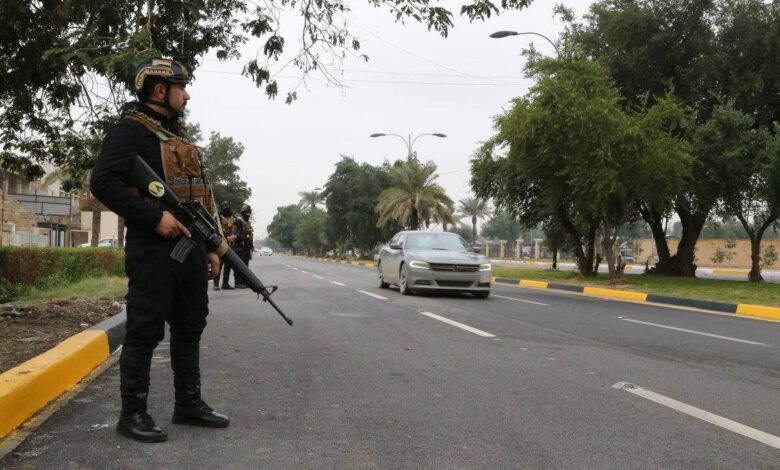
Counter-Terrorism Service sealed every entrance to Baghdad’s Green Zone and moved with military precision through the residential compounds within. When the sun rose, 47 people were in custody. Among them: twelve sitting members of parliament, a former governor, a senior adviser to the outgoing prime minister, and an array of oil ministry officials.
The trigger was the confession of Adnan al-Jumaili, the Deputy Oil Minister for Refining Affairs, detained the previous month on corruption charges. Investigators say al-Jumaili’s testimony, accompanied by the prior seizure of more than $85 million in public funds, implicated an entire ecosystem of officials in schemes to misappropriate state revenues. The Commission of Integrity issued the warrants. Several suspects fled before security forces reached them; the Green Zone was locked down to prevent further escapes.
A security official quoted by Arab News was blunt: “What has happened today is only the simple beginning”.

“Between 2003 and 2020, Iraq lost more than $600 billion to financial and administrative corruption.”
— Former Iraqi Prime Minister Mustafa al-Kadhimi, March 2023
To understand the scale of what the arrests represent, one must first reckon with the arithmetic of plunder. Iraq sits atop the world’s fifth-largest proven oil reserves, some 145 billion barrels. Since 2003, oil revenues have exceeded $1.2 trillion. Former Prime Minister Mustafa al-Kadhimi confirmed that by 2020, more than $600 billion of that wealth had been lost to corruption. Independent analysts estimate that at roughly $35 billion stolen per year since then, the cumulative losses now approach $776 billion.
The banker of Baghdad: How Tom Barrack plans to starve Iran’s militia machine
And yet, in the summer of 2025, as temperatures climbed to 50 degrees across southern Iraq, the country’s power grid could produce only 28,000 megawatts against a peak demand of 55,000 megawatts.
In August 2025, the country suffered a nationwide blackout lasting nearly a full day. Iraqis endured rolling outages not because their country lacks the means to power a light bulb, but because those means were systematically looted by the men whose portraits hung in the ministries above them.
The political architecture that enabled this theft is known in Arabic as muhassasa, the sectarian quota system bequeathed by the U.S. occupation, under which every ministry, every state contract, every senior appointment was parcelled out among Shia, Sunni, and Kurdish factions as patronage. [The 2022 ‘heist of the century’ — $2.5 billion embezzled from the Iraqi Tax Authority in a single operation may account for as little as one percent of total losses since 2003.
The militia dimension compounds the financial one.
The Popular Mobilization Forces (PMF) — an umbrella of some 238,000 fighters receiving $3.6 billion in annual state funding, enshrined in Iraqi law in 2016 — are in practice the armed enforcement arm of Iran’s economic penetration of Iraq.
The state-owned Rafidain Bank was disbursing wages converted to dollars directly to PMF militia fighters until mid-2025. When U.S. Treasury pressure forced Rafidain out of that role, the PMF migrated its salary mechanism to Al-Nahrain Islamic Bank, shifting the problem rather than resolving it. Billions in oil revenues, deposited in New York and theoretically the property of the Iraqi people, have been financing the very forces that prevent Iraq from becoming a functional state.
Enter Ali al-Zaidi, 41, a banker and multimillionaire businessman who became Iraq’s prime minister in May 2026. His ascent was the product of Washington’s intervention: when former Prime Minister Nouri al-Maliki sought a third term, President Trump threatened to cut all U.S. support to Iraq if he returned to power. The Coordination Framework, the Shia umbrella coalition that controls parliament, withdrew Maliki and, after seven failed meetings, settled on Zaidi within 25 minutes as the ultimate compromise: a candidate who triggered no veto from Washington and no veto from Tehran’s clients in Baghdad.
The irony is razor-edged. Al-Zaidi formerly chaired Al-Janoob Islamic Bank. His bank was sanctioned by the U.S. in 2024 for alleged money laundering, fraud, and illicit use of American currency, and subsequently banned by Iraq’s own Central Bank.
Iraq’s anti-corruption prime minister, in other words, was born from a system that rewarded access to power through government contracts, political connections, and the grey zones of Iraqi finance. He represents the system even as he raids it. Whether that makes him uniquely positioned to know where the bodies are buried, or uniquely compromised in his capacity to exhume them, remains the defining question of his tenure. Sunday’s raids were launched on direct orders from al-Zaidi. The arrested lawmakers came from al-Sudani’s own Shia political bloc and from the Azm Alliance, an influential Sunni party. Provincial arrests extended to Babil, Diwaniyah, Nasiriyah, and Najaf. Former Babil governor Sadeq Madlool was taken into federal custody. The breadth of the operation signals that this is not a narrow factional purge. It is, at minimum, a message.
The war on Iran: Through the lenses of pragmatism and realpolitik
The message is amplified by the presence of Tom Barrack, the U.S. Special Envoy to Iraq and Syria, who arrived in Baghdad on 15 June, carrying what one analyst called a vault key. Since 2003, Iraq’s oil revenues have been deposited at the Federal Reserve Bank of New York. That mechanism — the dollar-cargo lifeline — is Washington’s primary lever of structural power over Baghdad. Barrack has made plain that the price of continued access is twofold: disarm the militias and root out the corruption. Two of Iran’s most powerful proxies in Iraq, Asa’ib Ahl al-Haq and Kataib Imam Ali, have already announced they will place weapons under state control. Kataib Hezbollah and Harakat Hezbollah al-Nujaba have refused, conditioning disarmament on the full withdrawal of U.S. forces.
Iraq’s Corruption Perceptions Index score places it 140th globally — among the most corrupt nations on earth.
The $600 billion estimated to have been stolen by 2020 could, analysts note, have funded the construction of 10,000 modern schools, 1,000 hospitals, and 5,000 residential complexes.
Instead, as of early 2026, Iraq’s electricity production stood at 29 gigawatts against a baseline national requirement of 40 gigawatts, and more than 40 percent of electricity generated is lost during transmission due to degraded infrastructure and energy theft.
landscape that has stripped the ‘resistance’ narrative of its last shred of credibility, and a confessing official whose testimony has already expanded the investigative net far beyond what was arrested Sunday.
Whether Ali al-Zaidi has the independence, the political longevity, and ultimately the will to deliver what the Green Zone has always refused to deliver is a question that 42 million Iraqis, and the international creditors watching their energy sector collapse, cannot yet answer. The vault in New York is open. The warrants are signed. The question is whether the arithmetic of stolen billions will finally be settled, or whether the Green Zone will again prove that it always wins.
The views expressed in this article belong to the author and do not necessarily reflect the editorial policy of Middle East Monitor.