Trump won big spending promises from NATO last year. This week in Turkey, he'll try to enforce them

WASHINGTON (AP) — President Donald Trump got what he wanted from NATO at last year’s summit: an alliance whose members had largely acceded to his demands to step up their defense spending.
This week when he meets leaders in Turkey, his mission is to enforce that pledge.
The speed with which most NATO countries have tried to heed Trump’s call to spend 5% of their annual gross domestic product on defense over the next decade underscores how the U.S. president has reshaped the alliance and bent it to his will — even as he continues to spar with its members over the Iran war, his flirtation with annexing Greenland, and various personal tiffs.

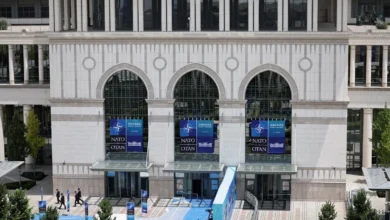
“President Trump fully expects that all allies will step up immediately and get on the path to 5% and do it with urgency,” Matt Whitaker, the U.S. ambassador to NATO, told reporters in a preview of the administration’s message before this week’s summit in Ankara.
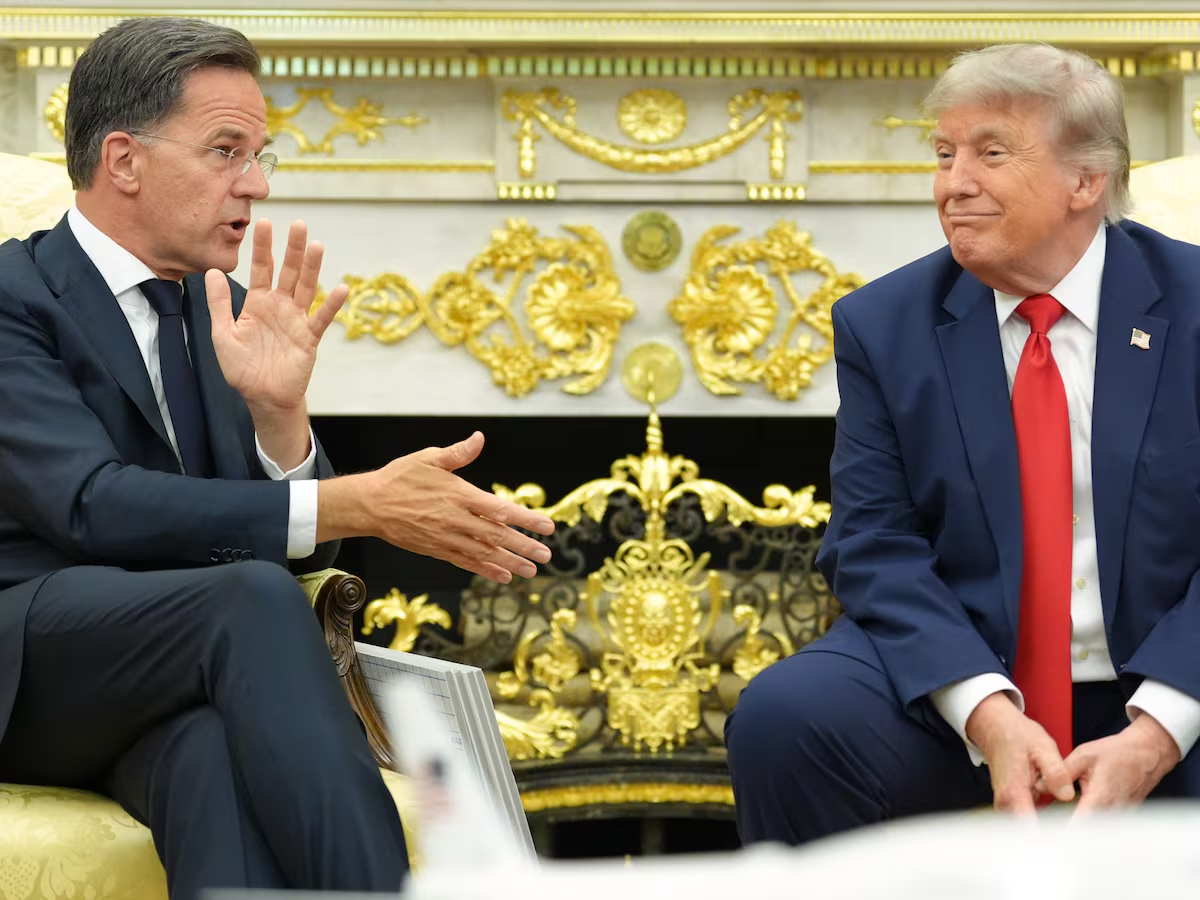
Trump leaves Monday evening for the summit, and for days leading up to the trip has been airing grievances about how much the U.S. spends on defense compared with other countries. That’s despite efforts from Mark Rutte, the alliance’s secretary-general, who tried to feed the ego of the tempestuous U.S. leader in an Oval Office meeting last month. There, he displayed large charts on easels showing what he called “ The Trump Trillion ” — how much allies had boosted their spending commitments since 2017.
Luke Coffey, senior fellow at the Hudson Institute, a conservative think thank in Washington, described the Ankara gathering as the “first report card” after last year’s summit in The Hague.
“If NATO members play their cards right — if the leaders show up demonstrating a commitment and a reasonable plan to meet these spending targets — then it’ll allow President Trump to take a victory lap,” Coffey said.
Trump will meet with Ukraine’s Zelenskyy
Trump left last month’s G7 summit in France buoyed by support from his counterparts for his interim agreement to end the war with Iran. He praised unity among leaders — who also worked to bring Trump onside to boost security assistance for Ukraine in its fight with Russia.
That war, now in its fifth year, is expected to be a key focus at the Ankara summit. The White House said Trump will meet with Ukrainian President Volodymyr Zelenskyy on Wednesday. Trump spoke with both Zelenskyy and Russian President Vladimir Putin on July 4.
Trump also plans to meet on the sidelines of the summit with Syrian President Ahmad al-Sharaa. The White House has not provided goals for that discussion, but it comes as Trump has publicly mused about Syria playing a bigger role fighting Hezbollah in Lebanon. Al-Sharaa, who led an Islamic insurgent group and whose rebel forces ousted former Syrian President Bashar Assad, has said he has no interest in doing so.
The U.S. president also plans a separate meeting with Turkish President Recep Tayyip Erdogan, the host of the summit whom Trump counts as a close friend.
But he has no bilateral meetings planned with other leaders. Despite the positive tone of the G7 summit, Trump resurrected feuds as soon as he returned stateside.
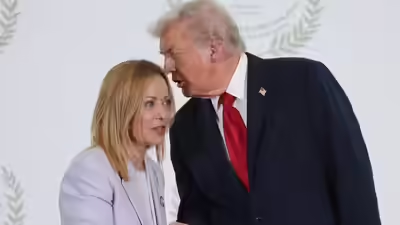
He proclaimed that Keir Starmer would resign as British prime minister before the embattled leader made it official, arguing that Starmer “failed badly” on immigration and energy. Meanwhile, Trump asserted that Italian Prime Minister Giorgia Meloni had begged him for a photo, prompting a ferocious denial by her and the cancellation of a U.S. visit by the country’s foreign minister.
Despite the fallout, Trump egged it on further on Sunday when he posted a photo on social media of Meloni smiling at him, along with the words “RESTRAINING ORDER NEEDED.”
Trump has remained on tense terms with Canadian Prime Minister Mark Carney, and while French President Emmanuel Macron charmed Trump with a lavish dinner at the Palace of Versailles last month, it hasn’t always been smooth between the two leaders.
Aware of those tensions, a bipartisan group of senators is again headed to the summit this year, trying to represent the broad support for the alliance on Capitol Hill and to serve as a counterweight to Trump’s often caustic attitude toward NATO.
“They are our best allies, they are our best trading partners, they are critical to our national security, to our economic success, and we need to encourage those relationships,” said Sen. Jeanne Shaheen, D-N.H., who is leading the delegation to Ankara. “That’s part of what Congress understands that the administration doesn’t seem to.”
Trump’s team is making the case for more NATO changes
The summit comes as Trump’s administration makes the case for what it calls “NATO 3.0,” which envisions an alliance that has Europe taking on more of its security needs, allowing the U.S. to shift its focus elsewhere.
The strategy was outlined by Elbridge Colby, a U.S. undersecretary of defense, earlier this year at a gathering of NATO defense ministers.
Then, in a scathing speech to other NATO defense ministers last month, Defense Secretary Pete Hegseth added to the pressure by announcing that the U.S. will conduct a six-month review of its forces in Europe. This surprised countries in the alliance that had anticipated coordinating with the Trump administration through the transition.
Trump himself sparked much confusion earlier this year when he seemed to send conflicting signals on the issue, announcing that he would send 5,000 U.S. troops to Poland weeks after ordering the same number of forces pulled out of the continent.
Shaheen said the NATO 3.0 concept “fails to understand — as this administration has consistently failed to understand — the threat that Putin and Russia are to Europe and subsequently to the United States.”
Europe is boosting spending, but still counts on the U.S.
The U.S. president last year was the driving factor in a broad target reached in The Hague for NATO countries to spend 5% of their GDP on defense over the next decade.
Of that, 3.5% would be for core defense spending and the rest would be related expenses, such as infrastructure. Spain said at the time that it couldn’t meet those levels, and some others have voiced reservations about the ambitious goal.
Despite the increased pledges and spending, experts say many parts of the continent are nonetheless reliant on the U.S. for their defense should they come under attack. The defining feature of the NATO alliance is the view that an armed attack on one member is an attack on all.
“This is the reality for most Europeans,” said Liana Fix, senior fellow for Europe at the Council on Foreign Relations. She said most are far from being able to defend themselves without the United States, “even if they’re starting to develop all that.”
Apart from the spending pledge, NATO has worked to accommodate Trump in other ways.
The alliance earlier this year introduced “Arctic Sentry,” a NATO-led military exercise aimed at countering Russian and Chinese activities in the region. It’s also meant to address Trump’s repeated threats to seize Greenland, since the Republican president has insisted the U.S. needs to acquire the semiautonomous territory of Denmark for strategic security reasons.
___
Associated Press writers Michelle L. Price in Washington and Lorne Cook in Brussels contributed to this report.
Copyright 2026 The Associated Press. All rights reserved. This material may not be published, broadcast, rewritten or redistributed without permission.