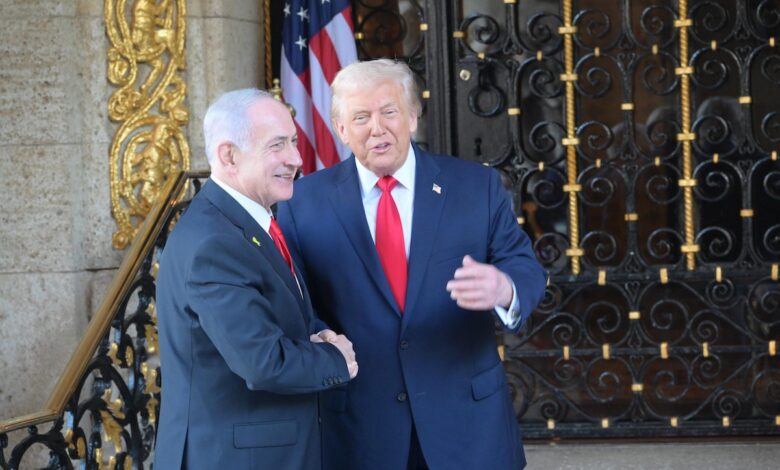
There is an old parable about two scorpions in a jar. Neither can leave. Neither trusts the other. And sooner or later, one strikes, not because it wants to kill the other, but because the jar has become unbearable.
Donald Trump and Benjamin Netanyahu are those scorpions now, and the jar is the wreckage of the Middle East they built together.
For the better part of a year, they marched in locked steps. One man’s appetite for spectacle matched by the other’s genius for making disaster look like deliverance. Netanyahu persuaded Trump that Iran could be shattered quickly, cleanly, at no real cost. Trump believed him because believing him was easier than doubting him, and doubt has never been a currency Trump trades in. The war came. But Iran did not break. And when the bill arrived, it was delivered to Trump’s door, not Netanyahu’s.


John Mearsheimer of the University of Chicago, who has spent a career mapping the architecture of American deference to Israeli interests, put the verdict as bluntly as a man of his discipline allows:
Netanyahu convinced Trump the war would be short and decisive, and Trump, in Mearsheimer’s words, was foolish enough to believe him.
Elsewhere, Mearsheimer has been blunter still, arguing flatly that Israel and its lobby own Trump, and that the President has demonstrated, repeatedly, a willingness to dance to Jerusalem’s tune.
Then came Lebanon, and with it the profanity that told the truth polite diplomacy never does. Reports of a fifteen-minute call, confirmed by Trump himself, describe the President screaming at Netanyahu, demanding to know what the hell he was doing. He called Netanyahu “crazy,” reminded him that he would be sitting in prison were it not for American protection, and scolded him in the most excruciating language, that the world now despised him for it. This is not the language of alliance. It is the language of a landlord screaming at a tenant who has torched the building and still expects a reference letter.
Netanyahu absorbed the insult silently, the way he absorbs everything, with a statement insisting nothing had changed, that Israel’s “position remains the same,” even as his troops turned back from Beirut on Trump’s order. One American official described the call more crudely: Trump had steamrolled him, and all the great warrior-statesman could manage in reply was a chastened “OK, OK”. This isn’t how empires normally treat client states, but this was never a partnership of equals. It is, as Jeffrey Sachs of Columbia University observes, the latest chapter in a decades-long bid for regional dominance. In this script, Netanyahu and the architects of Greater Israel are the sole victors; everyone else is left with the ashes. Sachs does not flinch from naming the architecture. The war on Iran, he argues, was never separate from the older “Clean Break” doctrine first sketched in 1996, a blueprint for regime-change wars with Washington cast as the enforcement arm of Israeli strategy. In that reading, Trump is not a partner but an instrument, wielded by a prime minister facing indictment at home and a coalition that cannot survive a genuine peace.
Gideon Levy of Haaretz, writing from inside Israel’s collapsing consensus, sees the same rot from the other direction. He has warned that Israel follows Netanyahu mindlessly toward a reckoning it has not yet allowed itself to imagine, and that the U.S.-Israel relationship itself is nearing its breaking point. Even Thomas Friedman, hardly a radical, has confessed to being torn, rooting against the Iranian regime while dreading what its defeat would do for two men, he flatly calls terrible people, “alleged crooks” running “anti-democratic projects” in their own countries.
Phyllis Bennis of Institute for Policy Studies frames the arrangement in the coldest terms available: not statesmanship, but real-estate logic: a transactional partnership between a president with no re-election ahead of him but a legacy to launder, and a prime minister facing an October election and a courtroom he has spent years trying to outrun.
Both men need a win they cannot contrive through governance, so they manufacture it through war. Both are impeachable, indictable, and disposable to the very coalitions that elevated them.
AIPAC, the Israeli religious right, and the Republican Zionist bloc in the U.S. Senate are Netanyahu’s insurance policy. Miriam Adelson’s checkbook and the MAGA base are Trump’s. Each man is one betrayal away from being fed to those bases as a sacrifice, and each of them knows it.
This is why the scorpion metaphor holds. Two men who need each other to survive politically are also the two men most capable of mortally stinging each other. Trump has already shown he will humiliate Netanyahu the moment the war stops being useful to him. Netanyahu has already shown he will defy Trump’s orders the moment his coalition demands it. The sting, when it finally comes, will not be ideological. It will be self-preservation, dressed up as principle, in a jar built from the bones of Lebanon, Gaza, and Iran, while the region, and the truth, are left to rot in the glass along with them.
The views expressed in this article belong to the author and do not necessarily reflect the editorial policy of Middle East Monitor.