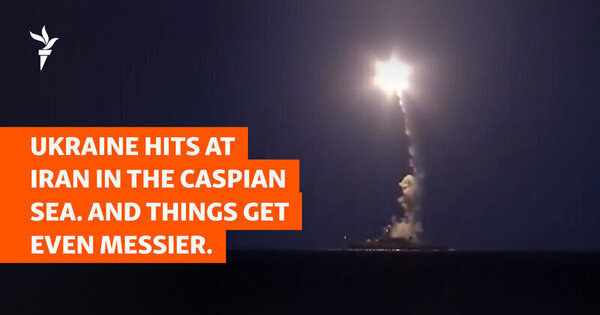
Iranian-designed drones have wreaked havoc for Ukrainian forces battling Russian troops as Moscow took Tehran’s technology and ran with it, supercharging production and deploying drones in devastating droves in its all-out war against Kyiv.
As far as Ukraine is concerned, that makes Iran an indirect combatant. And that means Iranian cargo ships heading to Russia are fair game as far as military targets go.
That’s what happened this weekend in the Caspian Sea, and Tehran is not happy.
Moscow’s 53-month-old invasion has scrambled politics for Europe. The US-Israeli war with Iran has scrambled politics for the Middle East.


So what do Ukrainian strikes on Iranian cargo — or Russian ships — in the Caspian mean for the two wars?
Ukraine’s drone capabilities have grown exponentially in quantity and in quality since 2022, when Russia launched its all-out invasion.
“If the Ukrainians continue doing this, it’s going to obviously make it more difficult for both Iran and Russia,” said Nicole Grajewski, an Russia-Iran expert with Sciences Po, the famed French university. But, she added, “I don’t see this as being a fundamental game changer in the war.”
“The Ukrainian strike against an Iranian ship represents a significant shift in tactics and sends a clear message that Ukraine will not tolerate aggression, regardless of where it originates,” said Luke Coffey, a Russia expert at the Hudson Institute, a Washington think tank.
“I suspect these types of operations will make shipping between Russia and Iran across the Caspian increasingly difficult,” he said.
SEE ALSO:
If Russia Wants To Stay On Washington’s Good Side, Why Help Iran Target US Forces?
Tehran ‘Leaves No Action Unanswered’
The circumstances of the July 25 incident are murky.
Ukraine’s main domestic intelligence agency,the SBU,said drones hit a Russian missile boat called the Molnyia, along with two cargo ships it said “were under international sanctions and were used to transport military cargo between Iran and Russia.”
Ukraine had “achieved very strong results with long range strikes in the Caspian Sea, including vessels used in military cargo shipments involving Iran,” Ukraine’s president, Volodymyr Zelenskyy, said in apost to Telegram.
That description points to two Russian-flagged cargo ships called the Port Olya 2 and the Begey, both of which are under international sanctions stemming from the Ukraine war.
It’s unknown exactly what the ships were transporting.
After receiving thousands of Iranian-built kamikaze drones in the initial months after the February 2022, Russia has set up its own assembly plants and added new enhancements to the original Iranian designs.
Iranian authorities reacted angrily to the ship attack, saying one sailor was killed and vowing retaliation. Ukraine’s top diplomat in Tehran was summoned to the Foreign Ministry in protest.
SEE ALSO:
Ukraine And Gulf Conflicts Have Become Increasingly Intertwined, Says Russia-Iran Analyst Nicole Grajewski
“Zelenskyy has attacked an Iranian commercial vessel, killing a sailor,” Iranian Foreign Minister Abbas Araqchisaid in a post on X, calling it “a blatant United Nations Charter violation done at Israel’s behest to drag Europe into its war.”
Kyiv will soon learn that Tehran “leaves no action unanswered,” Ebrahim Azizi, who heads the national security committee in Iran’s parliament,said in another post.
The Kremlin also weighed in, withspokesman Dmitry Peskov telling reportersthat the Ukrainian attack should be seen as an attack on Iran itself.
Angry rhetoric aside, it’s unclear to what extent Iran would be able to retaliate.
“Tehran is clearly angry, but it has very limited ability to project military power against Ukraine,” said Saeid Golkar, an expert on Iran’s military who is a professor at the University of Tennessee at Chattanooga.
“If it decides to respond, I’d expect something indirect such as cyber operations, intelligence activity, support for Russian operations, or possibly targeting Ukrainian interests abroad rather than a conventional military strike.”
“It’s not necessarily in Iran’s best interest to bring Ukraine into this conflict, and I don’t think it’s in Russia’s either,” Grajewski said. “The Russians may be putting pressure on Iran to kind of restrain themselves.”
Map: Naval Battles In The Caspian
Nate Swanson, who served as Iran director at the White House National Security Council under President Joe Biden, also doubted Iran’s ability to respond in a serious way.
“Iran’s bark is bigger than its bite when it comes to Ukraine,” said Swanson, now a researcher at the Atlantic Council, a Washington think tank.
“While it is possible that Iran undertakes some sort of symbolic response toward Ukraine, I doubt either Ukraine or Iran are looking to open more fronts in their respective wars.”
“Iran’s threats look more like signaling to Russia,” said Mikhail Troiskiy, who heads the Russia and Eurasia Program at the Fletcher School at Tufts University. “Tehran needs expanded support from Moscow, which likely isn’t granting all Iran’s requests for intelligence and equipment.”
SEE ALSO:
Ukraine Says It Hit Russian Caspian Sea Warship; Kremlin Boosts Security For May 9 Victory Day
‘It Cuts Both Ways’
The weekend’s attacks were not the first time Ukraine has hit targets in the Caspian.
Russia’s 28-ship Caspian Sea flotilla, which is based near Makhachkala, about 1,300 kilometers from territory still under Ukrainian control, has fired missiles at targets inside Ukraine in the past.
At least 12 Russian warships have previously been struck over the course of the Russian invasion, according to Coffey, though the extent of the damage in many cases was unclear.
Israel — which has conducted its own attacks on Iran in conjunction with US forces — has also hit Iranian targets on the Caspian.
On March 18, about three weeks after the start of the US-Israeli campaign, Israeli jets hit the port of Bandar Anzali, sinking an unknown number of naval ships.
Experts said it was possible Ukrainian forces acted this weekend with the help of Israeli intelligence.
“Strategically, it would make sense,” Golkar said. “Israel has excellent intelligence coverage on Iran, while Ukraine has a strong interest in disrupting Iran-Russia military cooperation.”
Iran and Russia conduct joint naval exercises of southern Iran on February 19. One of Iran’s closest allies, Russia has been noticeably subdued in its response to the US-Israeli war against Iran.
Zelenskyy, who was scheduled to meet President Donald Trump at the White House on July 28, was expected to try and portray the Ukrainian strikes as an important addition to the US campaign against Iran.
Zelenskyy was also expected to raise earlier Ukrainian claims that Russia has been supplying Iran with satellite images and other intelligence, helping Iran target US facilities in the Gulf region, including CIA stations.
The timing of the attacks was also likely intentional, Coffey said: to get the attention of the Trump administration.
“I don’t think it complicates matters for the Trump administration. If anything, additional pressure on Iran is likely to be viewed positively,” he said. “I also doubt it’s a coincidence that these strikes against Iranian shipping occurred just days before” Zelenskyy’s White House meetings.
SEE ALSO:
With Israeli Strike On A Caspian Port, Iran War Could Endanger Russia’s Trade Route With Tehran
But Kyiv’s efforts to intertwine the two wars may make things more difficult for Washington, Grajewski said.
The Americans “really don’t, for some reason, want to show that the Russians are involved in the [Iran] war,” she said. “So in that sense, yeah, it complicates things because the Ukrainians are coming out and saying that there’s direct Russian involvement.”
The Trump administration “wants to compartmentalize the two wars,” she said. “The more intertwined these two wars become, I think it’s going to be difficult to justify some of the policies coming toward Ukraine and connected to Iran.”
“This cuts both ways,” Golkar said.
“On one hand, disrupting Iran-Russia military cooperation aligns with broader US strategic interests without requiring direct American involvement. On the other hand, it adds another layer of complexity. Washington now has to manage relations with Ukraine, Israel, Gulf partners, and Iran while trying to prevent a wider regional escalation.”
Ukraine Hits At Iran. In The Caspian Sea, Things Get Even Messier.
Share
Copy link
Facebook
X (Twitter)
LinkedIn
Email
Share
Share
Copy link
Facebook
X (Twitter)
LinkedIn
Email
Share
Follow us
Facebook
X (Twitter)
Youtube
Instagram
Follow us


