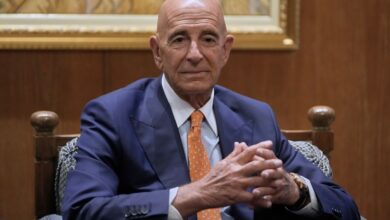
WASHINGTON — US Permanent Representative to NATO Matthew Whitaker said Washington expects its alliance allies to demonstrate stronger alignment on defense spending, Ukraine support, and broader security challenges at next weeks summit in Ankara.
Speaking to reporters on July 1, Whitaker signaled that tensions exposed by recent US military operations against Iran had eased within the alliance, even as he acknowledged disagreements over allied support during the campaign.
There is no doubt that the [US] President [Donald Trump] has expressed disappointment, Whitaker said, referring to some allies reluctance to provide base access and overflight permissions during the operation, as well as critical political statements that followed.
SEE ALSO:


Rubio’s Stark Warnings To NATO On Russia, Troops, And Alliance Strains
But he added that the alliance had moved beyond that period of friction.
Those days are past us, thankfully, he said, stressing that NATO members now better understand the importance of both political and military cohesion.
The comments underscore how the Iran conflict, alongside the war in Ukraine, is shaping the agenda of the Ankara summit, where leaders are expected to focus on defense spending, industrial capacity, and the alliances role in an increasingly volatile Middle East.
For the first time at a summit level, alliance leaders are scheduled to hold highly focused discussions on security challenges and political opportunities emanating from NATOs southern flank.
A special dedicated session will convene NATO leaders alongside representatives from four Gulf countries belonging to the Istanbul Cooperation Initiative, a key alliance partnership mechanism.
Turkish officials confirmed that the situation in the Gulf region will be “high up on our radar screen.”
In addition to discussing freedom of navigation through the Strait of Hormuz, alliance leaders are expected to use these dedicated sessions to conduct a comprehensive review of interconnected regional flashpoints, including Syria, Lebanon, Gaza, and the West Bank.
Turkey Pushes Diplomacy, Wider Regional Agenda
Turkish Deputy Foreign Minister Levent Gumrukcu, speaking separately at a policy forum organized by the Washington Institute for Near East Policy earlier this week, said Ankara would use the summit to press for stronger support for ongoing US-Iran diplomacy and wider regional stabilization efforts.
Turkey, which has sought to position itself as a regional mediator, said it wanted NATO to focus not just on military risks but also political opportunities across the Middle East.
Gumrukcu noted that Ankara hoped for a broader review of the region, describing the current situation as “highly fragile and volatile.”
Turkey has argued that its geography — bordering conflict zones from Ukraine to Syria and Iran — gives it a unique strategic role in helping NATO manage regional crises.
Defense Spending And Burden Sharing
In addition to Middle East security, Whitaker reiterated US expectations that all 32 NATO allies move toward a commitment to spend 5 percent of gross domestic product on defense, agreed at last years Hague summit.
He said some allies — including Poland, the Nordic countries, the Baltic states, and Germany — were leading efforts to meet or approach that benchmark, while others were lagging behind or lacked a credible path to reach it.
SEE ALSO:
‘Ambiguity Is Dangerous’: Don Bacon Warns Strains In Western Alliance Could Benefit Russia, Iran, And China
Since the Hague summit, Whitaker said allies had committed nearly $120 billion in additional defense spending, roughly half of which is being directed toward US-made equipment and systems.
The United States is not going anywhere, he said, but we have responsibilities globally.
He emphasized that NATOs focus must be on capabilities, not just spending levels, including air defense, precision strike systems, and unmanned technologies.
Ukraine Support And The PURL Mechanism
Whitaker said US support for Ukraine remains strong and ongoing, highlighting the PURL (Prioritized Ukraine Requirements List) mechanism under which NATO allies purchase US-made weapons and transfer them to Ukraine.
He said the program had already facilitated more than $6 billion in systems, including Patriot missile defense capabilities. He declined to preview specific announcements expected at the summit but said further commitments should be anticipated.
Addressing lingering questions about alliance unity following US operations against Iran, Whitaker said the campaign had highlighted gaps in allied military capabilities and political coordination.
He noted that some allies had critical niche capabilities, such as mine countermeasure systems, but said broader participation in major operations remained uneven.
He also cited US disappointment with some allies restrictions on base access and overflight permissions during the operation. However, he stressed that NATOs political and military relationships remained strong overall.
There is a deep military relationship, he said, pointing to decades of joint training and institutional cooperation among allies.
Whitaker confirmed that the United States is conducting a review of its military posture and basing in Europe, which he described as a routine but comprehensive assessment focused on global threats and operational requirements.
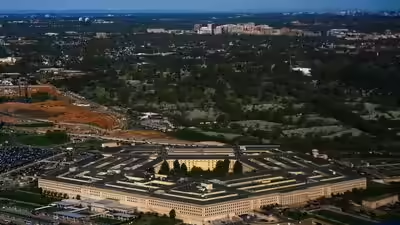
He said US troop levels in Europe had already been adjusted back to pre-2022 levels and that further reviews were under way, led by the Pentagon with input from US European Command and consultations with Congress and allies.
He emphasized that decisions would be driven by military needs and threat assessments rather than political considerations.
Outlook For The Ankara Summit
Whitaker said he expected the Ankara summit to mark continued progress on NATOs shift toward higher defense spending, stronger industrial capacity, and greater burden sharing.
He said the alliance must focus on producing more capabilities, including tanks, aircraft such as F-35s, air defense systems, counter-unmanned aircraft systems (UAS) technologies, and unmanned systems.
He also reiterated US support for allied efforts to expand defense production while cautioning against protectionist policies that could exclude non-EU allies.
Gumrukcu balanced this outlook from the European perspective, saying Europe could no longer rely excessively on Washington for its own defense.
We need to make NATO more European, he said, noting that Turkey’s host role at the gathering is meant to demonstrate Ankara’s growing role as a strategic bridge between NATOs eastern and southern fronts.
Looking ahead to the summit, Whitaker said he believed NATO was entering a new phase defined by measurable commitments rather than declarations.
This years summit is the next important step, he said, adding that the alliance would assess progress on defense spending and capabilities following last years Hague commitments.
He said he expected continued debate on burden sharing but expressed confidence the summit would reflect stronger alignment among allies.
US Envoy Whitaker Says NATO Has Moved Past Iran Operation Tensions
Share
Copy link
Facebook
X (Twitter)
LinkedIn
Email
Share
Share
Copy link
Facebook
X (Twitter)
LinkedIn
Email
Share
Follow us
Facebook
X (Twitter)
Youtube
Instagram
Follow us