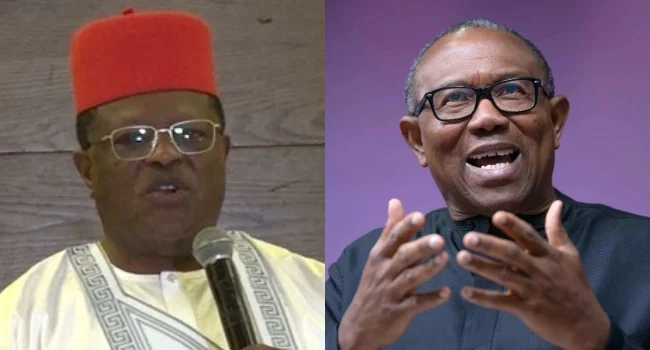
Minister of Works, David Umahi, has explained why he believes former Anambra State Governor and Labour Party presidential candidate in the 2023 election, Peter Obi, declined his invitation to a public debate.
Umahi said Obi avoided the proposed engagement because he knew he would not be able to defend his record when compared with his own achievements in public office.
The minister made the remarks in a statement released on Sunday through his Senior Special Assistant on Media, Francis Nwaze, while reacting to comments recently made by Obi regarding the challenge.
The disagreement stems from Umahi’s call for a public debate between both men, who served two terms each as governors of their respective states.
According to the minister, the proposed discussion was intended to focus on governance, leadership and the impact of their administrations on the lives of citizens.
Obi had earlier dismissed the invitation during an interview with media entrepreneur Chude Jideonwo. The former Anambra governor argued that presidential debates are meant for presidential candidates and not for individuals who are not contesting for the nation’s highest office.
He suggested that Umahi first become a presidential candidate before extending such an invitation. Obi also compared the situation to a football team that qualified for the FIFA World Cup being challenged by a team that did not qualify.
However, Umahi insisted that Obi misunderstood the purpose of the challenge.
According to the minister, the debate was never about political status, future ambitions or electoral contests. Rather, he said it was designed to give Nigerians an opportunity to assess the records of two former governors and determine whose administration delivered greater results.
“Many Nigerians expected what could have been one of the most consequential conversations on public service in recent times. Instead, Mr. Obi declined the invitation, explaining that he is currently a presidential candidate while Senator Umahi is not.
“Yet the challenge was never about electoral status. It was about accountability. It was about inviting two former governors to present their records before Nigerians and allow the public to judge whose leadership produced the greater impact.
“If governance is measured by performance, political ambition should not prevent an honest comparison of records,” the statement said.
Umahi further argued that his public service career extends beyond his years as governor of Ebonyi State.
The minister listed several positions he has occupied, including state party chairman, deputy governor, governor, Chairman of the South-East Governors’ Forum, Co-Chairman of the Southern Governors’ Forum, senator and Minister of Works.
He maintained that each role exposed him to increasing responsibilities and public scrutiny.
“By contrast, Peter Obi’s highest elective public office and entire experience has been Governor of Anambra State. Beyond that, he has not held any other executive or legislative public office. Not party chairman, not minister, and never a senator.
“At every stage, Umahi’s leadership was tested through elections, public scrutiny and increasing national responsibility,” the statement added.
The minister also pointed to infrastructure projects carried out during his administration in Ebonyi State. He cited roads, bridges, flyovers, schools, hospitals and other public facilities as evidence of what he described as measurable development.
He equally referenced ongoing federal road projects being executed under his supervision as Minister of Works, arguing that leadership should be assessed through visible improvements and completed projects.
Umahi took issue with Obi’s often-cited record of prudent financial management and savings during his time in office.
According to him, keeping funds in government accounts should not be considered a major achievement if it is not matched by significant infrastructure and development projects.
“Keeping money in the bank while leaving contractors unpaid and failing to complete meaningful, life-impacting projects cannot, by itself, be regarded as an achievement. Ultimately, leadership is measured by the tangible improvements it delivers to the lives of the people,” the statement said.
The minister also alleged that for most of Obi’s tenure as governor, Anambra State operated without democratically elected local government chairmen. He claimed caretaker committees were used until local government elections were eventually conducted close to the end of Obi’s administration.
Despite the disagreement, Umahi said he remains open to participating in a public debate on any credible platform.
He argued that anyone seeking to lead Nigeria must be willing to subject their record in office to public examination.
“One cannot credibly aspire to lead a nation as complex and demanding as Nigeria without a demonstrable record of performance as a governor.
“Likewise, it is difficult to convince Nigerians that you are prepared to challenge an administration led by a focused and determined President Bola Ahmed Tinubu when you are not even a match and cannot stand a debate with one of the key leaders of that administration on the basis of verifiable performance and achievements.
The statement by the minister concluded that, “Nigerians deserve the opportunity to evaluate records.”
What do you think about this?
Drop your opinion in the comment section.
FOLLOW US & Share this with someone who needs to see this.