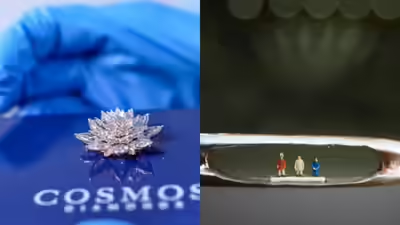
Spaceflight has carried everything from satellites and scientific instruments to memorial capsules and plant seeds beyond Earth’s atmosphere. Soon, another unusual payload will join that list. A specially engineered diamond is set to become the first of its kind to travel to space aboard Vikram-1, the maiden orbital launch vehicle developed by Indian private space company Skyroot Aerospace. While the payload may appear symbolic at first glance, its purpose is rooted firmly in science. The mission will examine how an advanced material performs in one of the harshest environments known, while also reflecting the growing ambition of India’s private space industry. As commercial spaceflight accelerates worldwide, even the smallest payloads can offer valuable insights into the technologies that could shape future missions.The launch will also carry Cosmos Diamonds’ artwork Cosmic Bloom alongside a remarkable micro-art creation by Ajay Kumar Mattewada. Crafted as an 18-carat gold rocket, the miniature artwork features microscopic sculptures of Sir C.V. Raman, Dr Vikram Sarabhai, after whom Vikram-1 is named, and Dr A.P.J. Abdul Kalam. Each sculpture is smaller than a grain of rice, combining art, engineering and India’s scientific legacy in a single payload.Skyroot Aerospace shared details of the unique payload on X ahead of the mission:
India’s Vikram-1 rocket to carry the world’s first diamond into space
The mission will carry Cosmos Diamonds’ Cosmic Bloom, making it the first known diamond artwork of its kind to fly aboard Vikram-1, Skyroot Aerospace’s inaugural orbital launch vehicle. Rather than being a ceremonial keepsake, Cosmic Bloom represents a fusion of art, innovation and advanced materials, symbolising India’s growing presence in commercial spaceflight while showcasing the potential of engineered diamonds beyond luxury.Diamonds are valued for far more than their brilliance. Laboratory-grown diamonds, in particular, have attracted increasing scientific interest because they combine exceptional hardness with outstanding thermal conductivity and resistance to extreme environments. These properties make them promising candidates for applications ranging from quantum technologies and radiation detectors to high-performance electronics, highlighting how a material long associated with jewellery is finding an expanding role in cutting-edge science and space research.According to NASA, materials sent into space must endure repeated thermal cycling, intense radiation, vacuum conditions and the powerful mechanical stresses generated during launch. Testing them in orbit provides engineers with performance data that simply cannot be reproduced completely in terrestrial laboratories.As NASA notes, space exposes materials to “radiation, vacuum and extreme temperatures”, making orbital testing an essential step in developing technologies for future spacecraft and satellites.
What makes Vikram-1 one of India’s most significant private rockets?

Vikram-1 marks an important milestone for India’s commercial space programme. Developed by Skyroot Aerospace, it is the company’s first orbital launch vehicle and one of the earliest privately built rockets designed to place satellites into low-Earth orbit from India.Named in honour of Vikram Sarabhai, widely regarded as the father of the Indian space programme, the rocket has been designed for the rapidly expanding small-satellite market. Its lightweight carbon-composite structure and modern propulsion systems are intended to reduce manufacturing time while offering customers a flexible and cost-effective launch option.The rocket also reflects a broader transformation within India’s space sector. Recent policy reforms have opened the door to greater private participation, allowing companies to develop launch vehicles, satellites and space technologies alongside government-led programmes.According to the Indian National Space Promotion and Authorisation Centre (IN-SPACe), encouraging private enterprise is central to expanding India’s commercial space capabilities and strengthening its presence in the global launch industry.
Why are diamonds attracting attention for future space technology?
Diamonds are becoming increasingly recognised as advanced engineering materials rather than just gems. The high efficiency of heat transfer of diamonds in comparison with many common materials renders them particularly suitable for use in electronic systems working in difficult conditions.Scientists explore the possibility of using synthetic diamonds in various aerospace applications, from quantum sensors to radiation-resistant electronics and optics. With the rising complexity of space vehicles and computing requirements, heat-conducting materials may become highly useful in the future.These investigations treat advanced materials as one of the important directions for future development of missions, realising that improvement of materials can result in lighter and more durable spacecraft. Even a single flight test may seem insignificant; however, every test brings one step closer to a larger picture.
How India’s private space industry is reshaping commercial launches
India’s space economy has entered a period of rapid change. What was once dominated almost entirely by government agencies is now evolving into an ecosystem where private companies are designing launch vehicles, manufacturing satellites and developing technologies for international customers.Skyroot Aerospace is among a new generation of firms aiming to make satellite launches more accessible for universities, research organisations and commercial operators. Demand for smaller, dedicated launch services has grown steadily as Earth observation, communications and scientific missions increasingly rely on compact satellites rather than a handful of large spacecraft.According to the Indian Space Research Organisation (ISRO), expanding private participation is expected to accelerate innovation, strengthen domestic manufacturing and improve India’s competitiveness in the global space economy. The success of missions such as Vikram-1 will therefore be measured not only by what they carry into orbit, but also by the confidence they inspire across the wider industry.
What challenges must advanced materials overcome in space?
Sending any new material into orbit is only the beginning. The conditions that spacecraft encounter once outside of Earth’s atmosphere are very different from those encountered by any object in terrestrial settings. There is wide variation in temperatures between the sunlit side and the dark side; there is high-energy radiation that causes material degradation, and there is a near-vacuum condition that impacts many other aspects.This is why technology demonstration projects are so important. Testing materials under real-world flight conditions allows engineers to test out their lab work before using new materials in actual spacecraft. Small-scale experiments could help develop better thermal protection and contribute to building long-lasting spacecraft that would work well in harsher conditions.If the spacecraft meets the project goals, then the journey of the diamond in Vikram-1 would be more than an interesting novelty. Another example of how breakthrough space technologies often start with incremental discoveries in material science will be presented.