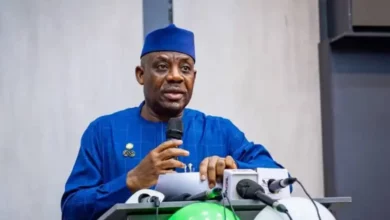
Bayelsa State Governor, Senator Douye Diri, has identified injustice, inequity and unfairness as major factors responsible for the challenges confronting Nigeria’s democracy.
Diri also called for the practice of true fiscal federalism and strict adherence to the rule of law, arguing that democracy would continue to struggle in Nigeria without fundamental reforms to the country’s political and economic structure.
The governor made the remarks on Tuesday while delivering a goodwill message at the 2026 Goodluck Jonathan Foundation Democracy Dialogue held at the International Conference Centre, Bauchi.
Speaking on the theme, “Beyond Elections: Can Political Parties and the Judiciary Save African Democracy?”, Diri said Nigeria had taken the wrong path in its democratic journey and needed to correct structural imbalances that had continued to undermine citizens’ confidence in the system.
He said democracy should be anchored on justice, equity and fairness, adding that the absence of these principles had created deep-seated grievances across the country.
According to him, the experience of Bayelsa State and the Niger Delta provided clear examples of what he described as injustice in Nigeria’s resource management and revenue allocation system.
Diri noted that more than six decades after crude oil exploration began in Oloibiri, Bayelsa State, the oil-producing communities had yet to experience development commensurate with the wealth generated from their resources.
He particularly cited Southern Ijaw Local Government Area, an oil-producing area that, according to him, remained without road access for decades despite its contribution to the national economy.
“It is ironical that at the end of every month, all our states go to Abuja to share oil money. I do not think that is what democracy is all about,” Diri said.
He said Southern Ijaw had remained without road access for more than 60 years until his administration constructed infrastructure to connect communities in the area.
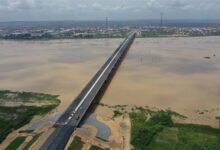
The governor disclosed that his administration also constructed a 630-metre bridge across a river to provide access to the headquarters of the local government area.
Diri also faulted the disparity in the number of local government areas across states and its implications for revenue allocation.
He noted that Bayelsa had only eight local government areas, while some other states had significantly more, yet revenue derived from resources in Bayelsa was distributed across the federation.
He described the situation as unfair and called for a restructuring of the country’s federal system to ensure greater equity in resource control and distribution.
“There is total injustice where my state has just eight local government areas. Some other states have 40 or more. But the resources from my state are shared to those local government areas from my eight,” he said.
According to Diri, the situation had persisted regardless of which political party or individual occupied the presidency.
“No matter who becomes president, this injustice and unfairness continue. Resources are being expropriated,” he said.
The governor argued that the challenges associated with resource exploitation were not limited to the Niger Delta, citing the discovery of gold in some northern states and the insecurity that had followed.
“Today, there is gold in Zamfara and other northern states. And what do we experience? Insecurity. Most of the insecurity has been traced to the discovery of gold in that far north,” he said.