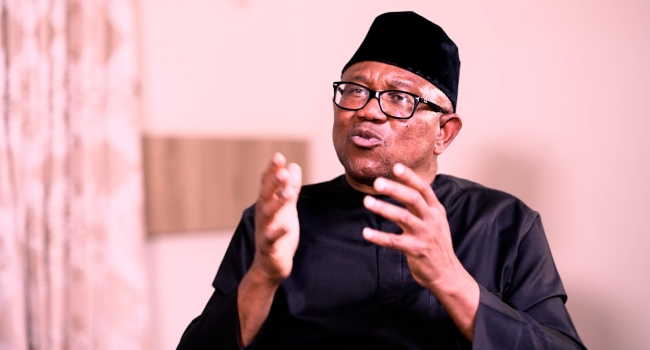
Former Anambra State governor Peter Obi has said he would have personally remained in Oyo State and taken charge of efforts to rescue dozens of abducted pupils and teachers if he were Nigeria’s president. His remarks have renewed debate over presidential leadership and the government’s response to mass kidnappings, although the victims were eventually freed through a joint security operation.
Obi, a leading opposition politician, criticised President Bola Tinubu’s handling of the crisis and argued that the country’s leader should have maintained a direct presence in the state until the captives were released.
The children and teachers were seized on 15 May 2026 when gunmen attacked three schools in Oriire Local Government Area of Oyo State. They remained in captivity for 56 days before security agencies announced their release on 10 July.
Obi said: “If I were President and 40 children were kidnapped, I would personally be in Ibadan until they were rescued.”

He argued that tackling insecurity requires one person to accept clear responsibility and coordinate the government’s response. He also claimed that Tinubu lacked the capacity to end Nigeria’s security crisis, a political judgment that the Presidency and the ruling All Progressives Congress are likely to dispute.
Related news
Obi attacks Tinubu’s response to Oyo school abduction
Obi said he had used a direct approach to security emergencies while serving as governor of Anambra State between 2006 and 2014.
He recalled a serious armed robbery incident during his administration and said the late President Umaru Musa Yar’Adua contacted him regularly until the matter was resolved, despite the two leaders belonging to different political parties.
The former governor presented that experience as an example of how a president should respond when lives are at risk.
According to him, national leadership during a security emergency should involve more than issuing instructions from Abuja. He argued that a president’s physical presence, constant communication and personal supervision could reassure affected families and pressure security agencies to produce results.
However, a president entering a forest personally would not normally form part of a professional hostage-rescue operation. Such missions require intelligence gathering, specialist personnel, surveillance and careful planning to avoid putting captives and security officers in greater danger.
Obi’s wider point appeared to be that he would have taken personal control of the political response and remained close to the affected communities until the victims returned.
His comments were reported by TheCable and followed weeks of public criticism over the length of time the children and teachers spent in captivity.
What happened during the Oyo school attacks?
Gunmen attacked Baptist Nursery and Primary School in Yawota, Community Grammar School in Esiele and L.A. Primary School on the morning of 15 May.
Earlier official accounts said 39 pupils and seven teachers were taken. Some of the children were very young, while the captives were believed to have been moved into the Old Oyo National Park and surrounding forest areas.
One teacher was killed during the original attack, while another, Michael Oyedokun, was later killed in captivity. The violence caused schools to close in several areas and led to protests by parents, teachers, campaigners and other Nigerians demanding urgent government action.
The size and difficult terrain of the national park complicated the search. Oyo State Governor Seyi Makinde said the wider area covered about 2,500 square kilometres and required intelligence, patience and coordination to avoid endangering the captives.
Tinubu later ordered the deployment of a specialised rescue unit and approved the recruitment of 1,000 forest guards in collaboration with the Oyo State Government. His administration said both military and non-military methods would be used to secure the victims’ freedom.
Joint operation secured victims’ release
The Nigerian Army said 44 pupils and teachers were freed after an intelligence-led operation involving more than 10 military, police, intelligence and local security organisations.
The operation included the Army, Navy, Air Force, police, Department of State Services, National Intelligence Agency, Nigeria Security and Civil Defence Corps, Amotekun, hunters and vigilante groups.
The Army said investigators targeted the kidnappers’ leaders, informants, supply routes and hideouts rather than launching an immediate assault on the suspected location of the hostages.
Multiple arrests in Oyo and other states reportedly disrupted the network and placed pressure on the captors to release the victims. Eight suspected kidnappers were taken into custody, while the Presidency said several others were killed during the operation. Those arrested remain suspects unless they are charged and convicted by a court.
Tinubu said no ransom was paid and no detained militant was released in exchange for the hostages. The authorities have not published every operational detail, which may be withheld for security reasons.
New Daily Prime previously reported how the 44 Oyo pupils and teachers regained their freedom, including the security agencies’ account of the month-long operation.
Security becomes major issue ahead of 2027 election
Obi’s criticism comes as insecurity becomes an important political issue ahead of Nigeria’s 2027 presidential election. Kidnapping gangs and armed groups have continued to target schools, farming communities, travellers and businesses. The Oyo attack was particularly alarming because it showed that large-scale school abductions, long associated with northern Nigeria, could also occur in the South-West.
Obi is expected to make security, government spending and leadership central parts of his political campaign. His supporters may view his remarks as evidence that he would provide more visible leadership during national emergencies.
His critics may argue that entering a forest or remaining at the scene does not itself guarantee a safe rescue and that political leaders must avoid interfering with sensitive security operations.
The successful release of the pupils and teachers also gives the Tinubu administration grounds to defend its approach. The operation took nearly two months, but the government says the victims were brought back without a ransom payment or a concession to the abductors.
The debate is therefore not simply about whether the rescue succeeded. It concerns whether the government acted quickly enough, communicated properly with the public and gave affected families sufficient assurance during the 56-day ordeal.
Obi’s statement is a political claim about what he would have done differently. It cannot be tested unless he holds presidential office, but it will add to public scrutiny of Tinubu’s security record as the next election approaches.
New Daily Prime: Read more Nigerian news and political coverage