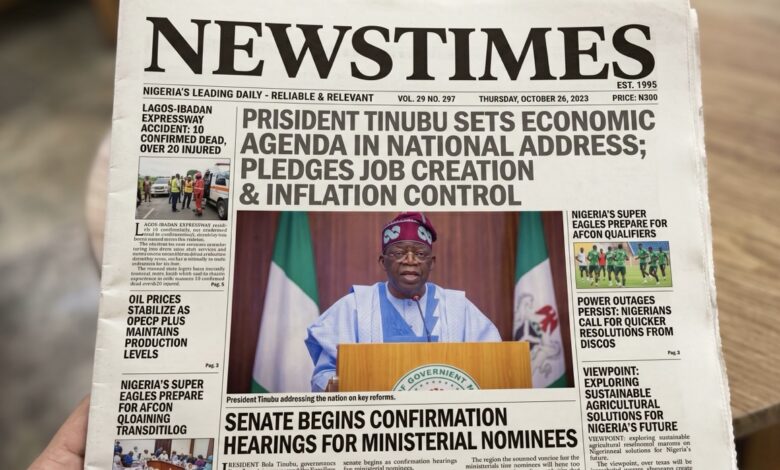
President Bola Tinubu on Thursday in Abuja said Nigeria’s refineries must return to productive use and generate value, as the Federal Government prepares to examine their structural, operational, financial and management problems.
Tinubu spoke at the State House when he received the National Executive of the Nigerian Union of Petroleum and Natural Gas Workers (NUPENG), led by its National President, Comrade Salimon Akanni Oladiti.
The President’s position gives profitability a central test in the planned refinery revival. He said simply seeing flames and smoke from a refinery would not prove that the facility was working properly.
READ RELATED NEWS
NNPC rejects claims it is selling refinery scrap

Nigeria’s refineries will never work, says Obasanjo
PETROAN applauds Dangote Refinery for securing Nigeria’s fuel supply amid global tensions
“The refineries that you mentioned are going to come back to work; we’re just building a very firm, resetting, and structural reworking of the economy of it. Ordinary flame and smoke of a refinery doesn’t mean that it’s working until it’s profitable and yields the value for which it is built,” Tinubu said.
His comments came after NUPENG asked the Federal Government to revive the country’s refineries.
Tinubu wants checks before refinery restart
Tinubu said the government would use research and technical assessments to identify the problems affecting the refineries before deciding how to fix them.
He said the review would cover structural, operational, financial and managerial issues. The government would then develop solutions that can support the facilities over time.
The President said the country had invested heavily in the refineries over many years and that they would not be allowed to waste away.
He also accepted responsibility for fixing the assets inherited from the previous administration.
“No matter what has happened in the years past, it’s now my responsibility as president to fix it and make it work for the greatest common good of our population. I take responsibility for that, and we will do it,” he said.
The refinery issue has also become important to NUPENG because the union represents workers in Nigeria’s petroleum and natural gas sector.
Oladiti asked Tinubu to sustain work towards bringing the refineries back into operation. He said functioning refineries would improve Nigeria’s energy security, reduce dependence on imported petroleum products and create more opportunities for Nigerian workers.
The NUPENG president also praised the removal of the fuel subsidy. He called it a courageous decision that had saved the country from decades of financial drain and depletion of national reserves.
He said the policy had freed resources for infrastructure and other parts of the economy.
NUPENG ties reforms to roads and workers
Oladiti pointed to the Lagos-Calabar Coastal Highway and the Sokoto-Badagry Superhighway as examples of major infrastructure projects under Tinubu.
The Lagos-Calabar Coastal Highway is 750 kilometres long, while the Sokoto-Badagry Superhighway is 1,068 kilometres, the union president said.
He said better roads were especially important to tanker drivers and other road users because poor roads can expose them to serious danger.
“For our members, a good road is the difference between arriving home safely and never arriving at all,” Oladiti said.
He also said every highway repaired or built could mean fewer accidents, fewer spillages, fewer deaths and less stress for drivers.
Tinubu also addressed local government autonomy, saying constitutional issues around its implementation were being reviewed for possible fine-tuning. He asked stakeholders for understanding.
The President promised NUPENG executives more inclusion in the implementation of the Presidential Initiative on Compressed Natural Gas, known as CNG.
He challenged the union to ensure that the benefits of CNG reach commuters.
Information and National Orientation Minister Mohammed Idris praised NUPENG for recognising what he called positive outcomes from the administration’s reforms.
Idris said the union’s position had helped reduce friction between trade unions and the government. He cited the removal of fuel subsidy and infrastructure construction as examples.
The NUPENG leaders later decorated Tinubu as the Grand Patron of the union.
Tinubu also recalled his relationship with the late Frank Kokori, a former NUPENG president, and said they struggled together for Nigeria’s democratic system.
For More News Details, Visit New Daily Prime.