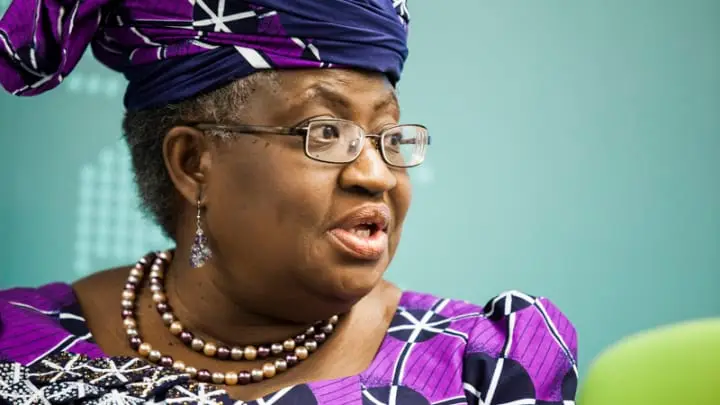
The Director-General of the World Trade Organisation (WTO), Ngozi Okonjo-Iweala, has lamented the poor maintenance culture in Nigeria, saying the country cannot achieve meaningful development by relying only on its natural resources and budgetary allocations.
Naijaonpoint reports that Okonjo-Iweala stated this on Monday while delivering the keynote address at the 2026 Delta State Economic and Investment Summit in Asaba.
The summit, themed “Harnessing Our Strengths, Unlocking Our Potentials,” brought together key stakeholders to explore investment opportunities and ways to strengthen the state’s economy.
Speaking on the need for proper planning and effective implementation of development projects, the WTO Director-General said Nigeria must improve its maintenance culture to preserve infrastructure and sustain economic growth.

She said having natural resources and allocating funds in the annual budget would not automatically translate into good roads, infrastructure or economic development without proper execution and maintenance.
“The fact is that endowments alone do not add value. Budgetary allocations alone do not lead to new roads or good maintenance.
“We lack a maintenance culture in the country. I have to say that. I’m Nigerian but we need that.
“We need better ports and digital infrastructure, and lower trade costs. Execution is what matters, and successful execution requires focus. It requires prioritisation,” she said.
Okonjo-Iweala challenged the Delta State Government to position the state as a global destination for skilled workers, manufacturing and investment.
She said the state had the natural resources, strategic location, infrastructure and human capital needed to emerge as one of Nigeria’s leading industrial centres.
The WTO chief urged the state to create an environment where businesses could grow, industries could compete internationally and young people could develop the skills needed to take advantage of new economic opportunities.
“Delta State should aspire to become a global destination for skilled labour, manufacturing, and investment by creating an ecosystem where industries can thrive, talent can flourish, and businesses can compete internationally,” she said.
Okonjo-Iweala commended the state Governor, Sheriff Oborevwori, for introducing a $100m Viability Gap Fund designed to reduce investment risks and attract private capital into the state.
She described the initiative as a practical step that could help turn investment commitments into actual projects and create more economic opportunities for residents.
She said the fund could help build confidence among investors and encourage private sector participation in the state’s development.
The WTO Director-General urged the Delta State Government to prioritise investments in Special Economic Zones, industrial infrastructure, agriculture, the blue economy, oil and gas, digital technology and artificial intelligence.
However, she advised the state not to spread its resources too thinly across too many sectors.
Instead, she urged the government to identify and focus on a few strategic value chains where Delta had clear advantages and could compete effectively.
She also stressed the need to improve infrastructure, regulatory processes and energy supply to support industrial development and attract local and foreign investors.
Okonjo-Iweala noted that the global economy was facing uncertainties caused by geopolitical tensions, climate-related shocks and disruptions to international supply chains.
However, she said these challenges were also creating new opportunities for countries and regions that were ready to diversify their economies and become part of global value chains.
She said the growing global interest in supply chain diversification, together with the implementation of the African Continental Free Trade Area, presented Delta State with an opportunity to attract industries looking for stable and competitive investment destinations.
Delta, FG Must Work Together
The WTO boss also called for stronger cooperation between the Delta State Government and the Federal Government.
According to her, while the Federal Government is responsible for providing macroeconomic stability and creating national policies, state governments must provide the right environment for businesses to operate, expand and create jobs.
She pointed to the Lekki Free Zone in Nigeria and the Glo-Djigbé Industrial Zone in the Benin Republic as examples of industrial zones that Delta State could study and learn from in developing globally competitive Special Economic Zones.
Okonjo-Iweala said Delta must take advantage of its current position and resources to transform its economy and reduce overdependence on natural resources.
The WTO Director-General said the state was at a critical point in its development journey and had the opportunity to build a diversified and resilient economy capable of competing with other economies around the world.
She expressed confidence that with proper planning, focused investment and effective execution, Delta could become a model for economic development in Nigeria and Africa.
“I am confident that Delta State can, and will transform itself from a resource-rich state into a diversified, competitive, resilient, and inclusive industrial economy that serves as a model for Nigeria and the wider African continent,” Okonjo-Iweala concluded.