The All Progressives Congress (APC) governors have drawn a firm line against political arrangements outside the ruling party and declared that they will not back candidates or structures capable of competing with the APC ahead of the 2027 general elections.
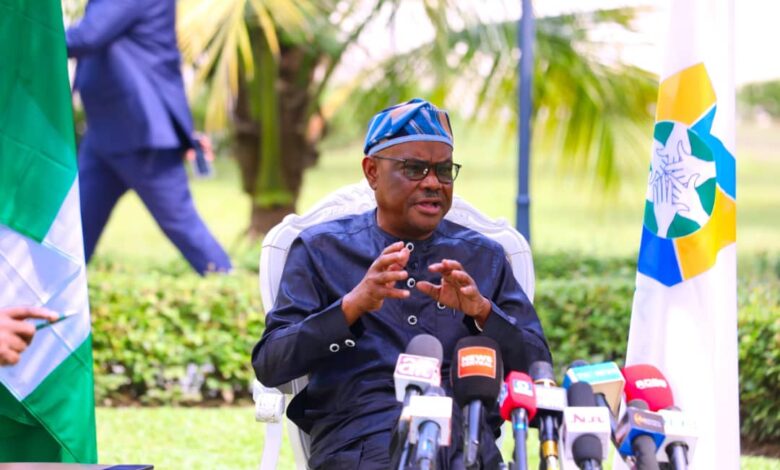
The position places the governors on a collision course with the political machinery associated with the Minister of the Federal Capital Territory, Nyesom Wike, whose Rainbow Coalition has attracted politicians from different parties while publicly presenting President Bola Tinubu’s re-election as one of its central objectives.
Chairman of the Progressive Governors Forum and Imo State Governor, Hope Uzodimma, announced the governors’ position after a high-level meeting at the Imo State Governor’s Lodge in Abuja on Monday night.
The governors resolved that they would not participate in, endorse or support any alliance capable of weakening the APC or jeopardising Tinubu’s return to office.


“The APC Governors Forum unanimously resolved that its members will not participate in, support or endorse any alliance or political arrangement capable of undermining the re-election of Mr President, weakening the APC or adversely affecting any candidate of the party at all levels,” Uzodimma said.
He stated that the governors’ campaign machinery would be dedicated to candidates sponsored by the APC.
“In other words, the forum has no intention to support any candidate at any level that is not an APC candidate because our candidates who are contesting the election are being sponsored by our party,” he said.
Uzodimma added that the governors would coordinate their campaign activities with the President and the strategic objectives of the party.
“The governors’ campaign commitment is exclusively to all APC candidates. All levels of the party campaign architecture will align with the expectations of Mr President and the strategic objectives of the party,” he said.
A message with Wike in the background
Although Wike was not named in the governors’ declaration, the timing has given the statement an obvious political context.
Wike is a registered member of the Peoples Democratic Party (PDP) but has been associated with a cross-party coalition that has attracted politicians opposed to the PDP’s internal direction. He has also maintained that the Rainbow Coalition is designed to support Tinubu’s 2027 presidential bid.
That arrangement creates a peculiar political equation.
The coalition can support Tinubu while simultaneously operating outside the APC’s formal structure. Meanwhile the governors’ resolution points to the fact that they want the President’s re-election effort anchored firmly within the party’s own campaign architecture.
The distinction could become significant as the election approaches, particularly in states where politicians are divided over whether to prioritise party loyalty or coalition strategy.
Governors take ownership of Tinubu campaign
The governors’ declaration also goes beyond rejecting rival structures. They have positioned themselves as central players in Tinubu’s re-election campaign across their respective states.
That commitment gives the state executives a direct role in mobilising party machinery, coordinating campaigns, and defending APC candidates at federal and state levels.
It also seeks to eliminate ambiguity over where governors elected on the APC platform should place their political allegiance.
Uzodimma, who had previously been accused by Wike of sponsoring political attacks against him, used the meeting to reinforce the forum’s collective position rather than responding to the allegation personally.
The governors’ stance could therefore intensify the contest over political structures before the 2027 campaign gathers full momentum.
Coalition politics enters new phase
Nigeria’s emerging 2027 political landscape is continuously shaped by alliances that cut across established party boundaries.
The Rainbow Coalition is one expression of that realignment. Its supporters present it as a platform capable of bringing together politicians from different camps around a common presidential objective. The APC governors, however, insist that support for Tinubu must operate through the party that nominated him.
That disagreement, as it appears, is not just about party labels. It concerns who controls the machinery that converts presidential support into votes at ward, local government, and state levels.
A parallel campaign structure can attract politicians, resources, and grassroots networks that would otherwise feed directly into the ruling party’s organisation. The governors’ warning suggests they see such competing channels as a potential source of divided loyalty within the APC.
With the 2027 election approaching, the struggle over campaign architecture could become as consequential as the contest for individual candidacies.
The APC governors have now made their position explicit: support for Tinubu must go hand in hand with support for APC candidates.
How Wike’s coalition responds to that boundary, and whether its members can operate alongside the party’s official structure without friction, may shape one of the most closely watched political alignments ahead of 2027.
READ RELATED NEWS UPDATES