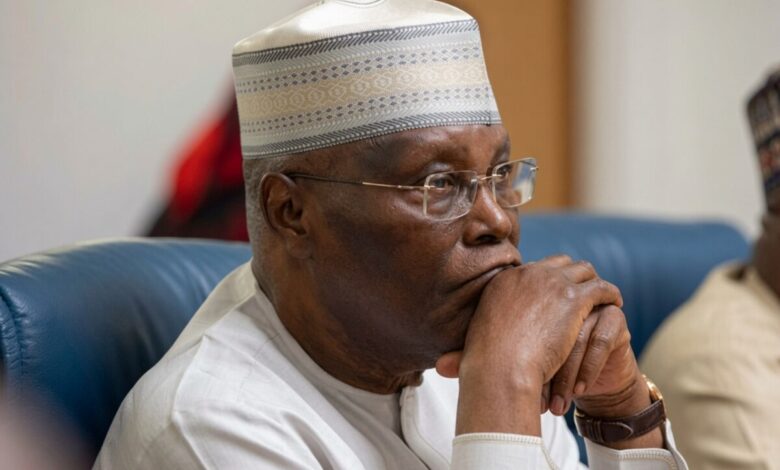
Former Vice-President Atiku Abubakar has criticised the Federal Government’s N24.7tn domestic borrowing between January and August 2026 where he said the surge is depriving Nigerian businesses of credit despite higher crude oil prices and improved government revenues.
Atiku, in a statement issued on Monday by his Senior Special Assistant on Public Communication, Phrank Shaibu, questioned why the administration of President Bola Tinubu was borrowing heavily when the price of crude had climbed above the $64.85 per barrel benchmark used for the 2026 budget.
He disclosed that government borrowing during the eight-month period was 90.5 per cent higher than the N12.98tn recorded in the corresponding period of 2025.
The former vice-president described the situation as evidence of what he called dangerous fiscal indiscipline.

“At the beginning of this fiscal year, the federal government budgeted on an oil benchmark of $64.85 per barrel. Today, crude oil prices have risen substantially above that benchmark,” Atiku said.
“Yet, instead of this windfall translating into lower borrowing, stronger businesses and relief for Nigerians, the federal government went into the domestic market and borrowed a staggering N24.7 trillion between January and August 2026.”
He also questioned what had happened to the money saved from fuel subsidy removal. He noted that the government had presented the policy as a measure that would free funds for other priorities.
According to Atiku, the naira’s flotation also produced a substantial nominal increase in government revenues, while stronger crude prices have provided another source of earnings.
“Oil prices have risen sharply. Revenues have improved. Yet the borrowing has not gone down, it has exploded,” he stated.
However, his central concern was the effect of government borrowing on businesses seeking funds to operate and expand.
Atiku cited figures showing that credit to the government increased by 43 per cent, compared with 9.6 per cent growth in lending to the private sector. He said the disparity meant public-sector borrowing was expanding about 4.5 times faster than credit available to businesses.
He maintained that the health of the private sector should be a key measure of whether economic reforms are producing results.
“If businesses are expanding, investing, hiring and gaining easier access to capital, then reform can claim some measure of success.
“But under Tinubu’s economic policy, the exact opposite is happening,” he said.
Atiku explained that banks could prefer lending to government because sovereign borrowing offers comparatively attractive and less risky returns. That preference, he said, leaves manufacturers, farmers, and entrepreneurs facing expensive credit.
“When banks can lend to the government at attractive, risk-free rates, why would they lend cheaply to the manufacturer in Aba, the furniture maker in Kaduna, the agro-processor in Kano or the young entrepreneur in Lagos?” he asked.
He linked the resulting pressure to postponed expansion, struggling factories, lost employment, and higher production costs.
“This government is not merely borrowing money; it is borrowing away the future of Nigerian businesses,” Atiku stated.
He pledged that his administration would impose fiscal discipline, reduce waste, prioritise productive expenditure, and gradually lessen government dependence on domestic borrowing.
“After three years of sacrifice, Nigerians deserve to see what happened to the subsidy savings, the additional revenues and the crude-oil windfall,” he said.
Meanwhile, the African Democratic Congress (ADC) has opened a separate front over the management of social intervention funds, following an Auditor-General’s finding that N33.75bn in cash transfers to 3.29 million households could not be verified.
The party’s National Publicity Secretary, Bolaji Abdullahi, said the finding was evidence of serious abuse of funds intended for vulnerable Nigerians and called for a full investigation.
The ADC demanded publication of the complete beneficiary register, the REMITA payment trail, and the identities of officials who allegedly obstructed the audit.
It also questioned the government’s announcement of a new $1bn Renewed Hope Social Protection Programme. It argued that transparency must accompany any fresh intervention.
The twin criticisms place government borrowing and social spending under scrutiny, while opposition figures demand clearer evidence of how increased public revenues are being deployed.
READ RELATED NEWS
Tinubu, Atiku clash over who should bear cost of economic reforms
Atiku vows to reopen borders, cut North’s cargo delays
ADC insists on independent judicial panel over PFIPC scandal