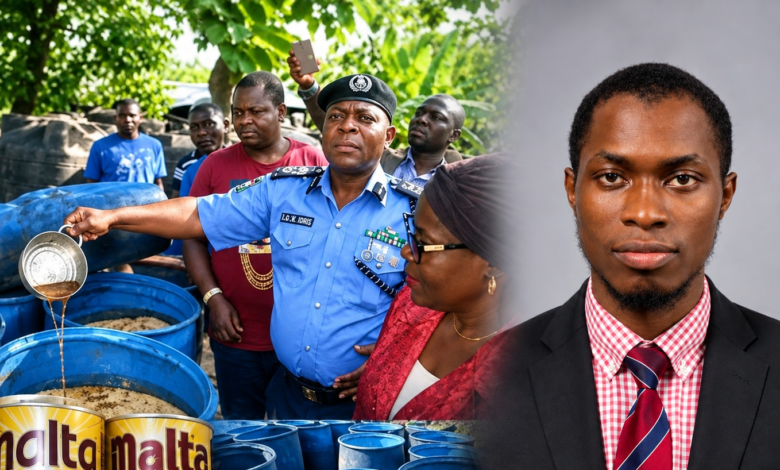
Nigeria’s growing exposure to fake and adulterated consumer products has become too serious to be treated as another scandal that fades from public attention after a few days, Medical Laboratory Scientist and Health Communicator, Ibraheem Olasunkanmi Qoseem, has warned.
Qoseem, writing on the proliferation of allegedly unsafe products, said recent revelations involving sachet water, palm oil, beverages and medicines had exposed vulnerabilities that could put consumers at risk.
He said the crisis had unsettled Nigerians, many of whom were now forced to scrutinise everyday products before consuming them.
“Fake or original, we are increasingly left with personal discretion and fate because, to the ordinary consumer, the difference is often difficult to determine,” he wrote.


The concern, he noted, extends across products that households use routinely, including drinking water, cooking oil, toothpaste, medicines and alcoholic and non-alcoholic beverages.
Qoseem said the situation was particularly troubling because some of the questionable products were allegedly manufactured, repackaged or rebottled locally rather than entering the country solely through import channels.
He cited recent social media reports showing the manual production of sachet water, the addition of Sudan dye to palm oil to alter its appearance and the rebottling of beverages in unhygienic facilities.
Such practices, he maintained, should not be reduced to isolated cases of counterfeit goods. They point to weaknesses in the systems responsible for protecting consumers from products that could compromise health.
The health communicator also warned about the possible consequences of consuming poorly manufactured or adulterated goods. He noted that products made under unhygienic conditions can expose consumers to health hazards, while inappropriate chemical substances and substandard medicines can interfere with treatment and produce harmful effects.
He questioned the tendency for public outrage to subside once an offending product is identified and regulatory agencies issue statements.
“Nigerians are angry. Social media is buzzing. Authorities have issued statements. A few days later, the noise dies down. Then we move on. Until another fake product appears,” he wrote.
Qoseem called for stronger action from regulatory and law-enforcement institutions, particularly the National Agency for Food and Drug Administration and Control (NAFDAC) and the National Drug Law Enforcement Agency (NDLEA).
He said accountability should not stop at the seizure of suspect products or public announcements. Authorities should also strengthen surveillance, investigate offenders, prosecute violations and publish information on the outcome of enforcement actions.
He further called for state governments to treat consumer safety as a public-health responsibility rather than an issue handled exclusively by federal agencies.
Qoseem proposed a coordinated mechanism involving relevant regulatory bodies and government authorities to tackle counterfeit and adulterated consumables.
He also encouraged members of the public to report suspicious products through appropriate channels instead of treating each discovery as another passing controversy.
The writer acknowledged that Nigerians had repeatedly endured difficult national circumstances and eventually resumed their daily lives. He, however, drew a distinction between crises that can be absorbed through adaptation and a threat that may directly affect what people eat, drink and use for treatment.
“This is a matter of life and death,” he stated.
He, in his conclusion, called for sustained public attention until effective action is taken.
READ RELATED NEWS UPDATES
NAFDAC uncovers Chinese network behind Nigeria’s fake goods trade
NAFDAC raids warehouse, seizes fake products worth N3.8b
Fake goods flood markets as regulators face fresh scrutiny
‘Any sickness I can’t treat in Nigeria should better kill me’ — Sowore