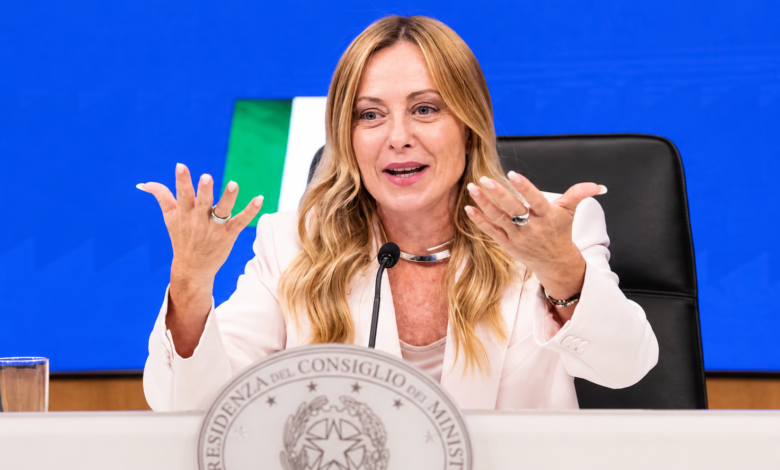
Italian Prime Minister Giorgia Meloni has announced plans to ban burqas and niqabs in schools, limit the number of foreign pupils in individual classrooms and require some migrant parents to learn Italian. The measures are not yet law, and important details — including the proposed classroom cap — have not been finalised.
The proposals could affect immigrant families across Italy, including Nigerians living in the country, if approved by parliament. Parents should note that there is no immediate new restriction on school places while the government prepares the legislation.
Meloni announced the measures on Sunday at an event organised by the youth wing of her Brothers of Italy party. She said the government wanted schools to promote integration while preventing situations in which Italian pupils become a minority in individual classrooms.
What Meloni’s school proposals would change
Under the planned measures, the government intends to set a legal maximum for the number of pupils without Italian citizenship who can be placed in one class.

Meloni has not yet announced what that percentage would be. Italy already has an Education Ministry guideline recommending that foreign pupils should generally account for no more than 30 per cent of a class, but school leaders say the limit has proved difficult to apply, particularly in neighbourhoods with large immigrant populations.
School heads have questioned what would happen when children live close to a particular school but the proposed limit has already been reached.
Antonello Giannelli, president of Italy’s National Association of Head Teachers, said the underlying educational issue could be understood but warned that implementation would be difficult because schools must accommodate children living in their local area.
The government also intends to require parents of foreign pupils experiencing serious problems integrating at school to learn Italian.
Education Minister Giuseppe Valditara has argued that language skills are essential to educational achievement and integration, while saying policies should also prevent discrimination and marginalisation.
Burqa and niqab ban planned for schools
A second part of the package concerns face coverings.
Reports from Reuters and the Associated Press say the government intends to prohibit the burqa and niqab in schools. Both cover much more of the face than the hijab: the hijab generally covers the hair and neck while leaving the face visible. The AP reported that the proposed measure does not cover the ordinary hijab.
Meloni said pupils should attend school with their faces visible and linked the policy to her government’s position on integration and equality between men and women.
The practical scale of the issue appears relatively small. ANSA cited an estimate from education publication La Tecnica della Scuola suggesting roughly 500 to 600 foreign female pupils could wear a burqa in Italian schools — around one student for every 660 classes. That figure is an estimate rather than an official government count.
Nearly one million foreign pupils in Italian schools
Italy has about 930,000 pupils without Italian citizenship, representing approximately 11.6 per cent of the country’s school population, according to figures reported by ANSA from the ISMU Foundation.
Importantly, many are not recent arrivals. About 65.2 per cent — more than 607,000 pupils — were born in Italy, highlighting how nationality and place of birth are not necessarily the same thing when discussing “foreign pupils”.
Lombardy has the largest number, followed by Emilia-Romagna, Veneto, Lazio and Piedmont. Milan, Rome and Turin have some of the country’s biggest populations of pupils without Italian citizenship.
The government argues that spreading pupils more evenly and improving language skills could help integration. Critics, however, question whether numerical limits would work in areas where migrant families are concentrated.
Save the Children warned that imposing a percentage cap could stigmatise children and create further school segregation, particularly if pupils born in Italy continue to be classified as foreign solely because of their citizenship. The organisation argued that improving educational support would be more effective than relying only on numerical thresholds.
Italian President Sergio Mattarella, without directly deciding the government’s policy, also stressed the importance of schools as places of integration. He said schools should help prevent ghettos and barriers and promote social cohesion.
Proposal must still become law
The most important point for families is that Meloni has announced a legislative proposal, not an immediate ban already operating across Italian schools.
The government has been preparing the measures as a bill, with ministers expected to consider the package before it goes through Italy’s legislative process. The exact classroom limit and detailed implementation rules therefore remain subject to the final text and parliamentary approval.
For Nigerian families living in Italy, this means there is no reason to assume that a child will automatically lose a school place because of the announcement. The effect will depend on the eventual legislation, its definition of a “foreign pupil”, the percentage set for each class and any exemptions or transition arrangements.
For continuing European and diaspora coverage, visit NewDailyPrime.
Related news
Foreign pupils turn away from UK private schools as visa numbers fall
Migrants may be denied asylum in UK under proposed France deal
Muslim groups reject Edo’s handover of schools to Catholic Church
Italian man found guilty of attempted rape on airline