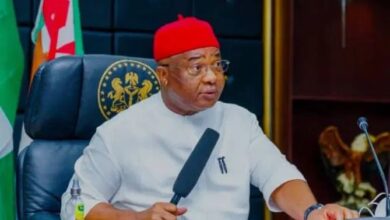
For his transformative leadership in Edo State, marked by bold reforms in education, healthcare delivery, and a decisive security crackdown, including stronger laws against cultism and kidnapping, special security squads, and the construction of more than 100 schools, Senator Monday Okpebholo is the Governor of the Year 2026.
Born on August 1, 1977, in Udomi, Esan Central Local Government Area of Edo State, Senator Monday Okpebholo has emerged as one of the most closely watched political leaders of his generation. His transition from the private sector to national and ultimately state leadership has been marked by an expanding commitment to public service, development and institutional renewal.

A Business Administration graduate of the University of Abuja, Okpebholo has also completed his master’s thesis in Governance and International Relations at the same institution. His political ascent gathered momentum in February 2023, when he was elected to represent the Edo Central Senatorial District on the platform of the All Progressives Congress (APC). He was inaugurated into the 10th National Assembly on June 13, 2023, bringing his private-sector experience and political outlook to national legislative responsibilities.
His ambition to serve Edo State on a broader scale, however, culminated in his election as governor. On November 12, 2024, Okpebholo assumed office at a time when the state faced considerable challenges, particularly in security, infrastructure and human capital development.
Security was among the most pressing concerns. Cultism, kidnapping and other violent crimes had fuelled widespread anxiety across several parts of the state. Benin City, Ekpoma, Auchi and other communities had witnessed disturbing incidents of cult-related killings, kidnappings and criminal activity, threatening both public confidence and economic activity.
Governor Okpebholo’s response was swift and uncompromising. Within weeks of taking office, he convened a security council meeting and issued a 48-hour ultimatum to the Commissioner of Police to halt the bloody cult clashes. The message was clear: the new administration would not allow criminal elements to dictate the climate of life and commerce in Edo State.
Beyond rhetoric, the administration moved to strengthen the legal and institutional framework for combating crime. It signed into law the Secret Cult and Similar Activities (Prohibition) Law, 2025, and the Kidnapping Prohibition (Amendment) Law, 2025. The legislation introduced tougher sanctions for those involved in cultism, kidnapping and related offences, and also targeted individuals accused of harbouring, sponsoring or supporting criminal networks.
The administration further established a Special Security Squad, Operation Flush Out Kidnappers and Cultists, to coordinate intelligence-gathering and enforcement operations. In its early operations, the squad reportedly arrested more than 20 suspects in Benin City and conducted raids in areas including Isiohor, Iguosa, Oluku and Ibiwe/Lagos Street.
The offensive also targeted properties allegedly used as hideouts by kidnappers or as meeting points for cult groups, with several such structures demolished. Recognising that arrests alone cannot guarantee lasting security, the governor also advocated faster judicial processes for serious security-related offences and sought the establishment of special courts to expedite the trial of kidnapping and cultism cases.
Education is another major pillar of the administration. The government inherited public schools burdened by infrastructure deficiencies and staffing shortages. In response, it embarked on the construction of more than 100 schools and recruited 6,000 teachers to address staffing gaps across the public education system.
The intervention recognises that Edo State’s long-term prosperity will depend substantially on the quality of its human capital. By combining investment in school infrastructure with large-scale teacher recruitment, the administration has sought not only to expand access to education but also to strengthen the foundations of sustainable learning.
At the tertiary education level, Governor Okpebholo has made substantial financial commitments to state-owned institutions. The monthly subvention to Ambrose Alli University, Ekpoma, was increased from N41 million to N500 million, while Edo University, Iyamho, received an increase from N25 million to N250 million. These measures aim to address longstanding challenges in institutional administration, academic infrastructure and student welfare, and to strengthen the role of higher education in producing the skilled workforce required for Edo’s future.
Infrastructure has become one of the most visible features of the administration. The government has embarked on major road projects, drainage works and flyover construction, including projects around Ramat Park and Aduwawa. Okpebholo has also shown a preference for direct oversight, personally visiting project sites to assess progress and reinforce his administration’s emphasis on delivery.
The development agenda extends beyond roads and public buildings. The state procured 100 new interstate buses to revive public transport under the rebranded New Edo Line, and tractors were acquired to support agricultural production across the three senatorial districts. These investments address two key development challenges: the need for more reliable public transport and greater mechanisation in agriculture.
Energy has also been prominent, with the launch of a 100-megawatt electricity project for Edo Central. For a state seeking to deepen agricultural production, attract investment and stimulate industrial activity, reliable electricity remains an indispensable foundation for sustainable economic growth.
Since assuming office on 12 November 2024, Governor Monday Okpebholo has pursued an agenda encompassing security, education, infrastructure, transport, agriculture and energy. His approach has sought to combine policy pronouncements with implementation, resource commitment and direct supervision.
He has paired stronger legislation with aggressive enforcement, combined school construction with teacher recruitment, significantly increased funding for tertiary institutions, and pursued road, drainage, transport, agricultural mechanisation, and energy projects.
For a state facing serious security, infrastructure and human capital challenges, the first phase of the Okpebholo administration has been characterised by urgency, visible intervention and a determination to direct government attention to areas of greatest need.
The breadth of these initiatives, together with the administration’s focus on turning commitments into concrete projects, makes Senator Monday Okpebholo a compelling choice for the Governor of the Year 2026 award.
His record is one of consequential governance at a time when Edo State required decisive leadership, bold intervention and a demonstrable commitment to improving the lives and prospects of its people.