An SNP MSP has suggested the party should consider boycotting Westminster if Prime Minister Andy Burnham continues to refuse another Scottish independence referendum, opening a new front in the dispute over Scotland’s constitutional future.
Steven Bonnar, the MSP for Uddingston and Bellshill and a former Westminster MP, said SNP politicians should examine whether refusing to take their seats in the House of Commons could be used to increase pressure on the UK Government. He pointed to Sinn Féin’s long-standing policy of abstention from Westminster as an example.
However, the proposal is not SNP policy, and the party leadership has not announced plans for its MPs to stop attending Parliament.
Bonnar said “nothing should be off the table” if the deadlock over another referendum continues. He also acknowledged that Scotland and Northern Ireland have different constitutional arrangements.

His intervention comes as First Minister John Swinney increases pressure on Burnham to establish a legal route for another vote on Scottish independence.
Swinney presses Burnham for legal referendum route
Swinney wrote to the Prime Minister on 10 September, asking for talks on creating a legal mechanism that would allow Scotland to hold another independence referendum.
The Scottish First Minister seized on remarks made by Burnham about constitutional votes, arguing that if the principle of holding a vote where there is clear public demand applies to Northern Ireland, Scotland should also have a route to make such a choice.
The Scottish Government has also published a draft Independence Referendum Bill and says it intends to continue pursuing a lawful vote. Its 2026–31 Programme for Government states that ministers will make the case for Scotland to decide its constitutional future through a legal referendum.
Burnham, however, has resisted calls for another immediate referendum and has focused his government on issues including living costs and public services.
The disagreement is important because the Scottish Government cannot simply organise an independence referendum with legal effect on its own under the current constitutional settlement.
In 2022, the UK Supreme Court ruled that legislation for a Scottish independence referendum relates to matters reserved to Westminster. Before the 2014 referendum, the UK and Scottish governments agreed a temporary transfer of powers under Section 30 of the Scotland Act to allow the vote to proceed lawfully.
That means any new referendum would need a lawful route involving Westminster unless the constitutional framework itself changes.
Boycott proposal would mark major SNP strategy shift
If the SNP adopted Bonnar’s suggestion, it would represent a significant change in the party’s approach to Westminster.
SNP MPs currently take their seats in the Commons, vote on legislation and use Parliament to press the UK Government on Scottish issues.
Sinn Féin takes a different approach. Its MPs follow a policy of abstention and do not take their seats at Westminster.
Bonnar argued that the SNP should at least consider whether a similar tactic could strengthen its hand if the UK Government continues to reject another independence vote.
But there is an important distinction between one MSP raising the idea and the SNP formally adopting it. No announcement has been made that SNP MPs will boycott Westminster.
For that reason, describing the development as the SNP already “threatening to boycott Westminster” would go further than the available evidence. The more accurate position is that Bonnar has raised abstention as an option that he believes should be considered.
Cardiff summit adds pressure over future of UK
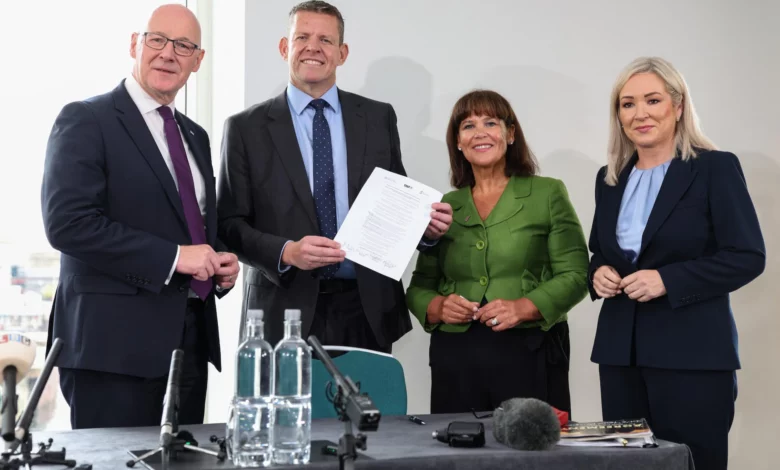
The row comes days after political leaders from Scotland, Wales and Northern Ireland met in Cardiff and signed a memorandum supporting the right of their nations to determine their constitutional futures.
Swinney, Welsh First Minister Rhun ap Iorwerth and Sinn Féin figures used the meeting to argue for greater control over constitutional decisions. The agreement increased pressure on Westminster but did not itself trigger any referendum or change the constitutional status of Scotland, Wales or Northern Ireland.
NewDailyPrime previously reported on the Cardiff agreement and the growing debate over the future of the United Kingdom. Read NewDailyPrime’s report on the UK independence push
Scotland last voted on independence in September 2014. Voters chose to remain in the United Kingdom by 55.3 per cent to 44.7 per cent, on a turnout of 84.6 per cent.
The political argument since then has centred not only on whether Scotland should become independent, but also on who should decide when another referendum can be held.
For Swinney and the Scottish Government, the issue is one of Scotland’s right to choose. For the UK Government, the question includes whether there is sufficient public support to justify reopening the constitutional issue.
Bonnar’s intervention adds another possible tactic to that dispute, but it remains a proposal rather than a decision by the SNP.
Related news
UK independence push: Scotland, Wales, Northern Ireland leaders unite for self-determination
Andy Burnham takes Labour leadership — Can he deliver?
Burnham under scrutiny over taxpayer-funded jet trip to Manchester