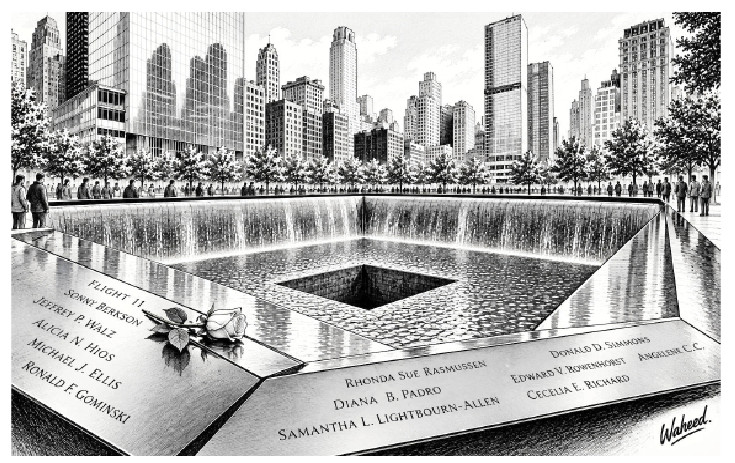
Twenty-five years ago, the world changed in a matter of hours. But perhaps the most enduring legacy of September 11, 2001, is not only what happened in New York, Washington or Pennsylvania; it is what happened afterwards, quietly and incrementally, to people all over the world who were nowhere near the World Trade Centre.
The 9/11 attacks killed 2,977 people, but their consequences reached billions. They changed how we travel, how governments watch us, how borders operate, how intelligence agencies share information, how Muslims are perceived, how nations define threats and, increasingly, how much privacy ordinary citizens are willing to surrender in exchange for the promise of security.


The anniversary coverage understandably remembers the victims and examines the wars that followed. Yet there is another story worth telling: the story of the ordinary citizen who gradually entered a world where security became a permanent condition of everyday life.
The world did not merely build stronger security systems after 9/11; it built a world organised around the expectation of danger.
The Day Security Came Home With Us
Before 9/11, airport security was something many travellers barely noticed. Today, the airport is a ritual of compliance. Remove your belt. Take out your laptop. Empty your pockets. Explain the bottle. Submit to scanning. Stand in line. Present identification. Repeat.
The changes were not irrational. The attacks exposed catastrophic weaknesses in aviation security and led to reinforced cockpit doors, universal checked-baggage screening, tighter passenger controls and the creation of the Transportation Security Administration in the United States.
But the bigger change was psychological. Security stopped being something governments provided in the background. It became something citizens experienced physically.
The same transformation spread beyond airports. Government buildings acquired barriers. Hotels installed scanners. Shopping centres introduced security checks. Major events became exercises in controlled entry. CCTV cameras multiplied. Identity documents became more important. Borders became more technologically sophisticated.
Even in countries far removed from the geography of 9/11, the language of security became embedded in everyday life.
In Nigeria, we know this world intimately. We queue to be searched before entering government offices, banks, hotels, airports, courts and sometimes places of worship. We accept checkpoints, guards, identification requirements and surveillance cameras as part of ordinary existence—not necessarily because each measure is effective, but because the possibility of danger has become normal.
That may be one of 9/11’s most enduring victories over the imagination: it taught the world to live permanently with the possibility of the next attack.
From Privacy as a Right to Privacy as a Bargain
The second transformation was less visible but perhaps more profound: the expansion of surveillance.
After 9/11, governments acquired new powers to collect, analyse and share information in the name of preventing terrorism. In the United States, the Patriot Act significantly expanded surveillance and investigative powers. Intelligence agencies became increasingly interested not simply in suspects, but in patterns: communications, travel, financial transactions and associations that might reveal a threat before it materialised.
The underlying logic was understandable: if terrorists could operate through networks, governments needed to understand networks. But technology did something else. It made mass observation increasingly cheap.
The post-9/11 security architecture therefore coincided with the explosion of the digital age. Smartphones, social media, cloud computing, facial recognition, biometrics, artificial intelligence and vast databases have created capabilities that intelligence agencies of 2001 could scarcely have imagined.
The irony is striking. We worry about government surveillance while voluntarily producing extraordinary quantities of personal information every day. We reveal where we are, whom we know, what we buy, what we believe, where we travel and what we search for. The security state does not always need to knock on the door. Sometimes, we have already opened it.