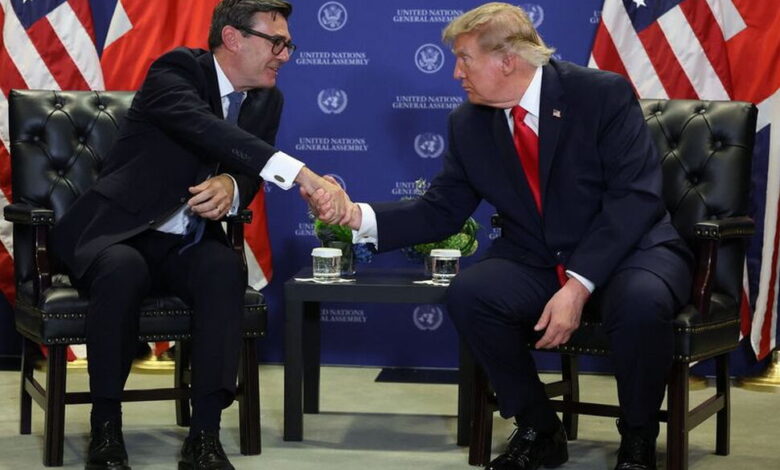
US President Donald Trump and UK Prime Minister Andy Burnham have held their first face-to-face meeting in New York, with Britain’s defence spending among the issues hanging over talks at the United Nations General Assembly.
The meeting matters because Washington has been pressing European NATO members to spend more on defence, while Burnham’s government is still working out how quickly Britain can increase military funding without putting further pressure on public finances. For Nigerians living in the UK, the debate is relevant because higher defence spending could affect future government choices on taxation and spending on other services.
The Telegraph reported before the meeting that Trump was expected to raise Britain’s progress towards NATO’s new defence-spending commitment. The two leaders later met on Tuesday, with Burnham saying they had established a “good connection” in their early discussions.
Trump pressure turns attention to UK defence budget
At the centre of the debate is NATO’s agreement that members should eventually devote the equivalent of 5 per cent of gross domestic product to defence and wider security-related spending by 2035.


That figure can be misleading if presented simply as 5 per cent for the armed forces.
Under the NATO agreement, at least 3.5 per cent of GDP is intended for core defence requirements, while up to another 1.5 per cent can cover areas such as critical infrastructure, cyber security, civil preparedness and the defence industrial base.
Britain’s existing plans are more gradual. The Telegraph reported that UK core defence expenditure is currently expected to reach about 2.7 per cent of GDP by 2030, while the government has committed to the NATO target of 3.5 per cent for core defence by 2035.
The government has not committed to reaching 3 per cent by 2030.
That gap has become an issue in relations with Washington because the Trump administration has repeatedly argued that European countries should carry a greater share of the cost of defending the continent.
NATO Secretary-General Mark Rutte also said during a visit to Britain last week that European allies and Canada must spend more and take greater responsibility for security. NATO nevertheless praised Britain’s role in defence technology and its support for Ukraine.
Burnham seeks common ground with Trump
The meeting comes only two months after Burnham became prime minister, making his first encounter with Trump an important test of the UK-US relationship.
Burnham had said before travelling to New York that the relationship between Britain and the United States remained “as strong as it has ever been”. He also said previous telephone conversations with Trump had helped the two leaders establish a connection.
Reuters reported after the two met that Burnham described their early relationship positively, despite policy differences between London and Washington.
Those differences extend beyond defence spending.
Burnham has been seeking stronger American backing for Ukraine, including additional air-defence support, while also calling for efforts to reduce instability in the Middle East. His government has taken positions on Israeli settlements and other foreign-policy issues that do not always align with the Trump administration.
Artificial intelligence was also high on Burnham’s agenda in New York.
Downing Street announced a new UK-US partnership focused on AI and autonomous defence technology, saying the two countries would cooperate on protecting critical infrastructure and developing new military capabilities.
The government also announced that Britain and the US had successfully carried out the first launch of a US-developed heavyweight torpedo from a British unmanned underwater vehicle.
Related news
Saudi Arabia support adds to defence debate
Burnham arrived in New York after approving limited British military assistance to Saudi Arabia following Houthi attacks on Saudi energy infrastructure.
The support is expected to involve defensive air-to-air refuelling for Saudi aircraft rather than British involvement in offensive strikes.
Burnham linked the decision to Britain’s economic interests, arguing that attacks on energy infrastructure and major shipping routes could increase oil and fuel prices and add to the cost-of-living pressure faced by UK households.
That decision adds another dimension to the debate over military resources at a time when the government is facing pressure to increase spending on both NATO commitments and emerging international crises.
What the NATO target actually means
The dispute is therefore not simply about whether Britain supports NATO.
Britain has accepted the alliance’s 2035 spending commitment. The disagreement is more about how quickly the country should get there, how the increases should be funded and what should count towards the overall target.
NATO members are required to produce credible plans showing how spending will rise towards the agreed level. The commitment is scheduled to be reviewed in 2029 as the alliance assesses the security environment and its military requirements.
For Burnham, increasing defence expenditure also creates a domestic political challenge because additional military spending has to compete with pressures on health, welfare, infrastructure and other government budgets unless ministers raise additional revenue or borrowing.
What readers should know: Trump’s meeting with Burnham comes as Washington continues to push European allies to spend more on defence. Britain has agreed to NATO’s long-term target, but it has not committed to reaching 3 per cent in core defence spending by 2030. The question now is how quickly Burnham’s government will increase military funding and how those increases will be financed. Public comments after the meeting suggested a cordial start to the Trump-Burnham relationship, although significant policy differences remain