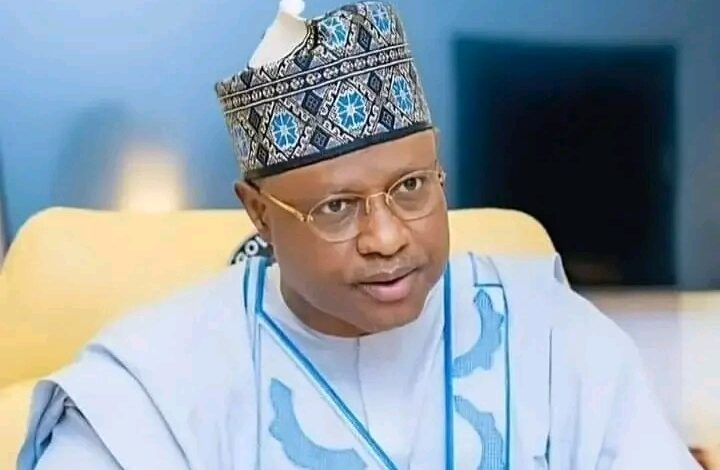
Nigerians gained room to form and join more political parties after a court battle led by the late Chief Gani Fawehinmi and Alhaji Balarabe Musa, Kaduna State Governor Uba Sani said in Kaduna on Saturday.
Sani said the pair challenged restrictions imposed by the Independent National Electoral Commission (INEC) on political associations seeking registration as political parties. The legal fight lasted more than two years and ended with a Supreme Court ruling in their favour in January 2003.
The governor spoke at the public presentation of Gani Fawehinmi And Uba Sani, A Tale Of Mentor And Mentee, written by Mrs Basirat Fawehinmi-Biobaku.
His account focused on how the court case changed the space available to Nigerians who wanted to organise politically outside existing parties.


How the court case changed party politics
Sani recalled that many human rights and pro-democracy activists had become discouraged over the restrictions on political associations.
Fawehinmi, he said, refused to allow that frustration to end their commitment to democratic rule.
“At a serious meeting, we told Chief Fawehinmi, our leader, that we were beginning to lose faith in democracy. But he would not permit frustration to become despair.
READ RELATED NEWS:
’I inherited loans, but borrowed no kobo’ — Uba Sani
FG, Uba Sani hailed for N178bn road and security success
There’s no opposition in Kaduna Gov Uba Sani
“He told us to have faith in the judiciary, faith in the rule of law and faith in democracy itself. Rather than abandon the democratic process, we would use the democratic process to defend democracy,” he said.
Sani said Fawehinmi and Musa took the issue before the courts after the restrictions created difficulties for political associations seeking registration.
“The legal battle lasted more than two years before the Court of Appeal delivered judgment,” he said.
He recalled that Justice Dahiru Mustapha delivered the Court of Appeal judgment in 2002. INEC appealed to the Supreme Court, which ruled in favour of Fawehinmi and Musa in January 2003.
Sani said the verdict “opened the political space in Nigeria and paved the way for the emergence of more political parties.”
He said Nigerians who belong to different political platforms today should remember the struggle that helped create the opportunity to organise politically.
“Many of those proudly identifying with all sorts of political platforms today may not know that the freedom they exercise was secured through difficult struggles by people like Chief Gani Fawehinmi. Democracy has a history, and every freedom has a cost,” he said.
The governor also called for activists, politicians from different parties and academics to meet from time to time to remember Nigerians who fought for democracy.
He presented Fawehinmi as a pan-Nigerian who believed that Nigeria’s progress depended on the development of every part of the country. Sani said the late activist also believed in empowering citizens without regard to region, ethnicity, religion or social standing.
From political freedom to student scholarships
Sani recalled another part of his relationship with Fawehinmi through the Gani Fawehinmi Scholarship Foundation.
He said education was one of the late activist’s major convictions and recalled serving as the foundation’s Northern Coordinator.
Sani said he persuaded Fawehinmi to establish a scholarship programme for brilliant but indigent university students in Northern Nigeria because educational deprivation was particularly severe in the region at the time.
The programme awarded scholarships to more than 1,000 indigent students across Northern Nigeria. Sani recalled travelling to universities in the region to identify deserving students.
“Many of those beneficiaries have since become medical doctors, lawyers, academics, engineers and professionals who are contributing meaningfully to national development,” he said.
He recalled that the scholarship scheme was flagged off in northern Nigeria 26 years ago at Arewa House. At the event, Fawehinmi challenged Northern leaders to confront the region’s educational crisis.
Sani said Fawehinmi warned that educational backwardness could become a monster if it was not addressed.
“Many of the challenges confronting Northern Nigeria today are connected, directly or indirectly, to inadequate investment in human capital,” he said.
The governor described Fawehinmi as one of the most formidable Nigerians of his generation, citing his commitment to principle, justice, ordinary citizens and democratic rights.
For More News Details, Visit New Daily Prime.