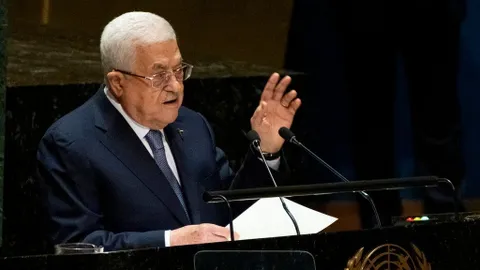
The United Nations General Assembly has approved a resolution allowing Palestinian President Mahmoud Abbas to address its 81st session by video after the United States denied him a visa to attend the meetings in New York.
The resolution was adopted with 152 countries voting in favour, while the United States, Israel and Paraguay voted against it. Colombia, Honduras, Panama and Peru abstained.
Under the resolution, Abbas will be able to deliver a pre-recorded address during the high-level General Debate, which begins next week. Palestinian officials who are unable to travel to the United States can also participate remotely in relevant UN meetings and conferences during the following year.
The decision came after Washington extended visa restrictions affecting Palestinian Authority officials and members of the Palestine Liberation Organization.


The United States has defended the restrictions, saying they were connected to actions by Palestinian officials that Washington considers an attempt to “internationalize” the Israeli-Palestinian conflict, including legal proceedings against Israel at international tribunals.
READ RELATED NEWS
UN Assembly: US denies Abbas visa, tightens curbs on Palestinian officials
US set to deliver 40,000 bombs to Israel
Speaking before the General Assembly vote, US Deputy Ambassador to the UN Tammy Bruce defended the American position.
“If the PA wants to be treated as a partner, it must stop subsidizing terror and stop using diplomatic theater as a substitute for serious governance,” Deputy US Ambassador to the United Nations Tammy Bruce told the assembly before the vote.
Palestinian officials have rejected Washington’s justification for the visa restrictions and criticised the decision to prevent Abbas and other senior officials from attending the UN meetings in person.
The Palestinian Foreign Ministry welcomed the General Assembly vote, saying the decision demonstrated broad international support for Palestinian participation in the 81st session. It said Abbas would deliver his address by video at the scheduled time.
The dispute has also raised questions about the 1947 agreement governing the UN headquarters in New York. The agreement generally requires the United States to facilitate access to the UN for foreign representatives, although Washington has maintained that visa restrictions can be imposed for security and foreign-policy reasons.
The latest resolution does not give Palestine a new status at the United Nations. Instead, it provides a mechanism for Abbas and other senior Palestinian officials to participate remotely when they cannot travel to the United States.
Abbas’s video address will therefore allow the Palestinian leadership to take part in the upcoming high-level debate despite the US visa restrictions.
The 81st General Assembly session opened on September 8, while the high-level General Debate is scheduled to begin on September 22.