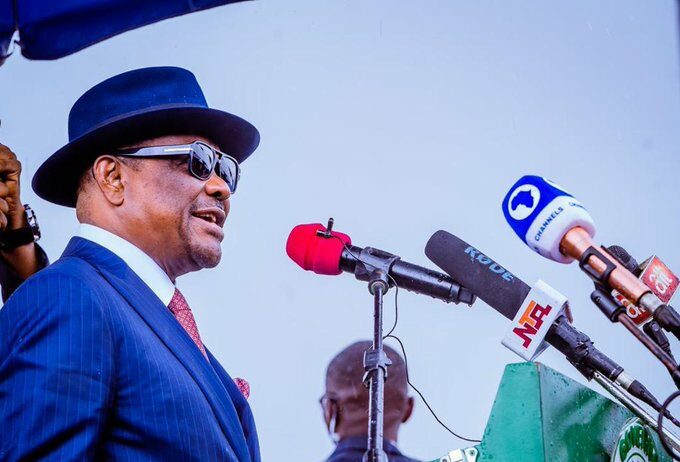
The political battle over President Bola Tinubu’s 2027 re-election campaign has intensified as Minister of the Federal Capital Territory, Nyesom Wike, defends his Rainbow Coalition against the position of All Progressives Congress (APC) governors who say they will back only candidates fielded by the ruling party.
The dispute centres on whether support for Tinubu can operate independently of the APC’s candidates in governorship and legislative elections.
The Progressive Governors Forum, led by Imo State Governor Hope Uzodimma, declared this week that APC governors would not participate in or endorse political arrangements capable of weakening the party or undermining its candidates.
The governors said their campaign commitment would cover Tinubu and other APC candidates contesting the 2027 elections.

Wike, however, has drawn a distinction between his support for Tinubu and the APC’s wider electoral programme.
In a recent interview with Arise News, the FCT minister said his political project was focused on securing support for Tinubu’s presidential bid, while the Peoples Democratic Party (PDP) remained free to field candidates for governorship, National Assembly and State House of Assembly contests.
“My support is for Tinubu, not APC,” Wike said
He maintained that the Rainbow Coalition was not an APC structure.
He also rejected suggestions that he had approached the APC Governors Forum seeking an alliance. Wike said the governors’ position had no bearing on his discussions with the President and insisted that Tinubu was aware of his political activities.
The disagreement has exposed a fundamental difference in how the two sides view political mobilisation ahead of the election.
The APC governors are concerned about competing political structures that could create divided loyalties within the ruling party. Uzodimma said the forum would not support an arrangement that could weaken the APC or adversely affect its candidates at any level.
Wike, on the other hand, maintains that presidential support can cut across party lines. He pointed to politicians in opposition parties who have expressed support for Tinubu while their parties continue to sponsor candidates for other elective positions.
He also cited Bayelsa as an example of where he believes opposition structures could contribute to Tinubu’s campaign without abandoning their own party identities.
The disagreement has placed the minister at odds with governors who control significant party structures in their respective states. The APC Governors Forum represents governors elected on the party’s platform, giving its position institutional weight within the ruling party’s electoral organisation.
Wike has challenged the assumption that being a governor automatically translates into decisive influence over presidential votes. He said electoral influence should be measured by the ability to deliver votes for the President rather than simply by occupying a state executive position.
The controversy has also drawn attention to Wike’s continued membership of the PDP while serving in an APC-led Federal Government and openly supporting Tinubu’s re-election.
Wike has defended the position as a political choice rather than a commitment to the APC, saying his support for the President does not require him to abandon the PDP.
The dispute is now becoming an important feature of the emerging 2027 political landscape. While the APC governors are seeking an integrated campaign structure centred on the party, Wike is advocating a cross-party mobilisation model built around Tinubu’s presidential candidacy.
Neither position has resolved the underlying question of how support for a presidential candidate can coexist with competing party interests in down-ballot contests.
As preparations for 2027 gather pace, the disagreement could shape how campaign structures are organised across the states and how political actors reconcile presidential alliances with their parties’ separate candidates.
For now, Wike and the APC governors are presenting two distinct approaches to the same electoral objective: one centred on a cross-party coalition for Tinubu, and the other on the established APC structure and its candidates at every level.
READ RELATED NEWS UPDATES