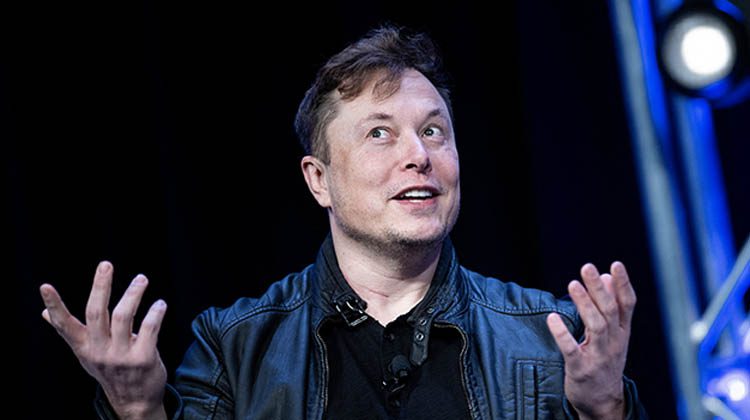
American billionaire Elon Musk has unveiled a new Tesla electric sports car capable of briefly taking to the air, performing mid-air flips and accelerating from zero to 60 miles per hour in less than one second.
The vehicle, known as the Tesla Roadster, was presented on Thursday, 15 October 2026, at a SpaceX rocket testing facility in McGregor, Texas, after nearly nine years of delays.
Developed by Tesla in collaboration with Musk’s rocket company SpaceX, the redesigned sports car uses high-pressure air thrusters to lift itself from the ground and perform aerial movements.
During the demonstration, the vehicle travelled along a curved ramp, briefly drove upside down and then turned through the air before landing on its wheels.


A separate demonstration showed the car jumping over five stationary Tesla vehicles, including the Cybertruck and Model Y.
Musk described the unveiling as a major step towards making flying cars a reality, although the vehicle remains a prototype and is not yet available for ordinary road use.
How Tesla’s flying car works
Unlike conventional aircraft, which rely on wings or rotating propellers to generate lift, the new Tesla Roadster uses a combination of compressed-air thrusters and a powerful suction system.
The technology was developed with engineering support from SpaceX, which specialises in spacecraft and rocket propulsion.
The thrusters release high-pressure air to generate force, allowing the car to move briefly above the ground, adjust its position and perform controlled aerial movements.
Meanwhile, fans beneath the vehicle create suction, helping it remain attached to the road or other driving surfaces.
Tesla demonstrated this capability by driving the Roadster along an inverted ramp without the vehicle immediately falling away.
The company says the technology also improves acceleration and cornering performance.
However, the demonstration does not establish that the Roadster can undertake sustained flights like an aircraft.
Its airborne movements were brief, and questions remain about how far or how high a production version could travel.
The technology also presents safety and regulatory challenges that would need to be addressed before any flying version could become widely available.
Tesla Roadster promises extraordinary speed
Beyond its ability to leave the ground, Tesla says the Roadster can accelerate from zero to 60mph in approximately 0.81 seconds.
The company also claims the sports car can reach speeds exceeding 230mph, equivalent to around 370 kilometres per hour.
If those figures are achieved in a production vehicle and independently verified, the Roadster would rank among the fastest-accelerating cars ever manufactured.
Its performance comes from combining electric motors with additional thrust supplied by its compressed-air system.
Musk has suggested that the final production model could deliver even greater acceleration.
However, the performance figures demonstrated or announced during the launch should not be treated as independently certified production specifications.
The company has yet to release a final road-ready model for independent testing.
When will Tesla’s flying car be available?
Despite the unveiling, customers hoping to own the new Roadster may have to wait until 2028.
Musk announced that production is expected to begin that year, extending a development schedule that has already experienced several delays.
The second-generation Roadster was first introduced in 2017, when Tesla indicated that deliveries could begin in 2020.
That deadline passed without the vehicle entering production, and subsequent launch expectations were also pushed back.
The latest announcement therefore represents an important milestone, but not a guarantee that customers will receive their vehicles in 2028.
Tesla has also introduced different proposed versions of the Roadster, including models offering enhanced performance and additional thrust capabilities.
Reports indicate that reservation arrangements include substantial deposits, while some advanced specifications remain available only to selected customers.
The company has not established a final retail price for every version of the car.
Can Tesla’s flying car legally operate on public roads?
The unveiling has raised an important question: whether a vehicle capable of leaving the ground can operate legally alongside conventional road traffic.
Road vehicles must meet safety standards governing matters such as braking, passenger protection, crashworthiness and other operational requirements.
Aircraft are subject to additional aviation regulations designed to protect passengers, other aircraft and people on the ground.
A car capable of controlled flight could therefore face both road safety and aviation approval requirements, depending on its design and how it is operated.
In the United States, the Federal Aviation Administration oversees civil aviation, although the precise rules applicable to the Roadster would depend on its final capabilities and classification.
Musk acknowledged that the vehicle was not necessarily designed with maximum safety as its overriding priority.
That admission highlights the difference between producing a prototype capable of performing spectacular manoeuvres and developing a commercially approved vehicle suitable for everyday travel.
The company has not confirmed that the flying version will receive approval for use on public roads or in regulated airspace.
What the flying Tesla means for the future of transport
The Roadster demonstration reflects a wider push by technology and automotive companies to develop new forms of transport.
Electric aircraft, flying taxis and other vehicles capable of vertical take-off have attracted investment as manufacturers explore ways to reduce road congestion and improve travel options.
However, the Tesla Roadster differs from many proposed flying taxis because it remains primarily a high-performance sports car.
Its current airborne capabilities are limited to short manoeuvres rather than sustained journeys between destinations.
For potential customers in Britain, Nigeria and other markets, several questions remain unanswered, including the vehicle’s final price, availability, maintenance requirements and regulatory approval.
Any future introduction into Nigeria would also need to comply with the country’s applicable vehicle importation and road safety rules, alongside aviation requirements if the vehicle were authorised to fly.
Tesla’s demonstration nevertheless shows how technologies associated with space exploration are being adapted for potential use in the automotive industry.
Whether those capabilities become practical features of commercially available cars remains uncertain.
For now, Musk’s latest Roadster has demonstrated that a sports car can briefly leave the ground using compressed-air technology, but it has not established that ordinary motorists will soon be able to fly their cars to work.
Read related news
How rich is Elon Musk? Fortune bigger than many countries
Elon Musk becomes world’s first trillionaire after SpaceX public listing
Trump says United State will run Venezuela after capture of President
Maduro to stand trial in United State as Trump hails ‘Brilliant Operation’