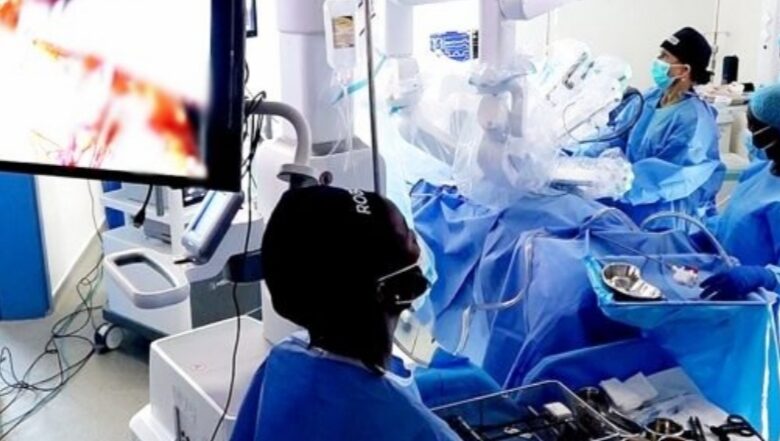
The Federal Government(FG) has designated Redeemer’s Health Village Robotic Surgery Academy as a TETFund Centre of Excellence, promising full tuition scholarships for qualified trainees as Nigeria seeks to build advanced surgical expertise at home and reduce dependence on overseas medical care.
The Federal Government has designated Redeemer’s Health Village (RHV) Robotic Surgery Academy as Nigeria’s 29th Tertiary Education Trust Fund (TETFund) Centre of Excellence, opening a new route for qualified medical professionals to receive specialist training in robotic surgery through government-funded scholarships.
Minister of Education, Dr Tunji Alausa, announced the arrangement during the academy’s inauguration on Thursday. He said TETFund would cover tuition fees for qualified medical professionals enrolled through its local scholarship scheme.
The initiative brings together RHV, RoboMed Global, the National Postgraduate Medical College of Nigeria (NPMCN) and Redeemer’s University. The partnership is designed to train surgeons and other professionals needed to operate and maintain advanced surgical systems.


The academy is launching with robotic surgical equipment valued at $4 million. Its chief executive, Adedamola Dada, said the institution aims to train 400 certified specialists within two years in urology, general surgery and gynaecology.
The programme will also cover operating theatre personnel, biomedical engineers and hospital administrators. This approach recognises that robotic surgery depends on more than a surgeon’s technical skill. Safe procedures require coordinated teams, reliable equipment maintenance, specialised nursing support and strict patient-care protocols.
RELATED NEWS:
RoboMed Global co-founder Dr Obi Ekwenna said the academy’s training model draws on aviation safety principles, including simulation, communication and team coordination. Candidates will undergo simulation exercises, supervised clinical practice and structured patient-care training.
Alausa also disclosed that the Federal Government had invested more than ₦250 billion in medical education over the preceding two years. He said the government planned to increase annual medical programme admissions to 20,000 within two years, citing the need to expand training capacity alongside Nigeria’s growing population.
The project could help develop specialist skills locally, potentially reducing the need for some patients to travel abroad for complex procedures.
However, establishing a training centre does not automatically make robotic surgery affordable or accessible to ordinary Nigerians. Treatment costs, insurance coverage, equipment maintenance and the availability of trained specialists will influence how many patients benefit.
The NPMCN will oversee academic standards and award postgraduate fellowship diplomas upon completion, while Redeemer’s University will lead specialised training for nursing teams and biomedical maintenance engineers.
New Daily Prime’s observation is that the academy’s success should be measured not only by the number of specialists trained but also by patient outcomes, the cost of procedures and the availability of services beyond the facility itself.
The government-backed scholarship scheme addresses tuition costs, but details on eligibility, the number of scholarships available and other expenses have yet to be specified in the announcement.
The central test will be whether this investment translates into a sustainable Nigerian workforce capable of delivering safe, high-quality robotic surgery without making advanced care accessible only to wealthy patients.
For More News Updates, Visit New Daily Prime News