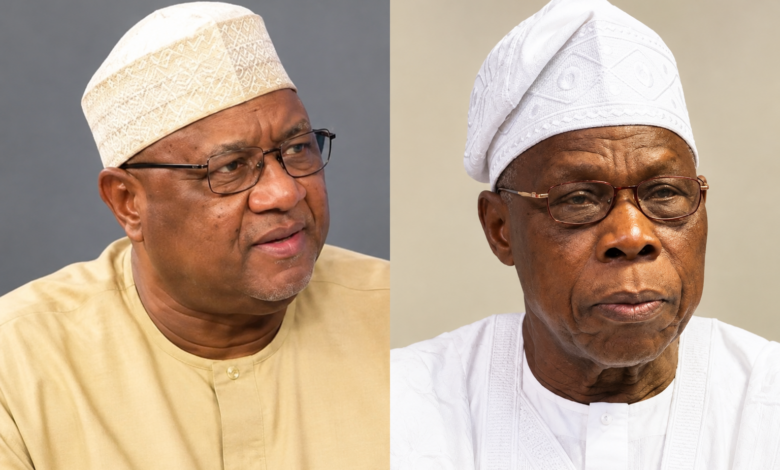
Former President Olusegun Obasanjo has warned that Nigeria risks passing an economic burden to generations yet unborn through excessive borrowing, while historian Umar Ardo has cautioned that dependence on foreign-owned artificial intelligence could expose Africa to another cycle of economic exploitation.
The two speakers raised concerns about Nigeria’s economic and technological independence at the third Ajibosin Annual Symposium, held on Friday at the Olusegun Obasanjo Presidential Library in Abeokuta. The event focused on using artificial intelligence to address grassroots challenges and accelerate national development.
Obasanjo directly challenged President Bola Tinubu’s recent defence of borrowing, in which the President reportedly said debt was not leprosy and that his administration only needed to work hard to repay its loans.
The former President rejected that comparison, drawing a distinction between the harm caused by a disease to an individual and the financial obligations that can burden an entire population across generations.
“What do our leaders know, and what do they not know? From what they know, what can they do for us? For anybody to say debt is no leprosy is absolute nonsense. Debt is worse than leprosy, because leprosy destroys only one person. Debt destroys generations,” he declared.
His intervention carries historical weight. Obasanjo secured about $30bn in Paris Club debt relief during his administration between 1999 and 2007, an episode that substantially reduced Nigeria’s external debt obligations.
However, the central issue in the present borrowing debate is not simply whether a government should take loans, but what those loans finance, how much they cost to service and whether the resulting investments generate enough economic value to justify the obligations.
RELATED NEWS:
Borrowing can fund infrastructure and productive projects that stimulate growth. Poorly managed debt, however, can consume public revenue through interest and repayment commitments, leaving less money for essential services and future development.
Obasanjo also questioned the influence of the World Bank and International Monetary Fund on Nigeria’s economic decisions. He recalled how former British Prime Minister Jimmy Callaghan received government support for sheep farming, contrasting that arrangement with international financial institutions’ resistance to agricultural subsidies in developing countries.
He also lamented the naira’s depreciation, citing a comparison between its value against the dollar when he started his farm 47 years ago and the exchange rate of about ₦1,500 to the dollar referenced in his remarks.
Beyond public finance, the former President warned that technology could become a tool of exploitation when countries adopt it without sufficient control.
“I don’t know too much technically about AI. But I know that anything that is not in your control can be abused against you,” he said.
Ardo developed that concern in his lecture, warning that Africa could become a supplier of valuable data while foreign companies retain control of computing infrastructure, artificial intelligence models, intellectual property and profits.
He traced the continent’s economic history from the transatlantic slave trade through colonial extraction to the post-independence export of raw materials. His concern is that artificial intelligence could reproduce the same unequal arrangement in a new form.
“Data may become the fourth commodity in this long history of extraction,” he warned.
The distinction is important. Access to artificial intelligence does not automatically translate into technological independence. Without local infrastructure, skilled personnel, ownership of intellectual property and effective data protection, African countries could generate the information that powers these systems while capturing little of their commercial value.
The symposium therefore raised two connected questions for Nigeria: whether its borrowing will produce lasting prosperity and whether its technological adoption will build local capacity or deepen dependence on foreign interests.
For More News Updates, Visit New Daily Prime News