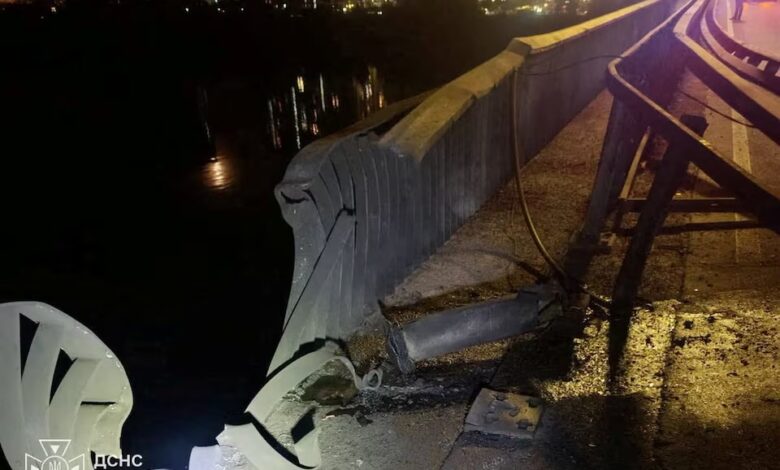
Russian aerial attacks have disrupted traffic across several bridges in Kyiv, with a fresh strike hitting the Northern Bridge over the Dnipro River on Saturday as Moscow intensifies its aerial campaign against Ukraine.
Kyiv Mayor Vitali Klitschko said the Northern Bridge was struck during a Russian air attack on October 3, damaging the road surface and overhead trolleybus cables. Emergency services were deployed to the scene, while traffic travelling from the eastern to the western bank was suspended. No casualties were reported in the latest incident, according to the mayor.
The attack followed several strikes on Kyiv’s Southern Bridge over the previous two days. The attacks also disrupted traffic on two other bridges, forcing authorities to introduce restrictions and causing major congestion across the capital.
The Dnipro River divides Kyiv into eastern and western parts, making its bridges important routes for residents travelling between residential areas and the city’s main government and business districts.


Russian attacks on the bridges have therefore created significant disruption for commuters, with local reports describing severe traffic congestion. The Associated Press reported that one Kyiv resident took 45 minutes to travel about four kilometres during the disruption.
READ RELATED NEWS
Russia-Ukraine War: Russian strikes kill five as Zelenskyy prepares to meet Trump
Trump rejects Iran’s seven-day plan as Tehran insists on diplomacy
The latest attacks came as Russia launched more than 100 drones against Ukraine overnight, according to Ukrainian President Volodymyr Zelenskyy. Kyiv and eight other regions were reportedly targeted.
Zelenskyy said a drone struck a high-rise apartment building in Kyiv, killing one person, while at least four others were wounded elsewhere.
He also called on international partners to strengthen sanctions against Russia, arguing that Russian drones and missiles continue to rely on foreign-made components.
“Every Russian drone can actually be stopped right at the production line,” Zelenskyy said in a social media post, arguing that tighter restrictions on the supply of components could limit Russia’s ability to produce weapons.
The attacks have also come amid renewed diplomatic efforts to secure limited ceasefire arrangements.
Ukraine’s Foreign Minister Andrii Sybiha said Kyiv had received separate proposals from the United States, India, Turkey and Egypt for a partial truce covering energy infrastructure and shipping in the Black Sea.
The proposals would seek to halt attacks on power infrastructure and Black Sea commercial shipping, which are important to Ukraine’s energy security and agricultural exports.
Sybiha said Ukraine was prepared to support such an arrangement if Russian attacks on Ukraine’s power grid and Ukrainian attacks on Russian oil refineries were halted, along with attacks on vessels transporting agricultural products through the Black Sea.
“We are ready for an energy and Black Sea ceasefire, but only in that combination,” Sybiha said.
However, Russia has continued to reject calls for a temporary ceasefire, arguing that a broader peace agreement is needed instead.
The conflict has also seen continued attacks by Ukraine against Russian energy and industrial infrastructure. Russian authorities said Ukrainian drones targeted several locations, while Ukrainian officials reported strikes against Russian oil facilities.
Claims from both sides about the damage caused by the attacks could not be independently verified.
The latest escalation has raised further concerns about the impact of the war on civilians as winter approaches. The UN High Commissioner for Human Rights, Volker Türk, said civilians were continuing to bear the consequences of the conflict.
“The war in Ukraine is a human rights catastrophe that is growing and intensifying by the week,” Türk said, according to the Associated Press.
For Kyiv residents, the repeated attacks on bridges add another layer of disruption to daily life, while the damage to transport infrastructure comes alongside continuing pressure on Ukraine’s energy system.
The renewed attacks demonstrate that, despite diplomatic efforts and proposals for limited ceasefires, the conflict continues to affect major Ukrainian cities and critical infrastructure.
As authorities assess the damage to Kyiv’s bridges, Ukraine is continuing to call for stronger international support for its air defense and tougher measures against Russia, while diplomatic efforts remain focused on finding limited areas where fighting could be reduced.