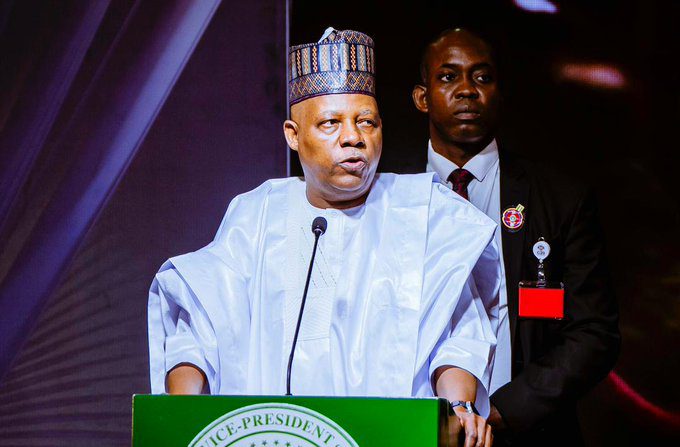
Vice-President Kashim Shettima has promised Nigerians relief from high food prices in the coming weeks, as persistent food inflation and a gap between the government’s reserve claim and central bank data raise questions about how quickly economic reforms will ease household hardship.
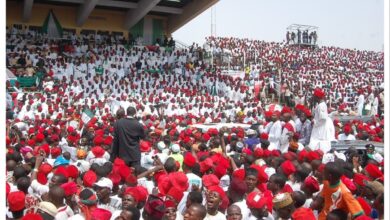
Shettima gave the assurance on Monday at the Presidential Villa in Abuja during a political gathering organised by the City Boy Movement and the Relax-Tinubu-Is-Fixing-Nigeria Movement, both of which are mobilising support for President Bola Tinubu’s re-election.
He defended the administration’s economic policies, saying the country could have suffered a deeper crisis without the decisions taken to reposition the economy.

“If the President had not taken those far-reaching decisions, wallahi, I am not talking to you as a politician. I am talking to you as a Nigerian, our economy would have collapsed,” he said.
The Vice-President acknowledged that Nigerians had endured difficult economic conditions but maintained that the reforms were beginning to yield results.
RELATED NEWS:
Shettima tells BRICS: ’Reform global system to match today’s realities’
Shettima reveals alleged plot to turn Tinubu against him months after inauguration
Shettima warns APC leaders against destructive politics ahead of 2027 elections
Food prices remain the immediate test
Shettima said the President would introduce measures to address agricultural challenges and bring down food prices.
“Be reassured that in the coming weeks, the President will come up with robust responses to agricultural challenges, and prices of foodstuff will certainly come down,” he said.
The promise comes against a difficult backdrop for households. Figures from the National Bureau of Statistics cited in the report show that headline inflation fell to 14.63 per cent in September 2026 from 15.39 per cent in August. Food inflation, however, stood at 19.59 per cent.
The distinction matters because lower headline inflation does not automatically mean that food has become cheaper. Inflation measures the rate at which prices rise. A decline in the rate can mean prices are increasing more slowly, rather than falling.
Shettima did not disclose the specific measures, funding arrangements or implementation timetable behind the promised agricultural intervention. Their practical effect will depend on whether they improve food supply, reduce transport and distribution costs, and make essential commodities more affordable.
Economic claims require closer scrutiny
The Vice-President also cited economic growth and foreign reserves as evidence of progress, claiming that the economy grew by 4.43 per cent in the latest quarter and that reserves were approaching $60 billion.
However, Central Bank of Nigeria data cited in the report placed external reserves at $55.07 billion on October 9. The figures refer to different claims and should not be treated as identical without further clarification.
Shettima also pointed to infrastructure investment and the Nigerian Education Loan Fund as part of the administration’s economic programme. He called on young Nigerians to communicate the government’s position in their communities.
The event was explicitly political, with organisers campaigning for Tinubu’s return in 2027. Shettima’s remarks therefore combined a defence of government policy with mobilisation for the President’s re-election.
Ultimately, the administration’s economic case will be tested not only by growth figures and foreign reserves, but also by whether families can afford food and other necessities. The promised price relief offers a clear benchmark against which Nigerians can assess the government’s next steps.
For More Details, Visit New Daily Prime News