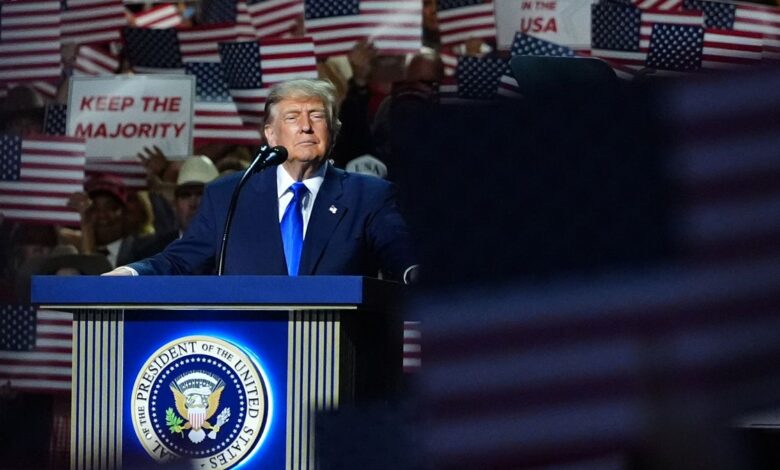
Senior Republicans have privately expressed fears that President Donald Trump‘s party could lose control of the US House of Representatives in the November 3 midterm elections, according to reports published on Wednesday, October 14. With fewer than three weeks until Americans vote, the concerns have raised questions about whether Republicans can retain their narrow majority and protect Trump’s legislative agenda.
Five senior Republican lawmakers told Politico anonymously that the party’s prospects had weakened, with some now concentrating on limiting potential losses rather than expanding their majority.
One Republican lawmaker reportedly predicted that Democrats could gain about 10 seats, enough to take control of the House.
However, Republican leaders continue to insist that they can retain control, and the election outcome remains uncertain.

Republicans privately raise concerns over Trump’s election impact
According to Politico, some senior Republicans believe the party faces an increasingly difficult electoral contest, partly because of dissatisfaction with Trump’s presidency.
One Republican lawmaker said the party was now trying to “save as many Republican seats as we can”.
The lawmaker also criticised the president’s prominence in the campaign, saying:
“President Trump has made this election all about himself.”
The comments highlight differences between the private assessments attributed to unnamed lawmakers and the public statements of Republican leaders.
Separate reporting by WIRED suggested that some White House aides have become increasingly concerned about the House elections and are directing greater attention towards protecting the Republican majority in the Senate.
Republican campaign organisations have also reportedly reduced advertising spending in several competitive House districts.
These include races in Iowa, New Jersey and Nebraska, where Republican strategists have reassessed their prospects.
However, withdrawing advertising from a particular district does not mean the election has been conceded. Campaign organisations regularly redirect funding towards constituencies where they believe additional spending could make a difference.
How many seats do Democrats need to take control?
The House of Representatives has 435 voting seats, and a party normally needs at least 218 to secure a majority when all seats are filled.
Democrats need a net gain of just three seats to regain control under the current electoral calculations.
This means that even relatively small changes in voting patterns across closely contested districts could determine which party controls the chamber.
A September survey commissioned by the non-partisan Cook Political Report found Democrats leading Republicans by 49% to 47% among likely voters in 37 competitive House districts.
The survey covered 1,052 likely voters between September 8 and 11, with a reported margin of error of approximately three percentage points.
The findings indicate a closely divided electorate in these districts, rather than a certain election result.
On October 9, Cook Political Report shifted its assessments of 18 House races towards Democrats, citing changes in polling and the political environment.
These assessments concern individual races and are not actual election results.
Mike Johnson insists Republicans can retain control
Despite the concerns reported among party insiders, House Speaker Mike Johnson has continued campaigning for Republican candidates.
On Wednesday, October 14, Johnson travelled to Bangor, Maine, to support former governor Paul LePage, who is contesting the state’s second congressional district against Democrat Matt Dunlap.
According to the Associated Press, Johnson maintained confidence in the party’s ability to defend its majority and pointed to the importance of turnout in competitive constituencies.
His public position contrasts with reports that some senior Republicans have become more pessimistic about the election.
Johnson also acknowledged the possibility of losing control of the House during a Fox News interview reported by Reuters on October 8.
He discussed what his political future might look like if Republicans lost their majority but maintained that his immediate priority was winning the election.
Why voters are turning their attention to the economy
Economic concerns have become central to the midterm campaigns.
Rising household costs, fuel prices, Trump’s tariff policies and the war involving Iran have featured prominently in political debates.
A Reuters/Ipsos poll reported on October 8 found 44% support for Democratic congressional candidates compared with 37% for Republicans.
The poll also recorded widespread dissatisfaction with Trump’s performance in office.
However, national voting preferences do not translate directly into House seats. Candidates compete in separate congressional districts, where local issues, constituency boundaries and voter turnout can influence the outcome.
Republicans are seeking to defend their record on economic management and national security, while Democrats have criticised the administration’s handling of living costs and its policy priorities.
What losing the House would mean for Trump
The outcome could significantly affect the remaining two years of Trump’s presidency.
If Democrats gain control of the House, they would be able to elect the Speaker and chair its committees, giving them greater influence over legislation and congressional investigations.
They could launch inquiries into the administration’s decisions, demand documents and scrutinise government spending.
Democrats could also block or demand changes to legislation supported by the president.
However, winning the House would not automatically give Democrats control of the entire federal government.
The Senate would remain a separate legislative chamber, while Trump would continue serving as president.
Most major legislation requires approval from both chambers of Congress before reaching the president.
A Democratic-controlled House could therefore make it harder for the administration to secure support for some of its priorities, even if Republicans retain the Senate.
Why the election matters to Nigerians in the US
For Nigerians living in the United States, the midterm elections could influence congressional debates about immigration, employment, education and economic policy.
Congress plays a role in immigration legislation, government spending and oversight of federal agencies.
Changes in the House majority could affect the political direction of future proposals concerning visas, border enforcement and immigration administration.
However, a change in congressional control would not automatically cancel existing visas, alter immigration status or grant new residence rights to foreign nationals.
Any such changes would depend on the relevant legislation, regulations or executive action.
Nigerians who hold US citizenship may be eligible to vote, subject to applicable registration and state election requirements. Nigerians living in the country without US citizenship are not eligible to vote in federal elections.
What happens before November 3?
Both parties are expected to concentrate their final campaigning efforts on competitive districts.
Republicans will seek to protect vulnerable seats while identifying opportunities to gain constituencies currently represented by Democrats.
Democrats, meanwhile, will attempt to turn dissatisfaction with the administration into enough additional seats to control the House.
Early voting is already underway in parts of the country, but the composition of the next Congress will not be settled until votes have been counted and the relevant election results established.
Read related news;
Trump announces Russia-Ukraine energy ceasefire amid uncertainty over terms
Trump announces Russian diesel supply deal after phone call with Putin
Oil prices fall as Trump rules out US strikes on Iran before midterm elections