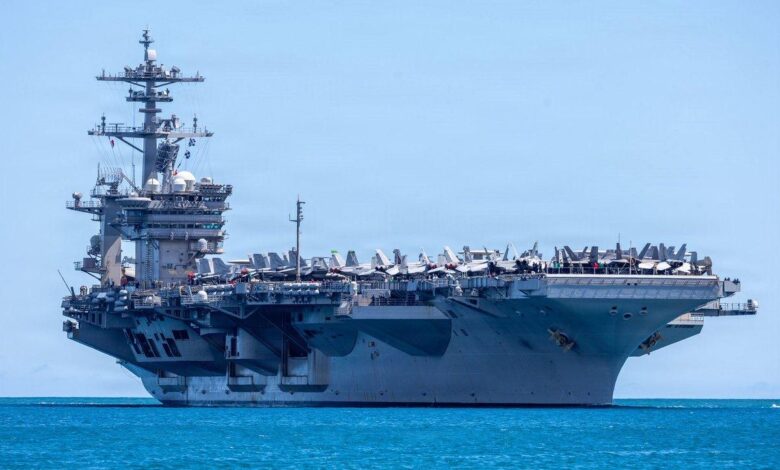
The United States is deploying about 9,000 additional sailors and Marines and a third aircraft carrier toward the Middle East as tensions with Iran intensify, in a major military buildup that could significantly increase Washington’s forces in the region.
The deployment includes the USS Theodore Roosevelt carrier strike group and the USS Makin Islandamphibious readiness group. Together, the ships are carrying more than 7,000 sailors and about 2,000 Marines, according to a US official cited by the Associated Press.
The move could bring three US aircraft carriers into the Middle East by late October, alongside thousands of additional military personnel and hundreds of aircraft. The USS George H.W. Bush and USS George Washington are already in the region, while the USS Boxer amphibious group is also deployed.
MAJOR US MILITARY BUILDUP RAISES FEARS OF WIDER REGIONAL ESCALATION


The latest deployment represents a significant expansion of US military power in a region already affected by the conflict with Iran.
The additional forces are being sent as Washington weighs its next steps following months of confrontation with Tehran. The buildup gives the United States additional naval, aviation and Marine capabilities in the Middle East at a time when the possibility of renewed fighting remains a major international concern.
US officials have not said that the deployment means an immediate attack on Iran is planned. However, President Donald Trump has indicated that further military action remains possible.
In an interview published Thursday, Trump said it was “possible” that the United States could increase bombing of Iran after the November 3 midterm elections. He declined to provide details about what any future operation might involve.
The deployment is therefore being closely watched by governments across the Middle East, particularly because any renewed US-Iran confrontation could affect neighbouring countries, commercial shipping and global energy supplies.
STRAIT OF HORMUZ REMAINS AT CENTRE OF TENSIONS
The strategically important Strait of Hormuz has become one of the central issues in the confrontation.
The waterway is a major route for international oil shipments, meaning any prolonged disruption could have consequences far beyond the Middle East.
Iran has proposed measures that include reopening the Strait of Hormuz as part of a broader ceasefire arrangement. Trump, however, rejected the latest Iranian proposal, saying it was not sufficient to meet US requirements.
Oil markets have already responded to the heightened tensions. Brent crude rose sharply on Thursday following reports of the additional US military deployment and other supply concerns. On Friday, however, prices eased slightly, with Brent trading around $101.61 a barrel and West Texas Intermediate at about $92.02.
READ RELATED STORY
Carrick takes Blame as United cup collapse deepens crisis
US pushes G20 to back Trump trade agenda amid China tensions
Three oil tankers hit by unknown projectiles in Strait of Hormuz
Iran-US Conflict: Iran calls for US and Israeli withdrawal from the Middle East
DIPLOMACY CONTINUES DESPITE MILITARY PREPARATIONS
Despite the military buildup, diplomatic efforts have not completely stopped.
The United States and Iran have remained involved in indirect diplomatic contacts, while regional countries continue to seek ways to prevent the conflict from widening.
The possibility of further US military action, however, has added pressure to those diplomatic efforts. Washington’s rejection of Iran’s latest ceasefire proposal and the movement of additional American forces have raised questions about whether negotiations can produce an agreement before tensions escalate further.
The United States has also strengthened defensive measures around key facilities belonging to regional allies. Reports indicate that additional Patriot missile batteries have recently been deployed to protect energy infrastructure in Saudi Arabia and Qatar.
The growing US military presence comes as the international community watches developments around Iran, the Strait of Hormuz and the wider Gulf region.
With thousands of additional American personnel and a third aircraft carrier now moving toward the Middle East, the coming weeks could prove important for both diplomatic efforts and regional security.
Washington says the deployment is part of its military preparations, while the possibility of renewed strikes against Iran remains under consideration.